


A Florida marina must keep 90% of its slips public. Residents say none are
Because the marina sits on public submerged land, most of its slips are supposed to remain available to the public. A residents' group says that isn't happening and has taken the complaint to the state.
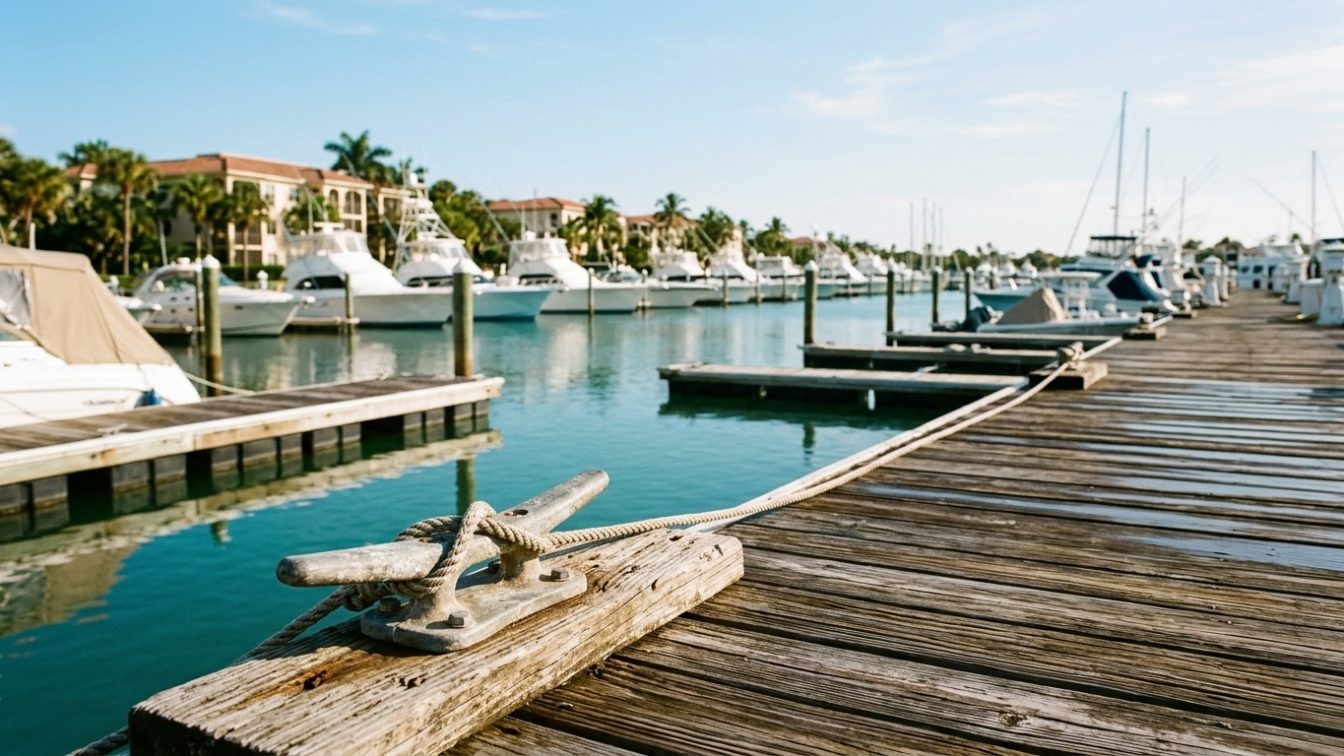
Table of contents
Summary of this article
- Tierra Verde Next, representing more than 1,000 island residents, filed a formal complaint with the Florida Department of Environmental Protection (DEP) alleging that marina operator Greenleaf Capital eliminated all public access to wet slips, according to WUSF/St. Pete Catalyst reporting from August 6, 2026.
- The marina sits on public submerged land. The land beneath the marina is owned by the State of Florida and leased to the operator under a sovereign submerged lands lease that requires at least 90% of wet slips to remain available to the public.
- Residents say public availability is now zero. The marina's 64 wet slips are allegedly occupied by two private boat clubs, a boat rental business, and pilot boats, with marina staff reportedly saying no public slips are available.
- The 90% requirement is a measurable, enforceable threshold. It turns "public access" into a concrete number the state can verify and enforce, rather than a vague promise.
- The group wants DEP to suspend Greenleaf's pending permits until compliance is determined. Greenleaf disputes the allegations and says it will cooperate with any DEP investigation.
The water beneath a marina is not always private. In Tierra Verde, an island community near St. Petersburg, the submerged land under Tierra Verde Marina belongs to the State of Florida, which means it belongs to the public. The state leased that land to a private operator on one clear condition: keep the water accessible to the people who own it.
Now a residents’ group says that access has quietly disappeared. Tierra Verde Next, an advocacy organization representing more than 1,000 island residents, has filed a formal complaint with the Florida Department of Environmental Protection (DEP). The complaint alleges that marina operator Greenleaf Capital eliminated all public access to the marina’s wet slips, despite a lease that requires at least 90% of them to stay available to the public. WUSF, in partnership with St. Pete Catalyst, reported the dispute on August 6, 2026.
If you live near the coast, use public waterways, or simply value your right to reach the water, this story matters more than a single local zoning fight. It’s a clear example of a building-biology principle applied to a shared resource: the most effective way to protect community health is to control problems at the source, and public access to water is exactly the kind of source-level resource that, once lost, is very hard to win back.
Public water is a shared environmental resource
Building biology looks at the health of the whole environment people live in, not just the air inside a home, but the resources a community depends on to stay well. Access to natural water is one of those resources. Time on and near the water supports physical activity, mental health, and a community’s connection to the ecosystem it lives beside.
Here’s the key idea: publicly owned water is a shared resource, much like clean air. No single person owns it, and everyone has a stake in keeping it available. That’s precisely why Florida holds submerged lands in trust for the public and only leases them to private operators under conditions designed to preserve public access.
“These are not Greenleaf’s waters,” said Geoff Comrie, who leads land-use and legal efforts for Tierra Verde Next. “They belong to the public. The state allowed Greenleaf to use them on the condition that the public retain access. That access appears to have been completely taken away.”
That framing is the whole story in one sentence. The lease is not a gift of public water to a private company. It’s a conditional permission. Break the condition, and the justification for the private use falls apart.
The exposure pathway: how private capture degrades community access
In building biology, an “exposure pathway” is the route by which harm reaches people. Usually that’s a contaminant moving through air, water, or dust. Here, the harm is the loss of a shared resource, and the pathway is quiet, gradual privatization.
Follow how it works. A marina holds a fixed number of wet slips, in this case, 64. Those slips are the physical points where the public can actually reach the water and launch a boat. When those slips are handed over entirely to private interests, the complaint names two private boat clubs, a boat rental business, and pilot boats, the public’s point of access closes. Not with a fence or a sign, but through allocation. The water is still there. The way in is gone.
This is a slow, low-visibility form of degradation, which is what makes it dangerous. A polluted waterway is obvious; the water changes color or smells. A privatized waterway looks exactly the same from the shore. The boats still bob in their slips. The only difference is who’s allowed to use them, and most residents never notice until they try to get a slip and are told none exist.
“If the allegations are true, what shocked us the most was the extent of their actions,” Comrie said. “Public access appears to have been eliminated entirely despite a clear 90% requirement.” The alleged jump from a 90% public requirement to zero public availability is the exposure pathway running all the way to its endpoint: a public resource fully captured.
The measurable threshold: why 90% matters
The most powerful part of this story, from a source-control standpoint, is that the protection was written as a number.
The lease doesn’t say the marina should “consider public needs” or “make reasonable efforts” to keep slips available. It sets a specific, measurable threshold: at least 90% of the wet slips must be available to the public. That’s the kind of concrete standard building biology prizes, because vague goals can’t be enforced but numbers can.
A measurable threshold does three things at once:
It defines compliance clearly. Anyone can count 64 slips and check how many are open to the public. There’s no room for interpretation about what “enough” access means.
It makes violations visible. The gap between 90% required and zero available (as alleged) isn’t a judgment call, it’s arithmetic. “It requires at least 90% of the wet slips to be available to the public, yet marina staff told us there are zero public slips available,” Comrie said. Public access is one pressure on Florida water; the algae covering Lake Okeechobee is another.
It creates an enforcement trigger. A clear number gives a state agency a firm line to measure against, rather than a fuzzy standard it has to argue about.
This is why written thresholds are such effective tools for protecting shared resources. They turn an abstract right, “the public should be able to reach the water”, into something you can verify, document, and enforce. Comrie’s assessment reflects that clarity: “It is implausible that Greenleaf did not know exactly what they are required to do.”
Source control: enforce the condition, don’t just fight the expansion
The residents’ approach shows a smart application of source control, addressing the root rather than the symptoms.
The group had already challenged a separate matter: a major marina redevelopment approved by the St. Petersburg Development Review Commission in May, which residents contested in circuit court over how the city applied land-use rules. That fight is about zoning and building height, the visible, above-water expansion.
This new complaint shifts the focus to the marina’s existing operations and the foundation the whole project sits on: the submerged lands lease. That’s the deeper source. If the operator is out of compliance with the very lease that grants it use of public water, the group argues, the state should pause everything else until that’s resolved. Tierra Verde Next is asking DEP to suspend Greenleaf’s pending permit applications until the agency determines whether the company is complying with its lease obligations.
Going after the lease rather than only the building plans is the equivalent of fixing a leak at the pipe instead of repeatedly mopping the floor. The lease is the source of the operator’s authority to use public water in the first place. Enforce its conditions, and every downstream dispute is affected.
The group also acted only after exhausting quieter options. Rather than raise the issue directly again, it filed with the state after 18 months of largely unproductive efforts to engage the operator on community concerns. And Comrie preemptively addressed one likely defense, that 2024 hurricane damage explains the missing access: “If Greenleaf attempts to blame this on the 2024 hurricanes, it appears they were significantly out of compliance well prior to then.”
Greenleaf, for its part, disputes the allegations. “Greenleaf is committed to following the terms of the sovereign submerged land lease and will cooperate with any FDEP investigation to demonstrate that it has complied with its legal obligations,” a company representative said. As of the reporting, DEP had not announced whether it would open a formal investigation.
What this means for you
You don’t have to live in Tierra Verde to use the lessons here. Public water access is a shared resource almost everywhere along the coast, and the tools to protect it are more concrete than most people realize.
Know that submerged land is often public. In Florida and many coastal states, the land beneath the water is held in trust for the public. Private operators using it typically do so under lease conditions, which means those conditions can be checked and enforced.
Find the written threshold. The strongest accountability tool is a specific, measurable requirement like the 90% public-access rule. Public records requests can surface the actual lease terms for a marina or waterfront facility near you. A clear number is far easier to enforce than a vague promise.
Document the gap. Violations of a shared resource are often invisible until someone counts. Recording what access actually exists, how many public slips, how many are truly open, builds the factual record an agency needs to act.
Use the enforcement channel, not just the courtroom. Filing a complaint with the state agency that holds the lease targets the source of the operator’s authority. It can be faster and more direct than fighting each downstream permit.
Organize before you escalate. A group of 1,000 residents carries weight a single complaint can’t. Collective action, backed by the lease’s own language, is what turns a private grievance into a public-accountability case.
The heart of this dispute is simple. A public resource was loaned out on the condition that the public keep access to it. When that condition is written as a hard number, 90%, the community has a built-in way to check whether the deal is being honored. Whether DEP investigates and what it finds remain open questions. But the residents of Tierra Verde have shown how a clear threshold, backed by an organized community, becomes a tool for protecting water that belongs to everyone.
Sources
- WUSF/St. Pete Catalyst, Aaron Styza. Tierra Verde group asks state to investigate marina lease violations (2026) (August 6, 2026):
Questions people ask
Who owns the water under Tierra Verde Marina?
The submerged land beneath the marina is owned by the State of Florida, which holds it in trust for the public. The state leased it to the marina operator, Greenleaf Capital, under a sovereign submerged lands lease that includes conditions intended to preserve public access to the water, according to WUSF/St. Pete Catalyst.
What does the complaint allege?
Tierra Verde Next, a group representing more than 1,000 island residents, alleges that Greenleaf eliminated all public access to the marina's wet slips despite a lease requiring at least 90% to remain available to the public. Residents say the 64 wet slips are occupied by two private boat clubs, a boat rental business, and pilot boats, with no public slips available.
Why is the 90% requirement so important?
It's a specific, measurable threshold. Rather than a vague promise to "consider public needs," the lease sets a concrete number that can be counted and verified. That makes compliance clear, violations visible, and enforcement possible, turning an abstract right to reach the water into an enforceable standard.
What is Tierra Verde Next asking the state to do?
The group filed a formal complaint with the Florida Department of Environmental Protection (DEP) and is asking the agency to suspend Greenleaf's pending permit applications until it determines whether the company is complying with its lease obligations. As of the reporting, DEP had not announced whether it would open a formal investigation.
How does Greenleaf respond?
Greenleaf disputes the allegations. A company representative said Greenleaf "is committed to following the terms of the sovereign submerged land lease and will cooperate with any FDEP investigation to demonstrate that it has complied with its legal obligations."
How can residents protect public water access in their own communities?
Learn whether the submerged land at a local marina is publicly owned, request the lease to find any written public-access threshold, document the actual access available, and file complaints with the state agency that holds the lease. Organizing as a group and relying on the lease's specific terms makes enforcement far more effective.

Have questions about the environment inside your home?
Air quality, mold, EMF, light and water all shape how a house feels and how the people in it feel. Whatever your concern is, the first step is finding out what is there.
Our certified team of environmental professionals and advocates can help.