


Most new U.S. homes now sit under HOAs, and many limit solar
2 of every 3 new U.S. homes are built inside a homeowners association, and some of those associations restrict rooftop solar. Whether they can do that depends on state law.
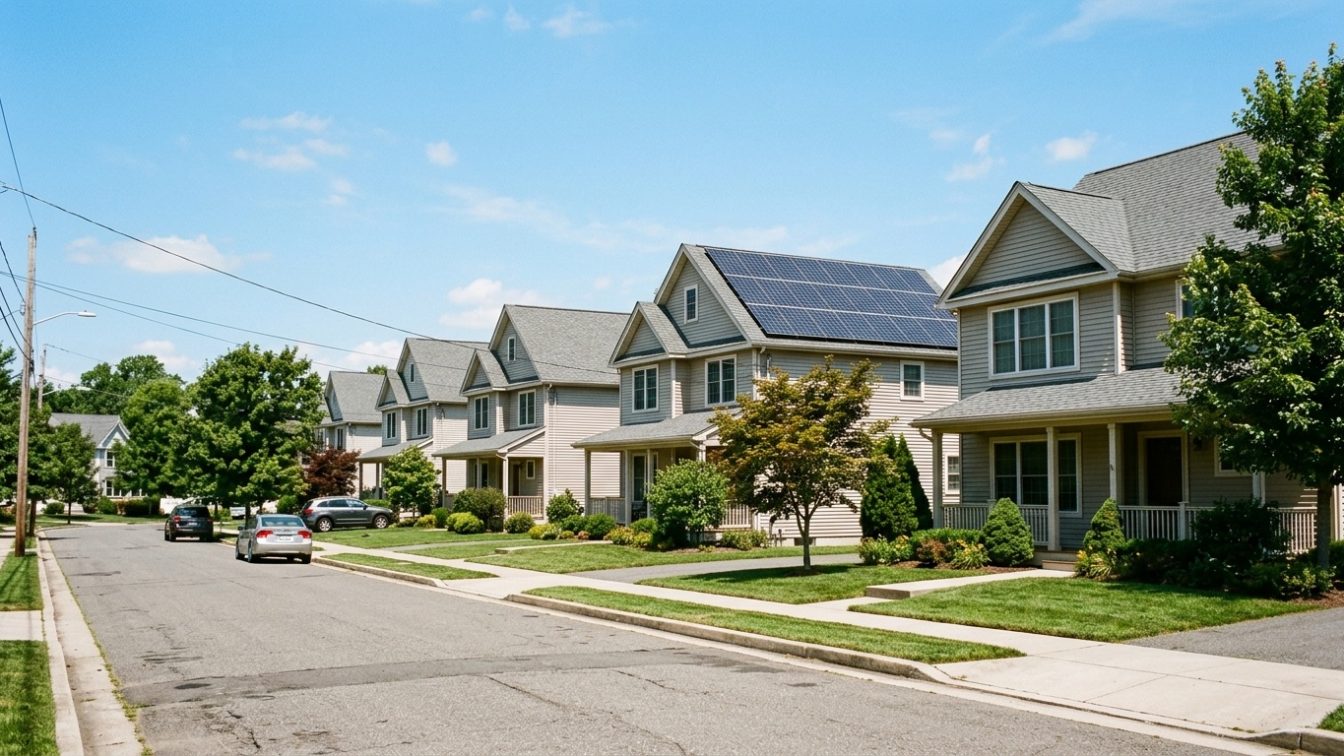
Table of contents
Summary of this article
- Roughly two out of every three new homes in the United States are built within a homeowners association, and a third of existing homes fall under one, according to Michigan State University research published in The Conversation.
- In a study of 31 HOAs in Ingham County, Michigan, one-third limited household energy production such as solar panels or wind turbines, nearly half required lawn maintenance, and only 3% required native plants.
- A Wisconsin study found yards under HOA native-plant rules averaged 29.5% native cover, compared with 6.9% in yards without those rules; yards governed by both native-plant requirements and lawn limits averaged 42.1% native cover.
- Turfgrass lawns depend on fertilizer, pesticides, and gas mowers, chemicals that run off into local water and combustion that adds fine particulate matter (PM2.5) to the air, while providing little habitat for pollinators.
- Michigan, Minnesota, Arizona, and Delaware now bar HOAs from prohibiting solar panels, and 19 states have passed right-to-dry laws protecting outdoor clotheslines, according to The Conversation.
Roughly two out of every three new homes built in the United States are located within a homeowners association, and a third of existing homes fall under one, according to Michigan State University research published in The Conversation. That means the rules shaping your roof, your yard, and your energy use may not be yours to set.
Those rules carry more weight than paint colors and mailbox styles. Daniel Kramer, a professor of conservation at Michigan State University, and his colleagues studied how HOA rules affect the environment and household health. Their finding was direct: HOAs mostly present barriers to residential sustainability, not bridges toward it.
The consequence lands in your air, your water, and your monthly bill. A rule that mandates a turfgrass lawn commits you to fertilizer, pesticides, and a gas mower. A rule that blocks solar panels keeps your household tied to fossil-fuel electricity. Here is how those rules work, how they reach your health, and what you can do about them.
What HOA rules actually control
Homeowners associations occupy a position between private property and local government. They enforce rules, collect fees, assess fines, and maintain shared spaces. They also regulate house size, building materials, driveways, yards, trees, outdoor lighting, and energy production.
The rules are called codes, covenants, and restrictions, CCRs. They are often written by the developer who builds the neighborhood, before any homeowner moves in. Once homes sell, control passes to an HOA board that interprets and enforces them. Amendments frequently require a supermajority of homeowners to approve, which makes developer-written CCRs difficult to change and able to shape a neighborhood for decades.
Those rules tend to favor aesthetic uniformity, believed by some to protect home values. The Kramer team measured what that preference produces. They analyzed the CCRs of 31 homeowner associations in Ingham County, Michigan, examining 18 provisions covering building structure, landscaping, and energy.
The barriers outnumbered the supports. Nearly half of the HOAs required lawn maintenance. One-third limited household energy production, such as solar panels or wind turbines. One-quarter prohibited clotheslines that would let residents dry laundry without electricity. On the other side of the ledger, only 3% required native plants, 6% constrained fertilizer use, and 19% required residents to maintain trees.
Why a mandatory lawn is a health issue
Building biology studies how the built environment affects human health. Its first principle is source control: stop a harm where it originates rather than manage it after it spreads. A turfgrass lawn is a source, and an HOA rule requiring one commits a household to it.
A lawn is not passive ground. It runs on inputs, and each input carries a pathway to your health.
- Chemical runoff into water
- Turfgrass requires regular fertilizing to stay green and regular pesticide application to stay uniform. Rain washes a portion of those chemicals off the lawn and into storm drains, streams, and groundwater, the same water systems that feed local supplies. Nitrogen and phosphorus from lawn fertilizer are among the most common contaminants in residential runoff. The chemicals do not stay on the grass they were applied to.
- Combustion pollution from mowers
- A gas lawn mower burns fuel in a small engine with few or no modern emissions controls. That engine releases fine particulate matter (PM2.5) and other combustion byproducts directly into the air at ground level, in your own yard, while you or a crew stand behind it. PM2.5 is small enough to bypass the body’s defenses and lodge deep in the lungs. The EPA links it to asthma attacks, heart disease, and premature death, and sets its annual health-based standard at 9 micrograms per cubic meter of air.
- Urban heat
- A monoculture lawn holds and radiates heat, contributing to the warmth that builds up across a neighborhood. Higher local temperatures raise cooling demand, which raises energy bills, which pushes households toward rationing air conditioning during the heat waves when it matters most.
- Lost pollinators
- Turfgrass is significantly lower in biodiversity than native planting, particularly for pollinators and birds. A lawn offers bees and butterflies almost no food or shelter. As pollinator populations decline, the food systems that depend on them weaken, a slow, compounding cost that a uniform green lawn conceals.
Native plants reverse each of these pathways. They require less water, less fertilizer, and less mowing, which cuts the chemical runoff and the combustion pollution a lawn generates. They provide food and shelter for bees, birds, and butterflies. And they connect a yard to the surrounding ecosystem rather than isolating it.
The rules change the ground
The Kramer team’s second study measured whether pro-environment HOA rules actually shift what grows in a yard. They surveyed front yards in and around Madison, Wisconsin, comparing yards under HOA native-plant rules against nearby yards without them.
The difference was substantial. Yards subject to native-plant requirements averaged 29.5% native plant cover, compared with 6.9% in yards without those requirements, more than four times as much.
The strongest effect came from pairing two rules. Yards governed by both native-plant requirements and turfgrass limits averaged about 42.1% native cover, compared with 11.6% where an HOA required native plants but did not restrict lawn area. The lesson is specific: requiring native plants helps, but capping the lawn is what unlocks the full result. A rule can be as powerful a force for habitat as it has been against it.
Why blocking solar keeps your household on fossil fuel
The same CCRs that mandate lawns often limit solar. In the Michigan study, one-third of the HOAs restricted household energy production. That restriction has a direct health consequence.
Electricity demand is fixed at any given moment, and the grid meets it from some source. A rooftop solar array supplies part of a home’s demand directly, which means the grid, and the fossil-fuel plants on it, supply less. Every kilowatt-hour a solar panel generates is a kilowatt-hour a gas or coal plant does not burn, and therefore a measure of PM2.5 and nitrogen oxides never released into the air.
When an HOA blocks solar, it keeps that household tied to combustion-generated power. The pollution the panels would have displaced continues, released at power plants whose exhaust reaches the airshed the neighborhood breathes. A rule written for uniformity produces a measurable emissions cost.
States are setting guardrails
The rules are not fixed, and state law is increasingly overriding the most restrictive ones.
Michigan, Minnesota, Arizona, and Delaware now prevent HOAs from prohibiting the installation of solar panels, according to The Conversation. California, Colorado, Washington, Nevada, and Utah require HOAs to accommodate drought-resistant landscaping. Maryland, Maine, Florida, and Illinois prevent HOAs from banning low-impact or native landscaping. And 19 states have passed right-to-dry laws that stop HOAs from banning outdoor clotheslines.
These laws do not make HOAs environmental leaders. They set limits, ensuring that a neighborhood’s aesthetic preferences cannot veto a state’s clean-energy, water-saving, or wildlife goals. The pattern that inspired several of them is instructive. Janet and Jeff Crouch spent over a decade turning their Maryland yard into bird and pollinator habitat with native plants and trees. Their HOA ordered them to replace it with turfgrass. The expensive legal fight left their yard mostly intact and helped push Maryland to pass a low-impact landscaping law in 2021, which declared that requiring turfgrass or restricting pollinator gardens and xeriscaping were “unreasonable limitations.”
What you can do
You cannot rewrite your CCRs overnight. You can find out what they actually say, use the protections your state already provides, and reduce your household’s exposure at the source.
- Read your CCRs before you assume a ban
- Many homeowners never check the exact language. Look specifically for provisions on solar panels, native or low-impact landscaping, turfgrass requirements, fertilizer, and clotheslines. Know what is written before you plan a change.
- Check your state law
- If you live in Michigan, Minnesota, Arizona, or Delaware, your HOA cannot ban solar. If you live in California, Colorado, Washington, Nevada, or Utah, it must accommodate drought-resistant landscaping. State law can override a restrictive covenant, confirm which protections apply to you.
- Propose a native-plant provision that also caps lawn
- The Wisconsin data shows a native-plant rule alone raised cover to 29.5%, but pairing it with a turfgrass limit reached 42.1%. If you serve on or petition your board, propose both together.
- Cut lawn inputs now
- Even within a lawn rule, you can reduce harm: switch to an electric or manual mower to eliminate the combustion PM2.5 in your yard, and cut back on fertilizer and pesticides to reduce runoff into local water.
- Add native plants where the rules allow
- Beds, borders, and permitted sections of a yard can hold native flowering plants that support pollinators and need less water and chemical input than grass.
- Pursue rooftop solar under state protection
- Where your state bars solar bans, an HOA cannot stop you, though it may set reasonable placement conditions. Solar cuts the fossil generation your household triggers and shields you from rising electricity bills.
Two out of three new American homes come with a rulebook someone else wrote. In one Michigan study, a third of those rulebooks limited solar and only 3% required native plants. But the same research shows a rule can build habitat as effectively as it once blocked it, and a growing number of states now bar the most restrictive bans. The cost of a mandatory lawn and a solar prohibition is measured in runoff, in PM2.5, in lost pollinators, and in a bill tied to combustion. The first step to lowering it is reading the rules you already live under.
Sources
- The Conversation. HOAs are often barriers to sustainable landscaping and solar energy, here's how they could be bridges instead by Daniel Kramer and Madeline Carr, Michigan State University:
- Kramer et al., HOA covenants and residential sustainability (Landscape and Urban Planning):
- Kramer et al., HOAs as an influential force in environmental policy (Landscape and Urban Planning):
- EPA, Particulate Matter (PM2.5) basics and health effects:
- EPA, National Ambient Air Quality Standards (NAAQS) table:
- EPA, nutrient pollution and residential fertilizer runoff:
- EPA, gas-powered lawn equipment and small engine emissions
- U.S. Fish and Wildlife Service, native plants and pollinator habitat
- U.S. Department of Energy, homeowner's guide to going solar:
Questions people ask
How common are HOAs in the United States?
Roughly two out of every three new homes are built within a homeowners association, and a third of existing homes fall under one, according to Michigan State University research published in The Conversation. HOAs have existed since the 1800s and expanded rapidly with suburban development in the 1960s and 1970s.
What did the Michigan study find about HOA rules?
Researchers analyzed the CCRs of 31 homeowner associations in Ingham County, Michigan, across 18 provisions. Nearly half required lawn maintenance, one-third limited household energy production such as solar panels or wind turbines, and one-quarter prohibited clotheslines. Only 3% required native plants, 6% constrained fertilizer use, and 19% required tree maintenance, barriers to sustainability far outnumbered supports.
Do HOA native-plant rules actually work?
Yes, and the effect is measurable. A Wisconsin study found yards under HOA native-plant requirements averaged 29.5% native cover, versus 6.9% in yards without them. Yards governed by both native-plant requirements and turfgrass limits averaged 42.1% native cover, compared with 11.6% where native plants were required but lawn area was not capped.
How does a turfgrass lawn affect my health?
A lawn runs on fertilizer, pesticides, and gas mowers. Fertilizer and pesticides wash into local water systems as runoff. A gas mower burns fuel with few emissions controls, releasing fine particulate matter (PM2.5), linked by the EPA to asthma, heart disease, and premature death, into the air at ground level in your yard. Turfgrass also holds heat and offers little for pollinators.
Can my HOA legally ban solar panels?
It depends on your state. Michigan, Minnesota, Arizona, and Delaware now prevent HOAs from prohibiting solar panels, according to The Conversation. In those states, state law overrides a restrictive covenant, though an HOA may still set reasonable placement conditions. Check your state's specific solar-access law before assuming a ban is enforceable.
Have questions about the environment inside your home?
Air quality, mold, EMF, light and water all shape how a house feels and how the people in it feel. Whatever your concern is, the first step is finding out what is there.
Our certified team of environmental professionals and advocates can help.