


The hallway thermostat doesn’t know what your bedroom is doing at night
A nursery two rooms away from the thermostat can run five degrees warmer, hot enough to disrupt an infant's sleep and raise real health risk.
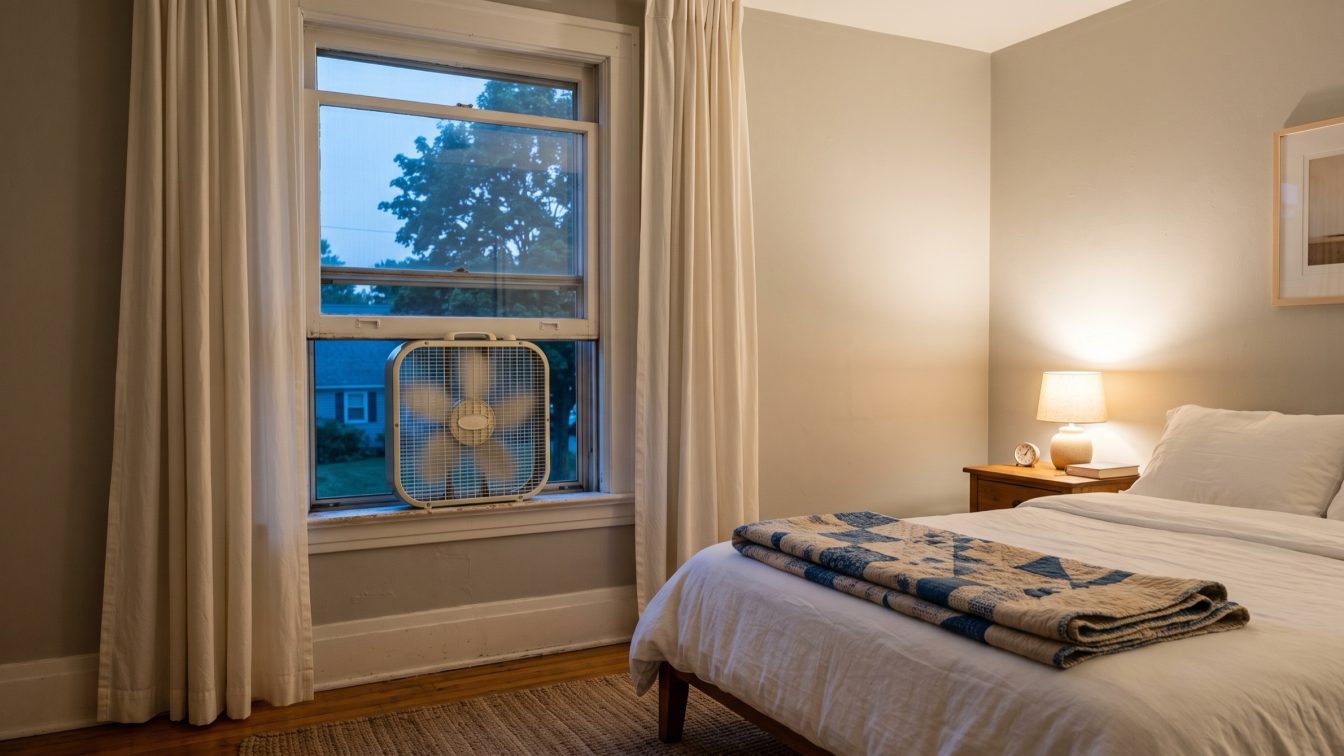
Table of contents
- Your bedroom is not the hallway
- An infant, an older parent, and a bad back do not share one safe temperature
- Block the heat before you touch the thermostat
- Cool one room, not the whole house
- What air conditioning actually costs you
- An oversized or undersized system creates its own hazard
- Know when a fan helps and when it works against you
- Protect the people who cannot regulate this on their own
Summary of this article
- A thermostat in the hallway measures only the hallway, not the bedroom, nursery, or sunlit room where someone actually sleeps.
- Infants, older adults, and people with chronic pain often need a cooler room for longer than a healthy adult does.
- Closing curtains, shutting windows during the heat of the day, and running a fan only below 90 degrees Fahrenheit cost nothing and matter before any thermostat setting does.
- Cooling one occupied room instead of an entire house cuts the work an air conditioner has to do and lowers the electric bill.
- Free or low-cost cooling centers, libraries, and utility assistance programs exist for the days a home cannot keep up with the heat.
Seventy-eight degrees is not a rule. It is a starting point, one that utilities and public officials lean on when they are trying to keep an entire electrical grid from failing on the hottest days of the year. That single number says nothing about the nursery two doors down from the thermostat, or the back bedroom that catches full sun until six in the evening, or the grandmother sleeping under a blanket because her circulation runs cold even in July. What follows is a walk through which room in your house actually overheats, why the thermostat on your wall cannot see it, what an infant or an older body needs that a healthy adult does not, and the low-cost moves worth making before you touch the dial at all.
Your bedroom is not the hallway
Central thermostats usually sit in a hallway, chosen for even wall space rather than for accuracy in any room where someone actually sleeps. That location matters more than most people realize. A room two doors away, especially one facing west or sitting above a garage, can run several degrees warmer than the hallway reading claims. Researchers writing in Energy Research & Social Science have documented exactly this gap between what a thermostat reports and what a room elsewhere in the same house is actually doing. A single number on a wall panel cannot speak for every room behind it.
The fix costs less than ten dollars. Buy a simple thermometer. Place it in the room where a baby sleeps, where an older parent naps, or wherever the sun hits longest. Read it at night. Read it again at three in the afternoon. Only then do you know what that room is doing, rather than what the hallway says it is doing.
An infant, an older parent, and a bad back do not share one safe temperature
A body regulates heat differently depending on its age and its health. Infants cannot sweat as efficiently as adults and can overheat faster in a warm room. Older adults often have a blunted thirst response and a weaker capacity to sweat, which delays the warning signs their own body would otherwise send. People managing chronic pain frequently report that heat worsens inflammation and stiffness, even in a room that feels tolerable to everyone else standing in it. None of these bodies read a thermostat the same way a healthy adult does.
One energy researcher who studies household cooling costs learned this directly. Her infant daughter began vomiting at night and broke out in small bumps across her chest one summer, while the household thermostat sat at 79 degrees Fahrenheit. The family first blamed food. Only after the mother lowered the hallway setting enough to bring the child’s bedroom near 74 degrees did the vomiting stop. The thermostat had said the house was fine. Her daughter’s body said otherwise.
If someone in your home is very young, very old, pregnant, or managing a chronic condition, treat their room as its own zone. Adequate cooling for a healthy adult in the living room is not automatically adequate for a crib down the hall.
Block the heat before you touch the thermostat
Several no-cost and low-cost steps work before any adjustment to the thermostat matters at all. Close curtains on any window that faces direct sun, since sunlight through glass adds heat faster than most people expect. Close windows and doors during the hottest part of the day, and only open them when it is cooler outside than inside, which usually happens overnight or early in the morning. Skip the oven during peak heat, since every appliance running inside a sealed home adds to the load your cooling system has to remove.
These moves cost nothing. A renter without any control over a building’s insulation or its air conditioning unit can still do every one of them today.
Cool one room, not the whole house
An air conditioner has less work to do when the gap between the outdoor temperature and the indoor setting is small. Raising the setting even one or two degrees measurably reduces how often, and how hard, the system has to run. But comfort does not require conditioning every square foot of a house equally. Keep the people in your home in one shaded room, on a lower floor, or away from a west-facing wall, rather than spreading the same cooling effort evenly across rooms nobody is using.
A portable fan or a window unit dedicated to that one room accomplishes more per dollar than pushing the whole-house system harder. Shrink the space you are actually cooling, and the job shrinks with it.
What air conditioning actually costs you
Air conditioning already accounts for more than half of a typical home’s electricity use during summer months, according to research published in the journal Energy and Buildings. Every degree you raise the setting reduces that load, because the system removes less heat from the air passing over its coil. Households in the United States commonly keep their summer thermostat near 72 degrees Fahrenheit on average, a Nature Energy study found, well below the 78 degrees often recommended as a cost-saving starting point. The gap between what a household actually wants and what it is told to accept is exactly why one number cannot serve as policy for every home.
Humidity changes the math further. Running the system also pulls moisture out of the air, and that matters more than people expect. When the temperature climbs above 90 degrees Fahrenheit and the humidity climbs above 60 percent, the air feels like it is above 100 degrees Fahrenheit, according to the National Weather Service’s heat index chart. A dry 90 degrees and a humid 90 degrees are not the same room.
An oversized or undersized system creates its own hazard
Air conditioning does not just cool. It dehumidifies, passing air over a cold coil that pulls water directly out of it. A system sized too large for the room cools the air quickly and shuts off before it has run long enough to remove sufficient moisture, leaving relative humidity above the 60 percent mark where mold becomes a real risk. A system sized too small never catches up at all, leaving a room hot and humid at once, and risking early failure that leaves a home with no cooling whatsoever on the worst possible day. Either failure turns a comfort problem into a moisture problem. Moisture spreads. It rarely stays contained to the room where it started.
Know when a fan helps and when it works against you
Your skin already runs a cooling system of its own, sitting somewhere between 90 and 94 degrees Fahrenheit at rest, shedding heat mainly through sweat evaporating off its surface. A fan speeds that process along by moving air across damp skin. Below 90 degrees indoors, a fan helps, and the Centers for Disease Control and Prevention recommends using one to cool the body under that threshold. Above 90 degrees, air moving across skin that is cooler than the air itself works the opposite way, pushing heat into the body rather than away from it, an effect researchers have compared to a convection oven. A study published in the Annals of Internal Medicine found that fan use in very hot, humid conditions raised core body temperature rather than lowering it. Check a thermometer before you switch on a fan, and trust it over habit.
Protect the people who cannot regulate this on their own
Watch for dizziness, unusual thirst, nausea, confusion, or exhaustion in anyone in the household, and move that person to a cooler space right away if any of these appear, following guidance the Centers for Disease Control and Prevention publishes on heat stress illness. Confusion, loss of consciousness, and a very high body temperature signal heat stroke, and that is an emergency requiring a hospital, not a fan. People have died indoors after turning off a working air conditioner during high heat, and after cooling systems failed without anyone noticing in time, cases documented in Public Health Reports and reported by news outlets covering deaths during Phoenix’s 2025 heat season. Infants and people managing chronic health conditions may need a cooler room for a longer stretch of the day than a healthy adult requires, not just a lower number on a wall panel.
If the heat inside your home ever puts your health at risk, call your local 211 hotline or search for a cooling center near you. Libraries, senior centers, splash pads, and even a movie theater offer free or low-cost hours in conditioned air. Utility companies frequently offer payment plans for households behind on a summer bill, and federal weatherization assistance programs help cover the cost of insulation and appliance upgrades for households that qualify.
No single number belongs on every thermostat in every house. The right setting is the one that keeps the specific people inside that specific house safe, at a cost the household can actually sustain, and you find that by watching the rooms and the bodies inside them, not the wall panel.
Sources
- The Conversation. Why 78 degrees isn't the right thermostat setting for everyone during a heat wave (2026)
- Nature Energy. study cited on average U.S. household summer thermostat settings and comfort/safety findings (2025)
- National Weather Service. heat index chart (undated)
- Energy and Buildings. study cited on residential air conditioning's share of summer energy use (2007)
- Centers for Disease Control and Prevention. heat and health guidance (undated)
- Annals of Internal Medicine. study cited on fan use and core body temperature in heat (2019)
- Energy Research & Social Science. study cited on discrepancies between thermostat readings and room temperatures (2026)
- Centers for Disease Control and Prevention / NIOSH. signs and symptoms of heat-related illness (undated)
- Public Health Reports. study cited on deaths associated with turning off air conditioning during heat (2020)
- The Guardian. reporting on Phoenix heat deaths linked to cooling system failures (2025)
- U.S. Department of Energy. Weatherization Assistance Program guidance (undated)
- American Standard. blog post recommending a 78 degree thermostat setting (undated)
- PBS NewsHour. guidance on avoiding heat-related illness (undated)
Questions people ask
Is 78 degrees Fahrenheit safe for everyone during a heat wave?
No. It functions as a cost-conscious starting point, not a safety threshold. Infants, older adults, and people with certain health conditions may need a cooler room even when 78 degrees feels tolerable to a healthy adult.
Why does my bedroom feel hotter than what the thermostat shows?
Most thermostats sit in a hallway chosen for wall space, not for accuracy in every room. Rooms farther from the thermostat, especially those facing direct sun or sitting above a garage, commonly run several degrees warmer than the hallway reading suggests.
Is it cheaper to cool one room instead of the whole house?
Yes, in most cases. A portable fan or a window unit dedicated to the room people are actually using reduces the total space your system has to condition, which lowers the load on the main air conditioner and the resulting bill.
When should I stop relying on a fan to cool down?
Stop relying on a fan once the indoor temperature passes 90 degrees Fahrenheit. Above that point, air moving across skin warmer than the air itself can push heat into the body instead of removing it, according to Centers for Disease Control and Prevention guidance.
What are the warning signs of heat stress I should watch for?
Dizziness, unusual thirst, nausea, confusion, and exhaustion are early signs. Confusion, loss of consciousness, or a very high body temperature signal heat stroke, which requires emergency medical care immediately.
What can I do if my home cannot stay cool enough and I cannot afford to run the air conditioner more?
Call your local 211 hotline or search for a cooling center, library, or senior center offering free air-conditioned hours. Utility companies often offer payment plans, and federal weatherization assistance programs help cover insulation and appliance upgrades for qualifying households.



Have questions about the environment inside your home?
Air quality, mold, EMF, light and water all shape how a house feels and how the people in it feel. Whatever your concern is, the first step is finding out what is there.
Our certified team of environmental professionals and advocates can help.