


The Atlantic sargassum belt got so big it may now feed itself
Researchers say the giant mats now recycle nutrients that help seed the next bloom, making the belt partly self-sustaining. Rotting sargassum also releases hydrogen sulfide as it piles up on shore.
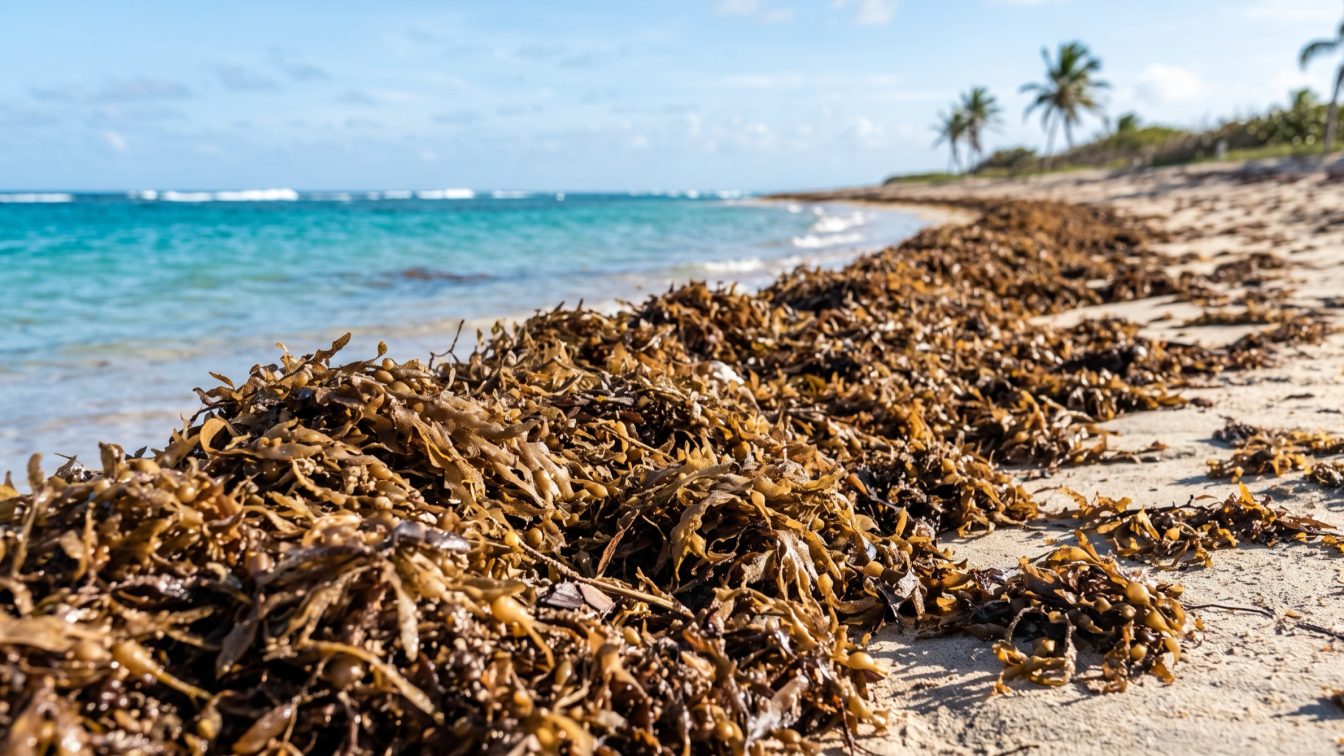
Table of contents
Summary of this article
- Sargassum blooms turned chronic after 2011. Unusually large mats first appeared in the tropical Atlantic in 2011. By 2025, the Great Atlantic Sargassum Belt exceeded 37,500 million tons, according to research published in Science.
- The bloom now feeds itself. Researchers at Georgia Tech and the University of South Florida found the floating mats form an ecosystem they call the "sargassumsphere," which recycles nutrients and seeds the next bloom.
- Rotting seaweed releases three gases of concern. As sargassum decomposes, it emits hydrogen sulfide, ammonia, and methane, a public health concern flagged by the U.S. Environmental Protection Agency.
- Scientists can now forecast blooms. A predictive model built by the research team reproduced blooms from 2011 to 2022 and correctly predicted the 2023 and 2024 events. Summer 2026 forecasts point to another record.
- The waste has value. Sargassum can be converted into biofuel, fertilizer, compressed building panels developed at the National Autonomous University of Mexico (UNAM), and bricks made from roughly 40% sargassum blended with limestone.
Sargassum stopped being a seasonal nuisance and became a permanent one. In 2011, unusually large mats of the brown seaweed appeared in the tropical Atlantic between Africa and Brazil. By 2025, the Great Atlantic Sargassum Belt exceeded an estimated 37,500 million tons, according to research published in the journal Science. Forecasts from the University of South Florida point to summer 2026 breaking records again.
The reason matters for anyone who lives near, works on, or vacations along the Caribbean, Gulf, and tropical Atlantic coasts. Researchers who study oceans, marine life, and algae blooms have found that these mats now sustain themselves. The seaweed is, in effect, feeding its own expansion.
That shift changes the problem from a passing bad season into a chronic one. It also changes how coastal communities and homeowners should think about air, water, and the buildings that sit at the edge of the water.
What sargassum is, and why 2011 was the turning point
Pelagic sargassum is a floating brown seaweed. It carries small, grapelike, air-filled bladders that keep it at the surface. Those bladders gave the seaweed its name, from sargaço, the Portuguese word for grape. Christopher Columbus wrote about sailing through vast mats of it. For centuries, the seaweed stayed mostly in the Sargasso Sea, a calm region of the subtropical North Atlantic.
The 2011 blooms broke that pattern. Sargassum began appearing far south of its usual home, and the mats grew more frequent, lasted longer, and spread wider. Large volumes now wash ashore across Central America, the Caribbean, and the Gulf of Mexico each year.
Scientists spent years hunting for a single cause. They examined extra nitrogen and phosphorus washing out of the Amazon and Congo river basins from fertilizer and other human activity. They studied Saharan dust blowing across the ocean. They tracked shifts in ocean temperature, winds, and currents. None of those explanations, on their own, matched the year-to-year swings in the belt.
The “sargassumsphere”: how the bloom became self-sustaining
The newer finding reframes the whole problem. A research team including scientists at Georgia Tech and the University of South Florida concluded that the main driver has changed over time.
Here is the mechanism in plain terms. In the winter of 2010, strong winds pushed sargassum south from the Sargasso Sea. For several years, those winds kept mixing deeper, nutrient-rich water up to the sunlit surface, acting like a giant spoon and giving the algae what it needed to grow.
But a sargassum mat is more than seaweed. It is a floating community of fish, shrimp, crabs, and countless tiny organisms. The research team calls this ecosystem the “sargassumsphere,” and it works much like a mobile reef. Those animals gather food from a wide area and recycle nutrients through their waste and through the breakdown of older sargassum. In this way, nutrients get pulled in from a much larger stretch of ocean and concentrated right around the seaweed, fuel for the next bloom.
That feedback loop is why the blooms now persist. To test the idea, the team built a mathematical model of the mechanisms driving the blooms, using measurements of nitrogen content and isotope composition in sargassum collected around the U.S. Virgin Islands. The model reproduced the blooms from 2011 to 2022 and predicted, ahead of time, the size and behavior of the 2023 and 2024 blooms. That accuracy supports the self-sustaining theory.
The exposure pathway: what happens when it rots on shore
The health concern begins when the seaweed lands and starts to decompose. As sargassum breaks down, it releases hydrogen sulfide, ammonia, and methane. The U.S. Environmental Protection Agency lists these emissions as a public health concern tied to sargassum inundation events. Marine blooms reach people through the air as well as the water, the way red tide toxins travel inland.
Hydrogen sulfide is the gas most people notice first. It produces the rotten-egg smell that clears a beach. At low levels it irritates the eyes, nose, and throat. Higher, sustained concentrations can cause headaches, nausea, and breathing problems, which is why decomposing piles close to homes and hotels are more than an odor issue.
From a building-biology standpoint, the guiding principle is source control. You cannot stop the seaweed offshore, but you can limit how much its gases reach the air you breathe indoors. A few practical steps follow from that:
Put distance and time between people and rotting piles. The gases are strongest as the seaweed decays on the sand. Fresh sargassum that is cleared quickly produces far less exposure than mats left to rot for days.
Manage your indoor air on heavy-bloom days. When the smell is strong, close windows on the seaward side, run mechanical ventilation that draws from cleaner air, and use filtration indoors rather than relying on open windows for fresh air.
Keep vulnerable people farther back. Children, older adults, and anyone with asthma or heart conditions feel these irritant gases sooner. On peak days, staying inland or upwind is a simple, effective fix. Pets meet the water first, and a dog can die within hours of swallowing it.
Support fast, mechanical removal. Communities that clear sargassum quickly, before it fully decomposes, cut the volume of gas released near the built edge.
Forecasting turns a nuisance into a manageable event
The predictive model does more than confirm a theory. It opens the door to early-warning systems. If coastal towns know weeks ahead that a large bloom is heading their way, they can schedule cleanup crews, warn residents with breathing conditions, and time beach access.
That lead time is the difference between reacting to a wall of rotting seaweed and managing an expected arrival. For coastal homeowners and hotel operators, a forecast is the moment to prepare ventilation and removal plans rather than scramble.
From waste to building material
There is a regenerative side to this story. Sargassum is a large, renewable stream of biomass that needs no land, freshwater, or fertilizer to grow. Several uses are already moving from lab to real projects.
As a fuel, sargassum is rich in carbohydrates that convert into bioethanol, biogas, bio-oil, or hydrogen. Scientists in Barbados developed a process that combines excess sargassum with wastewater from the island’s rum industry to make biofuel. Barbados is also encouraging farms to use processed sargassum as a fertilizer and soil amendment, because it carries organic matter, potassium, calcium, magnesium, and trace elements. The key qualifier: the seaweed must be processed to remove salt and excess metals first.
The building applications are the most striking. Researchers at the National Autonomous University of Mexico (UNAM) developed compressed panels similar to drywall using sargassum. In Mexico, entrepreneur Omar Vázquez Sánchez makes low-cost bricks from roughly 40% sargassum blended with limestone and other organic materials. Used as a mortar additive or panel, sargassum can trim reliance on conventional, carbon-intensive building products.
That is the regenerative-design opportunity in one line: a coastal problem becomes a coastal resource. The same seaweed that fouls a beach can end up in the walls of a nearby building.
What this means for you
Sargassum is not going away. The research shows the bloom now sustains itself, so coastal residents should treat it as a recurring feature of the shoreline, not a fluke.
The practical response has two parts. First, protect your air: control exposure to the hydrogen sulfide, ammonia, and methane that rotting piles release, especially for children, older adults, and people with respiratory conditions. Second, watch the forecasts, because prediction now makes preparation possible. And where local industry can capture the seaweed for fuel, fertilizer, or building material, the smelly nuisance turns into something useful. Learning to live with sargassum, and to build with it, is how affected coasts turn a chronic disaster into an opportunity.
Sources
Questions people ask
What is sargassum and why is it piling up on beaches?
Sargassum is a floating brown seaweed. Unusually large mats began appearing in the tropical Atlantic in 2011. Since then the blooms have grown, and by 2025 the Great Atlantic Sargassum Belt exceeded an estimated 37,500 million tons, according to research published in Science.
Why do scientists say the bloom is now self-sustaining?
Researchers including teams at Georgia Tech and the University of South Florida found the floating mats form an ecosystem they call the "sargassumsphere." The animals living in the mats recycle nutrients through waste and decomposition, concentrating them around the seaweed and fueling the next bloom.
Is the gas from rotting sargassum dangerous?
Decomposing sargassum releases hydrogen sulfide, ammonia, and methane. The U.S. Environmental Protection Agency lists these emissions as a public health concern. Hydrogen sulfide causes the rotten-egg smell and can irritate eyes, nose, and throat, with stronger effects at higher, sustained levels.
How can I reduce exposure at home during a bloom?
Focus on source control and clean indoor air. Keep distance from rotting piles, close seaward windows on heavy-smell days, use mechanical ventilation and filtration instead of open windows, and keep children, older adults, and people with asthma or heart conditions farther inland or upwind.
Can sargassum be put to good use?
Yes. It can be converted into biofuel, fertilizer, and soil amendments once salt and excess metals are removed. Researchers at the National Autonomous University of Mexico (UNAM) developed compressed building panels, and entrepreneur Omar Vázquez Sánchez makes bricks from roughly 40% sargassum blended with limestone.
Will sargassum keep coming back?
The research indicates yes. Because the bloom now sustains itself, scientists expect it to persist. A predictive model that correctly forecast the 2023 and 2024 blooms points to summer 2026 potentially breaking records.

Have questions about the environment inside your home?
Air quality, mold, EMF, light and water all shape how a house feels and how the people in it feel. Whatever your concern is, the first step is finding out what is there.
Our certified team of environmental professionals and advocates can help.