


Red tide toxins can drift 2.6 miles inland and into your home
Waves break red tide algae apart and throw brevetoxin into the air, where researchers kept finding it up to 2.6 miles from the shore. You don't have to touch the water to breathe it in.
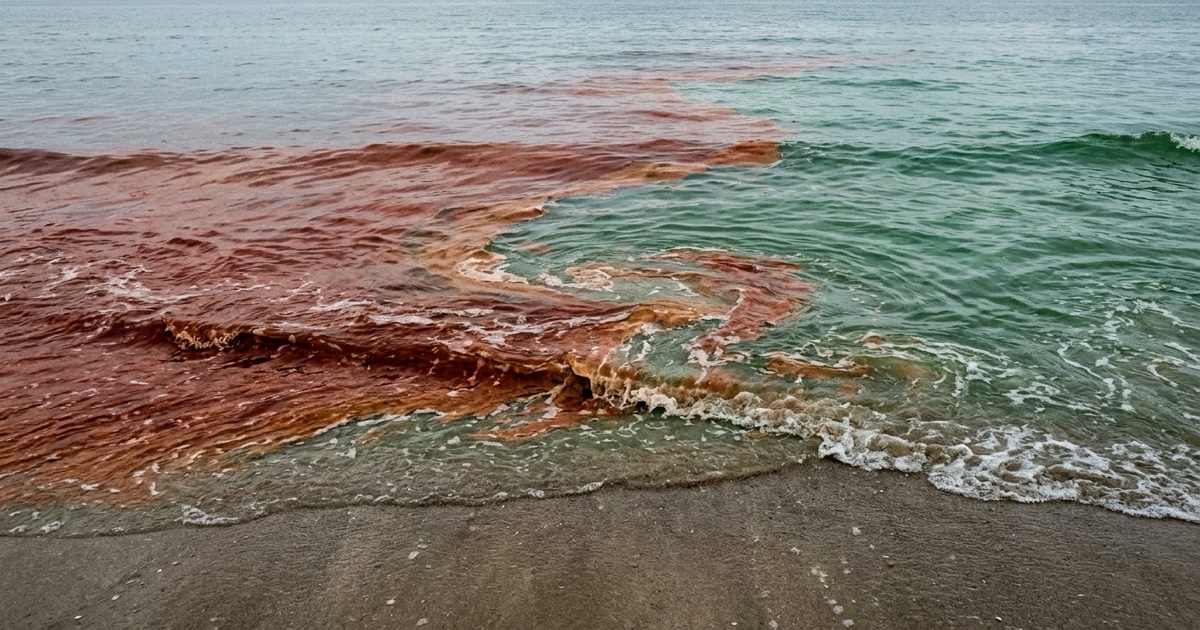
Table of contents
- What is red tide, and why does it make you cough?
- How does something in the water end up in your air?
- How far inland does red tide travel?
- Does wind decide whether it reaches you?
- Should you close your windows?
- What happens if you have asthma?
- Who needs to be most careful?
- What should you check before you drive down?
Summary of this article
- Red tide is an algae bloom off Florida's coast. Surf tears the algae apart and throws its toxin into the air you breathe.
- You never have to touch the water. Coughing, sneezing and stinging eyes all come from air blowing off the surf.
- Researchers kept finding the toxin 2.6 miles from the beach, so a rental a few streets back is not automatically clear.
- Wind decides your afternoon. A breeze off the water brings it to you; a breeze off the land takes it away.
- One hour on the beach during a bloom is enough to bother someone with asthma. Seven years of follow-up found no lasting damage.
- Children, older adults, anyone immunocompromised and anyone with a long-term lung condition have the worst time of it.
- Nobody is required to measure the air at a beach. The forecasts exist because researchers and volunteers built them.
What is red tide, and why does it make you cough?
Florida’s red tide is a bloom of algae called Karenia brevis, which carries a toxin called brevetoxin, and FWC lists what it does to people as coughing, sneezing, and irritation of eyes, nose and throat.
The part that catches visitors out is the distance. You’re on dry sand, nowhere near the water, and you start clearing your throat like you walked into a dusty attic. Your eyes sting. Somebody down the beach is coughing too, and nobody’s swimming.
That happens because these algae are fragile. Waves tear them apart, brevetoxin spills into seawater, and surf throws it up with the spray. So whatever’s bothering you travels in air just above the water, drifting inland on whatever breeze is running that afternoon.
It can also go on a long time. A bloom, FWC says, “can last as little as a few weeks or longer than a year.” That’s why a Gulf coast family checks before heading out, and why one week of vacation falls on a good stretch and the next doesn’t.
We should say this isn’t a rare event either. Wang and colleagues followed 137,930 people living in coastal ZIP codes on Florida’s west coast from 2012 to 2019, which is roughly the population living with this on and off for years.
As of 2026 we’ve found two more things worth knowing before you book anything. Red tide kills fish, so a beach can smell before it makes you cough. And FWC’s advice about the water itself is blunt: don’t swim in or around red tide. People come out with skin irritation, rashes, and burning or sore eyes.
How does something in the water end up in your air?
Wave action breaks K. brevis cells open and releases brevetoxin, which forms an aerosol where air meets sea, a mechanism Lora Fleming and colleagues set out in Environmental Health Perspectives in 2005.
Watch white foam where a wave collapses. Every bursting bubble flicks a little seawater upward. Normally that’s just salt spray, and it’s what leaves film on your sunglasses.
During a bloom that spray carries something extra, because surf has already torn those cells open, brevetoxin runs loose in seawater, and the same bubbles lift it into air you’re breathing.
That’s the whole trick. You don’t have to touch water. You don’t have to swim, or wade, or go anywhere near it. If air over surf moves toward you, so does brevetoxin.
Fleming’s team named three things deciding how much of it forms: how hard wind blows along shore, which way it points, and how big surf is running. Which is why a rough day feels worse than a calm one.
We find this is the part people get backwards. They watch water for a color change, when whatever decides their afternoon is happening in six feet of air above it.
How far inland does red tide travel?
Barbara Kirkpatrick and colleagues ran six air samplers four miles inland from Siesta Key Beach and kept finding brevetoxin 2.6 miles from the beach and 1 mile from the shoreline, published in Harmful Algae in 2010.
We think this is the most useful question in the subject, and almost nobody answers it. Two and a half miles covers most of a beach town.
| How far back you are | What samplers found |
|---|---|
| On the sand | highest concentrations |
| 1 mile from shoreline | brevetoxin detected |
| 2.6 miles from the beach | brevetoxin still detected |
| 4 miles inland | far end of the sampled line |
Concentrations ran highest at water’s edge and fell steadily as samplers moved back, which is how people describe it anyway. Brutal on sand. Noticeable at a parking lot. Mild by a main road.
So being further back helps, and we’d still rather you knew that number than trusted a rule of thumb. But if a rental listing tells you a place is fine because it isn’t beachfront, nobody has published a distance that makes a house safe, and there’s no point where this simply stops.
Does wind decide whether it reaches you?
Wind direction decides whether a bloom in the water becomes a problem in the air, and FWC and NOAA both state that respiratory risk drops when breezes blow offshore, away from the beach.
Checking a wind arrow costs nothing, and we’d check it before anything else.
Onshore means air coming off water toward land, carrying whatever rides above surf to you, your rental, your car and your open windows. Offshore means that breeze travels from land out to sea, taking the same material with it.
Same water. Same bloom. A completely different afternoon, hours apart on the same day.
Which explains most arguments about red tide. Two people visit one beach on the same day, hours apart, and come away with opposite stories. One says it’s overblown. The other left after twenty minutes. They’re both telling the truth about the day they got.
So look at that arrow before you look at any map. Breeze off land, and sand can be far better than water suggests. Breeze off water, and assume any report understates what you’re walking into.
Should you close your windows?
No agency publishes a distance or a wind speed at which a household should close up, and we’d rather name that gap than fill it with a guess.
What can be established is narrow. Brevetoxin turns up a couple of miles inland. Offshore breezes reduce it. Nobody has published a rule saying close your windows within so many miles of a bloom.
So it’s your call, and what we see people on the coast do is simple. Onshore breeze with a bloom nearby, they shut windows on a water-facing side and run air conditioning. Wind turns offshore, they open up again.
Anyone in that house whose lungs already have a job gets more caution rather than less, which in practice means kids, older relatives, people with asthma, and anyone whose immune system is busy with something else.
And if you notice a cough indoors, that’s your answer whatever a map says. Your throat beats a forecast written for a beach three miles away.
We’d rather say that plainly than pretend there’s a number. Kirkpatrick’s samplers found brevetoxin 2.6 miles inland, and that’s furthest anyone has published. It marks where somebody happened to put a sampler, and nothing more.
What happens if you have asthma?
One hour on a beach during a bloom raised respiratory symptoms in 59 asthmatics studied by Lora Fleming at Siesta Beach, while Judy Bean’s seven-year follow-up of 125 asthmatics found no lasting effect between blooms.
Both halves matter, and we find people hear only one of them. Which half you hear changes what you do about it.
Short term arrives fast. An hour isn’t long, and Fleming’s group still measured coughing, wheezing and chest tightness. People not taking asthma medication had a rougher time than people who were. Milian and colleagues found the same pattern in 97 asthmatics walking that beach.
Long term reads better. Bean’s team followed those asthmatics for seven years, through repeated blooms, and found no lasting damage. So a bad afternoon stays a bad afternoon.
Which makes this something you plan around rather than something you move away from. Active bloom, onshore breeze, asthma? Do something else that day. Take medication you already have. Keep a reliever on you rather than back in your room, because that walk back is what people regret. The Atlantic has its own chronic bloom, and the sargassum belt now recycles the nutrients that seed the next one.
We’re not telling you to avoid the coast. We’re telling you to check wind before committing to two hours on sand.
Who needs to be most careful?
FWC names four groups at higher risk from red tide: children, older adults, people who are immunocompromised, and anyone with a chronic respiratory condition.
That’s a wider net than we expected when we first read FWC’s list, and each group is on it for a reason worth spelling out.
Children breathe faster than adults and stand lower to ground, closer to spray. They’re also less likely to announce that air is bothering them and more likely to go quiet and tired.
Older adults are there because a cough that’s a nuisance at thirty can be genuinely rough at seventy-five, especially alongside anything else going on in a chest.
People whose immune systems are compromised, by treatment or by a condition, have less margin for an irritant they didn’t need.
And anyone with asthma or COPD is reacting to something their airways are already primed to react to.
If nobody in your group is on that list, a bad red tide day is unpleasant and then it’s over. If somebody is, five minutes of checking earns its keep.
What should you check before you drive down?
NOAA’s National Centers for Coastal Ocean Science publishes a respiratory forecast for Gulf coast beaches in Florida and Texas, combining K. brevis levels in water with wind speed and direction.
Two things, in this order. Is there a bloom near the beach you want, and which way is wind blowing when you plan to be standing on it.
Mote Marine Laboratory runs a second thing worth more than it sounds. Trained volunteers report from individual beaches on what they see that morning: dead fish, water color, wind direction, and whether people around them are coughing. Somebody standing on sand at nine beats a water sample taken Tuesday.
Then use whatever weather app you already have for a wind arrow. We’d check that one last, because it changes fastest.
Bloom nearby this week and an onshore breeze? We’d pick another beach or another day. Offshore, and that same beach can be fine. And if you arrive and people are coughing, believe them over anything you read before you left.
One last thing, and we think it catches people out. There’s no national air standard for this. The Clean Air Act covers six pollutants, and brevetoxin isn’t one of them. Nobody’s required to measure air at a beach, or to tell you when it changes. These forecasts exist because researchers and volunteers built them, not because anybody has to.
Sources
- Florida Fish and Wildlife Conservation Commission. Red Tide Current Status, with the Key for Results abundance categories (2026) FWRI Harmful Algal Bloom monitoring
- Florida Fish and Wildlife Conservation Commission. Red Tide Frequently Asked Questions (2026)
- US Food and Drug Administration. Appendix 5: FDA and EPA Safety Levels in Regulations and Guidance (2021) Table A-5, Natural Toxins, page A5-10 (June 2021)
- US EPA. NAAQS Table, criteria air pollutants under 40 CFR part 50 (2026)
- Fleming LE, Kirkpatrick B, Backer LC, Bean JA, et al.. Initial evaluation of the effects of aerosolized Florida red tide toxins (brevetoxins) in persons with asthma (2005) Environmental Health Perspectives 113(5):650-7
- Fleming LE, Backer LC, Baden DG. Overview of aerosolized Florida red tide toxins: exposures and effects (2005) Environmental Health Perspectives 113(5):618-20
- Milian A, Nierenberg K, Fleming LE, Bean JA, et al.. Reported respiratory symptom intensity in asthmatics during exposure to aerosolized Florida red tide toxins (2007) Journal of Asthma 44(7):583-7
- Fleming LE, Bean JA, Kirkpatrick B, Cheng YS, et al.. Exposure and effect assessment of aerosolized red tide toxins (brevetoxins) and asthma (2009) Environmental Health Perspectives 117(7):1095-100
- Kirkpatrick B, Pierce R, Cheng YS, Henry MS, et al.. Inland transport of aerosolized Florida red tide toxins (2010) Harmful Algae 9(2):186-189
- Bean JA, Fleming LE, Kirkpatrick B, Backer LC, et al.. Florida red tide toxins (brevetoxins) and longitudinal respiratory effects in asthmatics (2011) Harmful Algae 10(6):744-748
- Stumpf RP, Li Y, Kirkpatrick B, Litaker RW, et al.. Quantifying Karenia brevis bloom severity and respiratory irritation impact along the shoreline of Southwest Florida (2022) PLOS ONE 17(1):e0260755
- Collins KM, Hounshell AG, Kirkpatrick B, Cook A, et al.. Predicting Karenia brevis induced respiratory irritation at individual southwest Florida beaches using cell abundances plus wind direction and speed (2026) GeoHealth 10(4):e2025GH001664
- NOAA National Centers for Coastal Ocean Science. Gulf Coast Harmful Algal Bloom Forecast, and its FAQs (2026)
- Mote Marine Laboratory. Beach Conditions Reporting System (2026)
Questions people ask
What does the red tide number actually measure?
It measures the water. FWC counts Karenia brevis cells in a seawater sample and reports the result in five graded steps, from background at 1,000 cells or less up to high at more than 1,000,000 cells per liter. Nothing in that count describes the toxin in the air.
Is there a safe level of red tide?
No agency publishes one for what you breathe. FWC's categories are a classification scale for how much of the organism is in the water, and the only enforceable federal number, FDA's 0.8 mg/kg brevetoxin-2 equivalent, applies to shellfish flesh rather than to air.
Why does red tide affect one beach and not the next one over?
Wind direction and shoreline orientation. Onshore wind carries brevetoxin aerosol to the sand while offshore wind leaves it over the water, and NOAA's respiratory forecast uses each stretch of shoreline's compass orientation for exactly this reason.
Can red tide affect you away from the beach?
Yes, though it thins out fast. Kirkpatrick and colleagues measured brevetoxin at least 4.2 kilometers from the beach, about 2.6 miles, and 1.6 km, about 1.0 mile, inland of the shoreline, at concentrations far below what the beach sampler recorded.
What does red tide do to people with asthma?
In a 2005 study of 59 asthmatics at Siesta Beach, one hour of exposure raised reports of cough, wheeze and chest tightness and dropped FEV1 by 38.0 mL on average. A seven-year follow-up of 125 asthmatics found no chronic respiratory effect in stable patients.
How current is the red tide map?
FWC's daily sampling map carries the last eight days of samples and refreshes at 5 p.m. each day, so a dot may be up to a week old. The written statewide status report comes out on Friday afternoons.
Does red tide happen outside Florida?
Yes. NOAA's Gulf Coast harmful algal bloom forecast covers Florida and Texas for Karenia brevis, and NOAA states the forecast can be widened when a bloom reaches the northern Gulf Coast states or Florida's Atlantic coast, which it describes as a rare occasion.


Have questions about the environment inside your home?
Air quality, mold, EMF, light and water all shape how a house feels and how the people in it feel. Whatever your concern is, the first step is finding out what is there.
Our certified team of environmental professionals and advocates can help.