


A Dog Can Die Within Hours of Swallowing Lake Water, and No Safe Level Exists for Them
A dog gulps while it swims, then spends 10 or 15 minutes licking the rest out of its coat. That second dose lands in a body a fraction of a child's weight, and nobody has ever put a figure on the gap.
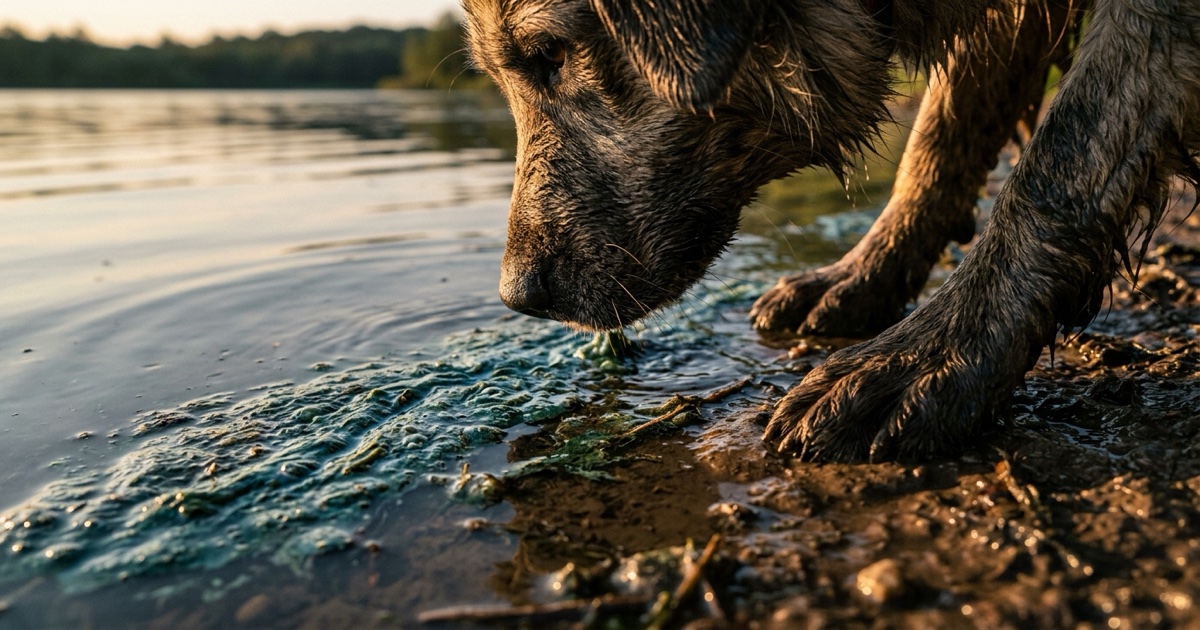
Table of contents
Summary of this article
- CDC states animals can get very sick or die within hours of swallowing cyanobacteria toxins.
- CDC's animal warning signs: vomiting, loss of energy, staggered walking, excessive drooling, difficulty breathing, tremors and seizures.
- EPA's recommended criteria are 8 parts per billion for microcystins and 15 for cylindrospermopsin.
- EPA derived those values from children's recreational exposure. Nothing in the document addresses dogs.
- EPA says the criteria are guidance to states, not regulations themselves.
- Toxins can be elevated before a bloom is visible, and can persist after it is gone.
- Blooms have been reported in ambient waters in every state.
- Poison Control takes calls at 1-800-222-1222, 24 hours a day.
Can blue-green algae kill a dog?
Yes, and fast. CDC says animals can get very sick or die within hours of swallowing toxins made by blue-green algae, and onset runs anywhere from minutes to days.
Read this part before anything else. If your dog swam in scummy water and is now vomiting, drooling or staggering, stop reading and call a vet. Care started soon after exposure saves animals that a wait-and-see evening would not. Poison Control takes calls at 1-800-222-1222, 24 hours a day.
Everything below assumes nobody is sick yet.
Blue-green algae is what all of us call it. Cyanobacteria is the actual organism, an ordinary bacteria living in fresh water almost everywhere, which under a few conditions multiplies into a bloom you can see from the dock.
A fraction of those cells make toxin. Most never do. Nothing on a surface tells you which kind of water your dog jumped into.
Warm still water, hard sun and runoff from farms and lawns are those conditions, and they arrive across most of this country in late summer. Which is also, near enough, the week a dog most wants to swim.
Why does a lake hit a dog harder than it hits you?
Because a dog drinks it. You wade in with your mouth shut and swallow almost nothing. A dog gulps while it swims, and then it does a second thing most of us never picture.
Watch a retriever come up the bank. It shakes, flops onto the warm grass, and starts working through its coat, and it keeps at that for 10 or 15 minutes. Every pass of that tongue moves lake water out of fur and into a stomach.
That’s a second dose. It arrives on your drive home, long after you decided that swim went fine.
Coat length matters more than we find people expect. A short-haired terrier carries less water up a bank than a retriever hauling a soaked undercoat, and spends less time licking it off again.
Dogs also pick the worst water in the lake. Blooms gather where it stands still and warm and shallow, downwind, in that corner where scum piles against the bank and nobody swims. People take one look and walk further along. Dogs go straight in.
Size does the rest. Whatever a mouthful does inside an adult, it does far more inside a body a fraction of that weight, and your dog swallowed more of it than you would have.
Is there a safe algae level for dogs?
No. No federal agency publishes one, and every figure that does exist was built for people. One was built specifically for children.
In May 2019 EPA recommended two figures for recreational water and derived both of them from children’s exposures, on the reasoning that a child takes in more water relative to size than other swimmers do.
| Toxin | Recommended figure | Written to protect |
|---|---|---|
| Microcystins | 8 parts per billion | Children in recreational water |
| Cylindrospermopsin | 15 parts per billion | Children in recreational water |
Look at that last column, because it’s the whole article. A child. Standing in shallow water. Mouth mostly shut.
Two more things sit inside that same document. Those figures go out to states, territories and tribes as advice, and it says so in its own words, that they are not regulations themselves. A state can adopt them, write something of its own, or skip both and post swimming advisories instead.
Nothing in it mentions a dog at all, and that silence says more than another figure would.
So an advisory posted at a boat ramp is doing a real job, and that job is a child in shallow water. Your dog is drinking it, then licking the rest out of its coat in your back seat, at a fraction of that child’s weight. Nobody has ever put a figure on that gap. We looked.
Can you tell by looking?
Not reliably, and this is the part that catches careful people. Toxin can already be high before a bloom is visible at all, and it can hang on after a bloom has faded or drifted downstream. Both of those come off that same document.
Water that looked awful last week and looks lovely today may still be carrying it.
A bloom can look like spilled paint, or pea soup, or blue-green scum streaking a surface. It can also look like grass clippings. Or a brown film. Or very nearly nothing. It can reek, and it can smell of nothing at all.
None of that’s a test. A harmless bloom and a lethal one look identical, because toxin gets made inside cells rather than shown on a surface. We’d love to hand you a color to watch for. Nobody has written one.
Which leaves us with a rule that costs nothing to follow. Scummy, discolored or foul-smelling, and the dog stays out. Bloom reported there this season, dog stays out, even on a clear blue day when it looks like a postcard.
What does poisoning look like in a dog?
Six signs, and a vet will ask about every one of them. CDC lists vomiting, loss of energy, staggered walking, excessive drooling, difficulty breathing, and tremors and seizures.
Two of those get misread constantly. Staggering and drooling look like a dog that overdid it in heat, and a hot dog after a swim is the most ordinary sight of an American summer. Heat sorts itself out in shade with cool water. This does not.
Time beats certainty here. We’d answer a maybe with a phone call rather than an hour of watching, because an hour is a real slice of what you have.
Say out loud that your dog was in fresh water, and say when. Most of these toxins have no antidote, so treatment is supportive care, and it works far better started early. A clinic makes different choices knowing a lake was involved an hour ago.
Call ahead rather than driving over unannounced, and we’d make that call from the car. Staff expecting a possible poisoning case can have things ready before you come through the door with a shaking dog in your arms.
If your regular clinic is shut, that Poison Control line runs 24 hours, and it will tell you which emergency hospital near you handles toxicology.
What do you do the moment the dog gets out?
Rinse it before it starts grooming. That one move interrupts a second dose, and we’d call it the most useful thing available to you in the 10 minutes after a swim.
Bring clean water for the job. Rinsing a coat with more of the same lake accomplishes nothing, and a jug in the trunk covers a medium dog.
Do not let your dog drink from a lake, a pond, a slow river, or a puddle at the edge of any of them. Carry drinking water and offer it every 20 minutes, because a dog that’s not thirsty takes far less interest in whatever stands at its feet.
Then watch. Those six signs, through the rest of that day and overnight, because an evening that starts normally proves nothing at all.
Look up whether your state health department or environmental agency runs a public bloom map, and do it before you drive out rather than after. EPA has blooms on record in ambient water in every state, so “we don’t get those around here” is not true anywhere.
One last habit worth building. Photograph the water before your dog goes in it. If something happens four hours later, that picture is the only evidence anybody will have, and a vet acts on a photograph faster than on your description of a green streak.
And the geography does not narrow it for you. EPA reports harmful algal blooms recorded in ambient waters in every state. Warm shallow water is the condition, and that turns up everywhere for part of the year.
The two numbers that exist, 8 micrograms per liter for microcystins and 15 for cylindrospermopsin, were derived for children swimming. Not for a 30-pound animal drinking the water and licking its coat dry afterwards.
What should you do before the next swim?
You’re left with a judgment call nobody is going to make for you, and that absence is the finding.
8 parts per billion is a real figure, carefully derived, and it protects a swimming child. It is advice to states rather than a rule. And it says nothing at all about a Labrador that drank its fill and then ate the rest off its own back.
We think that argues for one standing rule rather than a fresh call at every lake, because the call gets made at a shoreline, in August, with a wet dog pulling on a leash. Scummy, discolored or foul-smelling water is a no. So is a lake where a bloom was reported this season, even on a clear day.
That rule costs you a few swims between June and September, which is worth knowing before you agree to it. Costs on the other side aren’t symmetrical, and the word for how fast they arrive is hours.
We’re not telling you to keep a dog out of water. We’re telling you to look at the water first, and to rinse the dog before it licks itself dry.
Your dog can’t read a sign at a boat ramp. And nobody wrote that sign with your dog in mind.
Sources
- Centers for Disease Control and Prevention. Symptoms Caused by Freshwater Harmful Algal Blooms (2024)
- U.S. Environmental Protection Agency. Recommended Human Health Recreational Ambient Water Quality Criteria or Swimming Advisories for Microcystins and Cylindrospermopsin (2019) EPA 822-F-19-001
- U.S. Environmental Protection Agency. Recreational Water Quality Criteria and Methods (2026)
Questions people ask
Can blue-green algae kill a dog?
Yes. The CDC states that animals can get very sick or die within hours of swallowing toxins made by cyanobacteria, with onset ranging from minutes to days. Contact a veterinarian immediately if a dog seems sick after being in or near water.
Is there a safe algae level for dogs?
No federal agency publishes one. EPA's recommended recreational criteria of 8 parts per billion for microcystins and 15 for cylindrospermopsin were derived from children's recreational exposures, and the document does not address dogs.
What are the signs of algae poisoning in a dog?
The CDC lists vomiting, loss of energy, staggered walking, excessive drooling, difficulty breathing, and tremors and seizures. Staggering and drooling are the two most often mistaken for heat exhaustion.
Can you tell if water has toxic algae by looking at it?
Not reliably. EPA states toxin concentrations can become elevated before a visible bloom appears, and can persist after the bloom is gone or has moved downstream. A harmless bloom and a lethal one can look identical.
What should I do right after my dog swims in a lake?
Rinse the dog with clean water before it grooms itself, which interrupts a second dose from the coat. Do not let it drink lake water, and watch for the CDC's six signs through the rest of the day and overnight.
Are EPA's algae criteria legally binding?
No. EPA states that water quality criteria recommendations are guidance for states establishing water quality standards and are not regulations themselves. States may adopt different scientifically defensible criteria.
Where do harmful algal blooms occur?
EPA reports that harmful algal blooms have been recorded in ambient waters in every state. They form where elevated nutrients, warmer temperatures, still water and plentiful sunlight come together.

Have questions about the environment inside your home?
Air quality, mold, EMF, light and water all shape how a house feels and how the people in it feel. Whatever your concern is, the first step is finding out what is there.
Our certified team of environmental professionals and advocates can help.