


A crib mattress can give off far more chemicals under a sleeping child
In 25 bedrooms, air sampled inches from a sleeping child contained 31 compounds, more than the room air around it. Older mattresses also gave off more DEHP than newer ones, challenging the idea that hand-me-downs have finished off-gassing.
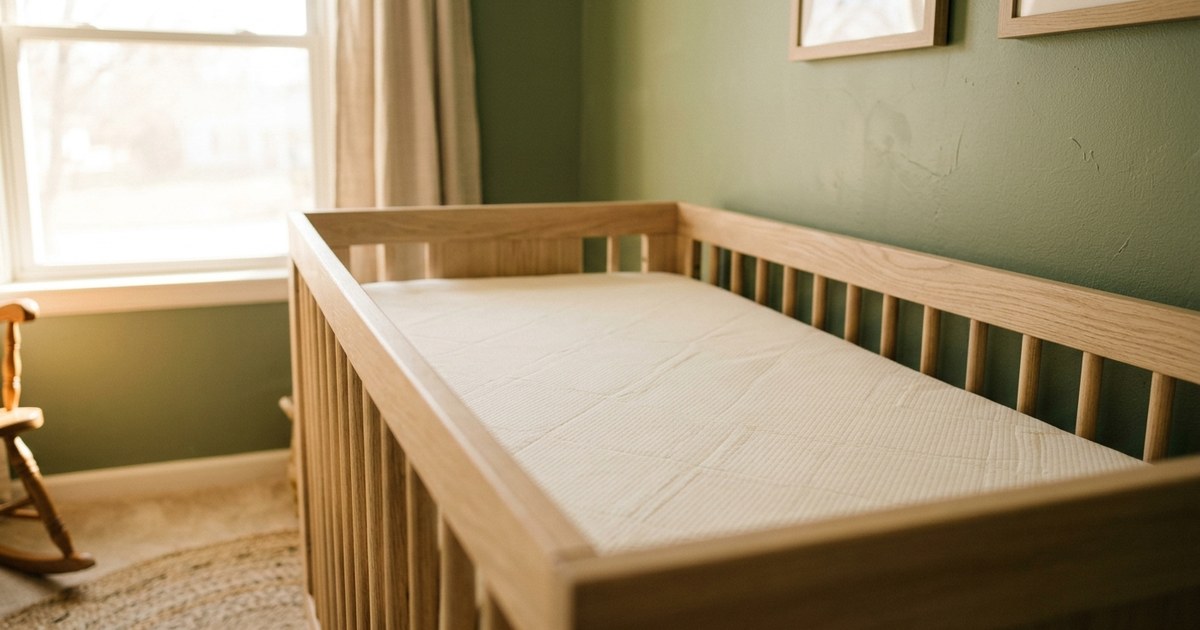
Table of contents
- Body heat is the switch
- The air near a sleeping child is not the air in the room
- Federal rules measure the foam, not the air
- One of the three phthalates found has no US limit at all
- Every mattress in the study was bought in Canada
- What a parent can change this week
- What this evidence does and does not show
Summary of this article
- Researchers tested 8 children's mattresses three ways. Cold, they released 12 compounds. Warmed to body temperature, 20. Warmed with a child's weight on top, 21.
- Across 16 new mattresses, 21 semivolatile compounds were found in four families: ortho-phthalates, organophosphate esters, benzophenones and salicylates.
- In 25 bedrooms, the air within inches of a sleeping child carried 31 compounds, more than the bedroom air at 28 or the mattresses themselves at 30.
- Older mattresses carried more DEHP and benzyl butyl phthalate than newer ones, which undercuts the assumption that a hand-me-down has finished off-gassing.
- Federal rules cap 8 phthalates at 0.1 percent by weight in a crib mattress. Nothing caps what a mattress gives off once it warms.
- 5 of the 16 mattresses carried between 1 and 3 percent organophosphate esters, flame retardants that appear on no list in that rule.
- 5 exceeded 0.1 percent on DiBP, DnOP or DiNP. DnOP carries no US limit at all after a federal panel lifted its interim ban in 2017.
- All 16 mattresses were bought in Canada and all 25 bedrooms were in Toronto and Ottawa. The test has never been repeated on mattresses sold in the United States.
A crib mattress sitting in a shop is chemically quiet. The same mattress under a sleeping child is not. Body heat warms the foam to skin temperature, a small body presses down on it for ten or twelve hours, and the number of compounds coming out of it roughly doubles.
Researchers measured 8 children’s mattresses three separate ways: cold at room temperature, warmed to body temperature, and warmed with a child’s weight on top. Cold, they released 12 compounds. Warmed, 20. Warmed and weighted, 21.
Same mattresses, same room, same air. The only variable was a child lying down.
Here is what the studies found, why federal rules do not cover it, and what a parent can change this week without buying anything.
Body heat is the switch
Every test a mattress goes through before it reaches a shelf is a cold test. Nobody in a showroom warms foam to skin temperature and lies on it until morning, and that is the one condition under which emissions climb.
Across 16 new mattresses, researchers counted 21 semivolatile compounds in four families: ortho-phthalates, organophosphate esters, benzophenones and salicylates. In plain terms, plasticizers, flame retardants and UV filters, in a product built for the person in the house with the least body mass to dilute any of it.
Nobody measured harm. What was measured is that everything known about crib mattress emissions had been learned from foam with nobody sleeping on it.
The air near a sleeping child is not the air in the room
Across 25 bedrooms, with children aged 6 months to 4 years, researchers sampled two things at once: the air in the room, and the pocket of air within inches of the child’s face.
The pocket carried more. Bedroom air held 28 compounds, mattresses themselves held 30, and the air immediately around each sleeping child held 31, the widest range of the three.
That gap matters for anything a parent might try. Airing out a bedroom does not necessarily reach the air a child is actually breathing, because the source lies underneath them rather than around them.
Two findings cut against instinct. Older mattresses carried more DEHP and benzyl butyl phthalate than newer ones, which undercuts the assumption that a hand-me-down has finished off-gassing. And bedding was identified as its own source of the flame retardant TBOEP, wherever the air around a child ran higher than the mattress alone could explain. Sheets, sleep sacks and a pile of soft toys are part of the picture, not just the thing underneath.
Two of the 25 rooms broke the pattern, and the authors reported that rather than smoothing it away.
Federal rules measure the foam, not the air
Federal rules cap 8 phthalates at 0.1 percent by weight in a crib mattress. Nothing caps what a mattress gives off.
The limit applies to any “child care article”, defined as anything a manufacturer intends to help a child under 3 sleep or to feed one. Crib mattresses qualify, and every plasticized component is covered separately so that covers are not treated as something other than what they cover.
The gap is in what the rule counts. It measures content, not emissions. A mattress can come in under 0.1 percent on every listed phthalate and still put 21 compounds into a child’s air once it warms, because the rule was written to answer what is in the foam rather than what leaves it.
Flame retardants show the gap most clearly. Five of the 16 mattresses carried between 1 and 3 percent organophosphate esters by weight. At that concentration they are not a trace, and they appear on no list in the rule.
One of the three phthalates found has no US limit at all
Five of the 16 mattresses came in over 0.1 percent on DiBP, DnOP or DiNP. Two of those three are federally restricted. The third is not, and the reason is a decision rather than an oversight.
DiBP and DiNP are named in federal rules and capped at 0.1 percent in anything built to help a child under 3 sleep. DnOP is not named anywhere. It was covered by an interim ban until a federal advisory panel reviewed it and concluded that “because the MOE in humans are likely to be very high, the CHAP does not find compelling data to justify maintaining the current interim ban on the use of DNOP in children’s toys and child care articles.” The Commission agreed and lifted the ban in 2017.
A label reading “meets all federal standards” cannot distinguish a chemical that passed review from one that was never limited. Nothing on the packaging separates those two cases.
Every mattress in the study was bought in Canada
All 16 mattresses were purchased in Canada, and all 25 bedrooms were in Toronto and Ottawa. That is a real limit on everything above, and it has never been repeated on mattresses bought in the United States.
The physics travel even though the shopping lists do not. Body heat pulls compounds out of warmed foam the same way in Tampa as in Toronto. Which brands, foams and flame retardants reach an American shelf is a separate question, and no published study answers it.
Anyone claiming American crib mattresses are cleaner is guessing. So is anyone claiming they are worse.
What a parent can change this week
The authors of the bedroom study made their own recommendation plainly: limit what goes into a sleeping space, and wash bedding more often than seems necessary.
Both are free, and both target what the measurements actually found. The air nearest a sleeping child carried more than room air, and bedding emitted on its own. Taking soft toys out of a crib and washing sheets more often addresses both, and a lab can detect the change within a week.
Airing a new mattress somewhere warm before it goes into a crib follows the same logic. Warm foam releases more, so releasing it somewhere other than a nursery is the point.
What this evidence does and does not show
Nobody measured harm. What was measured is what comes off warmed foam, and how much of it reaches the air within inches of a sleeping face. What any of it does to a child over years has not been published.
What is established is narrower and still worth knowing. Few objects touch a person for half of every day; a crib mattress does, at an age when the body has the least mass to dilute anything and is developing fastest. Warmed foam releases 21 compounds. The federal rule covering it was written about weight rather than air. And every mattress tested was bought in another country.
That is not an emergency, and it is not nothing. Take the toys out, wash the sheets, air a new mattress somewhere warm first, and read a compliance label as what it is: a statement about content, which is a different thing from a promise about air.
Sources
- Environmental Science & Technology. Are Sleeping Children Exposed to Plasticizers, Flame Retardants, and UV-Filters from Their Mattresses? (2025)
- Environmental Science & Technology Letters. Young Children's Exposure to Chemicals of Concern in Their Sleeping Environment: An In-Home Study (2025)
- CPSC. 16 CFR 1307, Prohibition of Children's Toys and Child Care Articles Containing Specified Phthalates (2026)
- CPSC. Final rule, 82 FR 49938, lifting the interim prohibition on DnOP (2017)
Questions people ask
Do crib mattresses release chemicals?
Yes, and body heat increases it. Researchers measured 8 children's mattresses cold, warmed to body temperature, and warmed with a child's weight on top. Emissions went from 12 compounds to 20 to 21 across those three conditions.
Why does body heat matter?
Every test a mattress goes through before it reaches a shelf is a cold test. Warming foam to skin temperature is the one condition under which emissions climb, and it is the condition a mattress is actually used in.
Is the air near a sleeping child different from the room air?
Yes. Across 25 bedrooms, the air within inches of a sleeping child carried 31 compounds, against 28 in the bedroom air. Airing out a room does not necessarily reach the air a child is breathing, because the source lies underneath them.
Are older mattresses safer because they have off-gassed?
The measurements say the opposite. Older mattresses in the study carried more DEHP and benzyl butyl phthalate than newer ones.
Do federal rules limit this?
Only partly. Federal rules cap 8 phthalates at 0.1 percent by weight in any article intended to help a child under 3 sleep. That measures what is in the foam. No rule limits what a mattress emits.
Which chemicals found are not restricted?
DnOP. It was covered by an interim ban until a federal advisory panel found no compelling data to maintain it, and the Commission lifted the ban in 2017. DiBP and DiNP remain capped at 0.1 percent.
Were these mattresses sold in the United States?
No. All 16 mattresses were bought in Canada and all 25 bedrooms were in Toronto and Ottawa. No published study has repeated the work on mattresses sold in the US.
What can a parent do this week?
The study authors recommend limiting what goes into a sleeping space and washing bedding more often than seems necessary. Both are free, both target what the measurements found, and a lab can detect the change within a week.
Have questions about the environment inside your home?
Air quality, mold, EMF, light and water all shape how a house feels and how the people in it feel. Whatever your concern is, the first step is finding out what is there.
Our certified team of environmental professionals and advocates can help.