


Your Air Purifier Cleans Most of Your Living Space, Except for Colds
An air purifier is a particle machine. It works on cooking smoke, wildfire haze, pollen and dust, and one trial across 91 care homes found it does nothing at all about a cold.
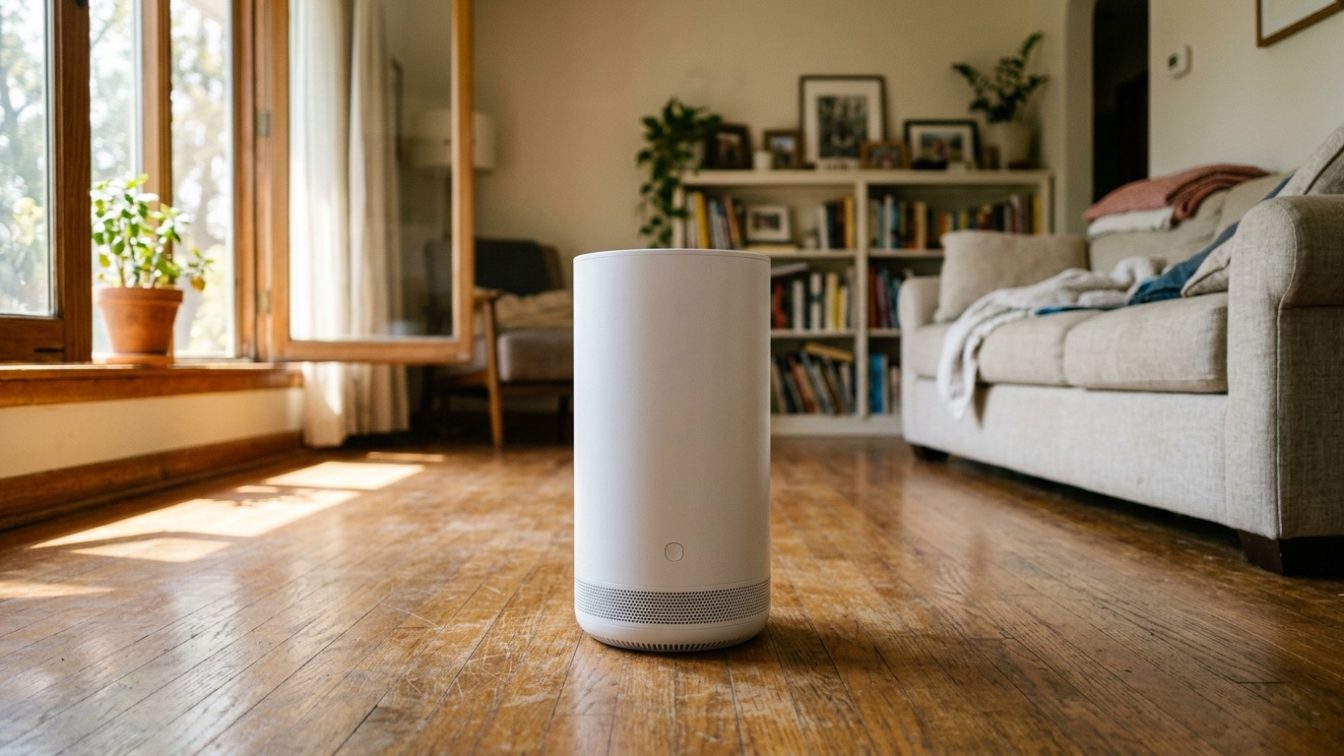
Table of contents
- What does an air purifier do for you?
- Does it help with allergies or asthma?
- Will it stop your household catching colds?
- Why doesn’t cleaner air stop a cold?
- Does it remove smells, fumes or radon?
- What size do you need for the room it runs in?
- Where should it go?
- What cleans your air more than any machine?
Summary of this article
- A HEPA filter pulls particles out of the air that passes through it. EPA reports small improvements in cardiovascular and respiratory health across studies using portable units.
- Allergy and asthma symptoms are the strongest case for owning one. EPA cites multiple studies finding improvement in one or more symptoms.
- Colds are the job it cannot do. Across 91 English care homes and 1,158 residents, infections ran 0.99 per resident with filters against 1.04 without, and every secondary outcome came back level.
- The machines were running. A separate paper found high adherence and stated the null was not caused by poor adherence.
- A filter improves a whole room over an hour. A cold crosses three feet of table in a second, which is why the two never meet.
- Gases are outside its job. EPA notes most units are designed to handle either particles or gases, so radon, combustion gases and fresh paint need a different answer.
- Size it by CADR for the room it runs in, put it where you spend the most time, and keep the airflow clear.
- Order matters more than hardware. EPA puts source removal first, ventilation second, filtration as a supplement to both.
Somebody in your house is coughing, and there is a machine in your bedroom that cost two hundred dollars and promises clean air.
Fair to ask what it is doing for you tonight. The answer is better than the box promises in one place and worse in another, and both halves have now been measured.
What does an air purifier do for you?
It pulls fine particles out of whatever air passes through it. EPA reports small improvements in cardiovascular and respiratory health across studies using portable HEPA air cleaners.
Think about what your house makes in an ordinary evening. Frying throws fine particles straight into your kitchen. Wood stoves leak them. Candles make them. Vacuuming without a sealed bag lifts what was lying on your carpet and puts it back into your air. Wildfire haze from three states away gets in through every gap in your walls, and your house has no way of pushing it back out.
All of that drifts. Drifting is the one thing a fan in the corner can work with, because sooner or later that air comes past the machine and goes through the filter.
So the honest version of this question splits in two. Your machine has jobs it does quietly and well, and one job it was never built for, and no box separates them for you.
A filter catches what floats. That’s the whole mechanism, and it’s enough to matter.
Does it help with allergies or asthma?
Yes, and this is the strongest claim anybody can make for one. EPA’s guide is unambiguous: multiple studies with portable HEPA air cleaners have found improvements in one or more allergy or asthma symptoms.
Pollen, dust, dander from your cat. Every one of those is a particle, every one drifts, and every one goes past your machine sooner or later.
Nobody is describing a cure. Symptoms improved. That is worth the shelf space to anybody who wakes up congested every March.
Bedrooms are where this pays. You spend eight unbroken hours in one room with the door shut, breathing the same air over and over, and a machine gets all night to work on a small sealed volume. A living room with a door open onto a hallway gives it a harder problem and more of it.
Buy one for a nose that runs every spring and you’re buying the thing it was built for.
Will it stop your household catching colds?
No. JAMA Internal Medicine published that answer in July 2026, from a trial called AFRI-c. Portable HEPA units went into 91 care homes across England for one winter each, 1,158 residents were followed from 2021 to 2024, and infections ran 0.99 per resident against 1.04 in the rooms with no machine.
That ratio is 0.92, and the interval around it stretches from 0.64 to 1.33. So a real benefit of about a third isn’t ruled out here, and neither is a harm of about a third. What is ruled out is the large obvious effect somebody buys a machine hoping for.
Everything else the University of Bristol team looked at came back level too. Staff sickness, antibiotic prescriptions, hospital stays, falls. Anything that works shows up somewhere on a list that long. Nothing showed up.
| Allergies, dust and smoke | Colds and flu | |
|---|---|---|
| What moves | particles drifting in room air | somebody talking three feet away |
| Evidence | the symptom studies EPA cites | 91 care homes, 1,158 residents, no difference |
| Your machine | doing its job | never in the conversation |
One escape from that result was closed before anybody could reach for it. Filters only work while switched on, so the first question about any null is whether the machines were running. A second paper in PLOS ONE followed that up and found high adherence, low contamination between groups, and said plainly that the null wasn’t caused by poor adherence.
We read that one twice, because it’s the part everybody skips.
The machines ran, and it made no difference to who got sick.
Why doesn’t cleaner air stop a cold?
Because a filter improves your whole room slowly, and catching something happens between two faces in about a second.
Picture your kitchen table. Air gets drawn in at one corner of the room, cleaned, pushed back out, and given an hour that room genuinely improves. Meanwhile somebody across the table coughs, and what leaves their mouth reaches you long before the fan in the corner has moved that air anywhere.
Averages are what machines improve. Catching something happens in moments and inches that no average describes.
Which is why AFRI-c surprised nobody who works on ventilation and startles everybody who owns a purifier. Two mental models of what the air in a room is doing. One of them survives 91 buildings.
One limit belongs here, and it comes from those researchers rather than from us. Infections were logged by care home staff during working days, and the authors wrote that their approach to collecting data may have under-reported mild infections. It doesn’t rescue the machines. It’s the honest edge of what a trial run inside working buildings can see.
Distance and seconds beat any machine on a timer.
Does it remove smells, fumes or radon?
Not unless it was built to, and most weren’t. EPA’s guide notes that most units are designed to handle either particles or gases.
This is where people feel cheated a year in. Gas ranges put combustion gases into a kitchen. Fresh paint and new furniture give off compounds for months. Radon rises through your foundation. None of those is a particle. HEPA catches particles.
Some machines carry a second bed of activated carbon for gases, and where yours does, that bed is the part with a service life nobody prints on the housing, loading up quietly through a whole year of cooking while the fan noise never changes. The beds are thin. You will never be told the day one stopped working.
Nobody has written a rule for the air inside your house, either. EPA’s outdoor figures, 9.0 micrograms per cubic meter across a year and 35 across a day, get quoted like household advice. Both were written for outdoor air across whole regions and are enforced against states. Your bedroom is not a state.
Read the box for what it filters, and assume it does nothing about gases unless it says so.
What size do you need for the room it runs in?
Big enough for that room, and EPA makes it the first decision: pick a portable air cleaner with a clean air delivery rate large enough for the size of the room or area where you’ll use it.
The higher that rate, the more it can pull out of your air and the larger the space it can serve. It’s printed on the box as CADR, the Clean Air Delivery Rate, in three numbers for smoke and dust and pollen.
Most disappointment starts here. A unit sized for a nursery gets carried into an open-plan living room, where it runs all day and turns over a fraction of the air in it. Nothing was wrong with the machine.
Measure the room before you shop. Floor area times ceiling height gives you the volume every seller is quietly assuming, and that assumption is eight feet. Plenty of American houses run nine or ten.
One right-sized unit in your bedroom beats three small ones spread around your house.
Where should it go?
EPA’s answer is the room you spend the most time in, with nothing blocking the airflow. Moving a machine two feet costs you nothing at all, and it buys more clean air than the next hundred dollars of purchase price would.
Bedrooms first, for the same reason they came first for allergies. Eight unbroken hours in one room is the longest stretch anybody spends anywhere, and a door closed from eleven until seven is the easiest room in your house to get clean.
Then leave it alone. Not behind a sofa, not in an alcove, not tucked into a cupboard with the door half shut. Air has to reach the intake and leave the outlet, and furniture pressed against either one turns a working machine into expensive noise.
Height matters less than people think. Clearance matters more. Give it a foot on every side, keep the intake facing the room rather than a wall, and stop worrying about the rest. A machine on the floor beside your bed with two feet of open air around it beats a better machine wedged into a bookcase.
Where it stands matters more than what it cost.
What cleans your air more than any machine?
Take the source out, then open a window. EPA is direct about the order: reduce or remove the sources of pollutants, ventilate with clean outdoor air, then treat filtration as a supplement to both.
Ventilation and filtration get sold as one idea and behave nothing alike. A window takes what is in your room out of the building. A filter takes that same air round a loop and hands it back cleaner. One removes, one polishes.
So run the hood over your range every time you cook, on high, and leave it going a few minutes after. Crack something open on the far side of the house while you do. Then filter, in whichever room your particles are made.
Where your worry is a specific gas rather than dust, no appliance answers it and no phone app does either. Radon and combustion gases need measuring in your own rooms, over days, with instruments nobody keeps in a kitchen drawer. That’s the point where it’s worth having your house measured rather than shopping for another machine.
Remove it, air it, then filter it. Buy the machine for particles, run it where you sleep, and stop asking it to catch a cold that crosses your table faster than your fan can turn.
Sources
- US EPA. Guide to Air Cleaners in the Home (2026)
- US EPA. Air Cleaners and Air Filters in the Home (2026)
- JAMA Internal Medicine. High-Efficiency Particulate Air Filters to Prevent Winter Respiratory Infections in Care Homes: The AFRI-c Cluster Randomized Clinical Trial (2026)
- PLOS ONE. Implementation and acceptability of high efficiency particulate air filters to reduce respiratory infections in care homes: process evaluation of the AFRI-c trial (2026)
- University of Bristol. Portable air filters do not reduce infections in care homes (2026)
Questions people ask
What does an air purifier actually do?
It pulls fine particles out of the air that passes through it. EPA reports small improvements in cardiovascular and respiratory health across studies using portable HEPA air cleaners. Cooking smoke, wood stove smoke, wildfire haze, pollen and dust are all particles, and all of them drift.
Do air purifiers help with allergies or asthma?
Yes, and it is the strongest case for owning one. EPA's guide says multiple studies with portable HEPA air cleaners have found improvements in one or more allergy or asthma symptoms. Nobody is describing a cure, and symptom relief is a real result.
Do air purifiers stop you catching colds?
No. Portable HEPA filters went into 91 care homes across England for a winter each, 1,158 residents were followed, and infections ran 0.99 per resident against 1.04 with no filter. The ratio was 0.92 and the interval ran 0.64 to 1.33, so the large obvious benefit is ruled out.
Were the filters actually switched on during that trial?
Yes, and the researchers checked. A separate process evaluation reported high adherence, low contamination between groups, and stated that the null result was not due to poor adherence. The machines ran and it made no difference to who got sick.
Why does clean room air not stop a cold?
Because the two work on different scales. A filter improves a whole room over an hour, while catching something happens between two faces about three feet apart in a second. Averages are what a machine improves, and infection happens in moments no average describes.
Will an air purifier remove radon, gas smells or fumes?
Not unless it was built for it, and most were not. EPA notes that most units are designed to filter either particles or gases. Radon is a gas, combustion gases from a range are gases, and a HEPA element does nothing to any of them.
What size air purifier do I need, and where should it go?
EPA says to pick a clean air delivery rate large enough for the room where you will use it, and to place the unit in the room you spend the most time in with the airflow unobstructed. Bedrooms first, because eight unbroken hours behind a closed door is the easiest air in the house to clean.
Have questions about the environment inside your home?
Air quality, mold, EMF, light and water all shape how a house feels and how the people in it feel. Whatever your concern is, the first step is finding out what is there.
Our certified team of environmental professionals and advocates can help.