


A Working Cattle Ranch Just Became Part of Florida’s Wildlife Highway
The easement cost about $6 million, most of it from Florida's Rural and Family Lands program, with $2 million from an Air Force readiness fund. It permanently blocks development.
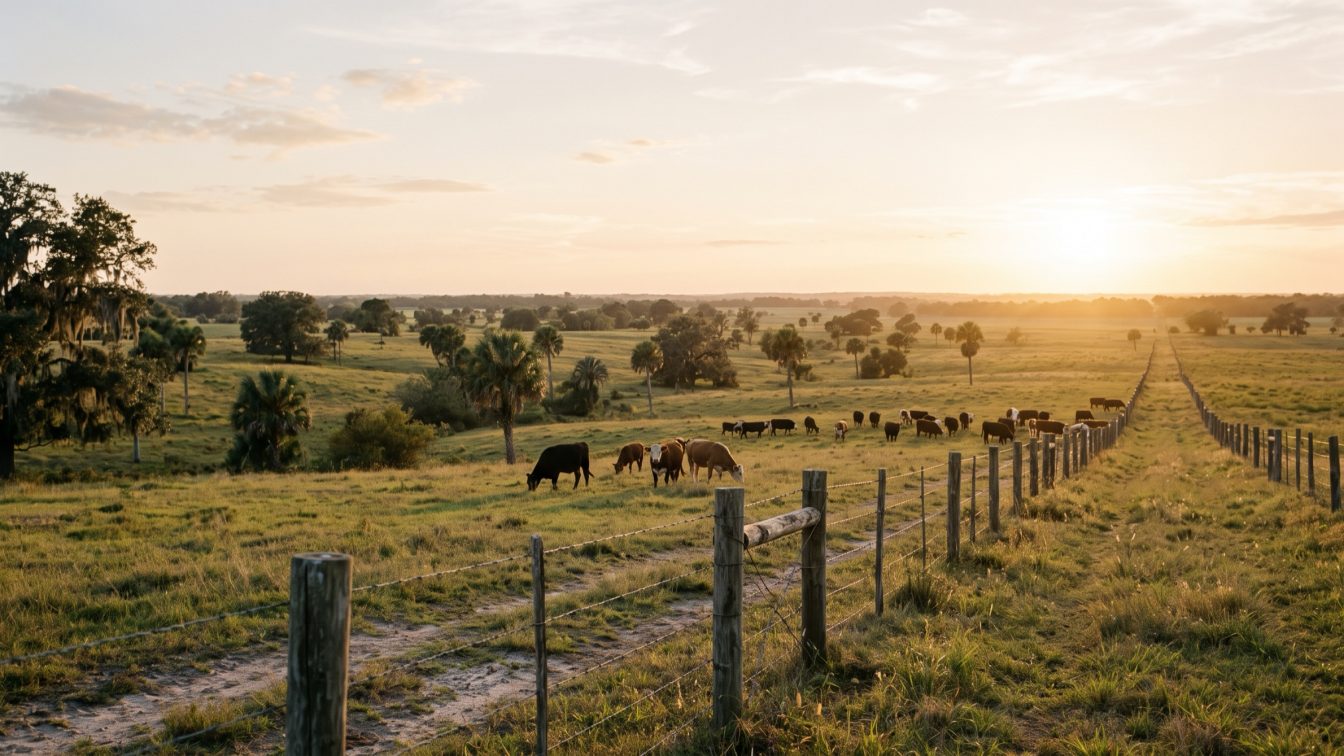
Table of contents
- A conservation easement keeps land in private hands and takes development off the table
- A wide-ranging cat cannot live on one deeded parcel
- Connection matters more than total acreage
- The Florida Wildlife Corridor spans 18 million acres, and most of it still needs protecting
- Keeping the ranch a ranch is the strategy, not the compromise
Summary of this article
- Conservation Florida helped protect Square One Ranch, a 1,564-acre family-owned cattle ranch in Highlands County, adding it to the Florida Wildlife Corridor through a voluntary conservation easement.
- The easement was funded with about $6 million: $4.1 million from Florida's Rural and Family Lands Protection Program and $2 million from the U.S. Air Force's Readiness and Environmental Protection Integration (REPI) program.
- In exchange, the family agreed to never develop the property, keeping it as working ranchland and wildlife habitat permanently.
- Square One Ranch is adjacent to AP Ranch, which Conservation Florida protected in 2024. Together they form more than 2,500 acres of continuous corridor, next to Archibald Biological Station.
- The Florida Wildlife Corridor spans roughly 18 million acres, stretching from the Everglades to Georgia and Alabama, but only 10 million acres are officially conserved.
- That leaves 7 to 8 million acres still unprotected and open to development, according to Conservation Florida president and CEO Traci Deen.
- The corridor functions as a "green highway" that Florida panthers, black bears, bobcats, and other wildlife use to travel, hunt, mate, and raise young.
- Protecting connected land reduces habitat fragmentation, the leading pressure on the endangered Florida panther.
A family cattle ranch in Highlands County will never see a subdivision, a strip mall, or a warehouse. Its owners agreed to a permanent conservation easement, a deal that keeps the land in agriculture forever in exchange for payment now. The 1,564 acres involved are modest next to the roughly 18 million acres that make up the Florida Wildlife Corridor, the state’s connected chain of wild and working land running from the Everglades up to the Georgia and Alabama lines. But this parcel, called Square One Ranch, does something more valuable than its size suggests. It closes a gap next to another protected ranch, and together the two properties form over 2,500 unbroken acres that a Florida panther, a black bear, or a bobcat can cross without meeting a fence, a road, or a rooftop.
A conservation easement keeps land in private hands and takes development off the table
A conservation easement is not a sale of the property. The family that owns Square One Ranch keeps the deed, keeps the cattle, and keeps working the land. What they gave up, permanently and by their own choice, is the right to develop it. That restriction is recorded against the land itself, so it binds every future owner, not just the family that signed it. In return for that permanent restriction, the ranch received roughly six million dollars in public funding. Florida’s Rural and Family Lands Protection Program contributed $4.1 million, and the U.S. Air Force’s Readiness and Environmental Protection Integration Program contributed $2 million. Conservation Florida, the nonprofit that negotiated the deal, calls it a voluntary easement, and voluntary is the operative word. Nobody was forced to sell a future they had not yet decided to give up.
A wide-ranging cat cannot live on one deeded parcel
The Florida panther does not stay put. Neither does a black bear or a bobcat. These animals move across large stretches of land to hunt, to mate, and to raise young, and a single ranch, however well protected, cannot hold that movement on its own. Traci Deen, president and CEO of Conservation Florida, described the broader corridor this way: “It is sort of a green highway, if you will, throughout our state that wildlife use to roam.” Protecting Square One Ranch does not create habitat out of nothing. It preserves a stretch of a route that animals already use, and it keeps that stretch open at the exact moment when the land around it is filling in with houses and pavement.
Connection matters more than total acreage
Here is where acreage alone misleads a reasonable homeowner into thinking bigger always means better. It does not. A wildlife corridor behaves something like a vein. Blood does not need every inch of that vein to be wide. It needs the vein to be open along its entire length, because a single blockage partway through can choke flow to everything downstream, no matter how healthy the rest of the vessel is. A wildlife corridor works the same way. One developed parcel in the wrong spot can sever a route that took decades to protect on either side of it. Square One Ranch matters because of where it sits, not only how large it is. Deen called it “a critical connector piece in that corridor landscape.” It connects north to existing easements, and it sits directly beside AP Ranch, another working cattle operation that Conservation Florida protected in 2024. The two ranches together form that 2,500-acre stretch of continuous corridor, and both sit adjacent to Archibald Biological Station, a research property already dedicated to conservation.
The Florida Wildlife Corridor spans 18 million acres, and most of it still needs protecting
The Florida Wildlife Corridor is not a single trail or a park. It is the entire network of connected public and private land that lets wildlife, and the natural systems tied to green space and water quality, move the length of the state. Of the corridor’s roughly 18 million acres, only 10 million are currently under some form of official protection. The remaining acreage is not lost. It is simply unprotected, which means it remains one purchase or one rezoning away from breaking the chain. Deen put a number on what is left: “We’ve got about 7 to 8 million acres left that are opportunities.” She described the overall effort plainly: “Truly, it’s acre by acre that we’re working to conserve Florida, and it’s a mission we’re really proud of.” At the current pace, a deal the size of Square One Ranch would need to happen roughly twenty more times to close that gap.
Keeping the ranch a ranch is the strategy, not the compromise
A reasonable homeowner might assume that protecting land for wildlife means removing people from it entirely. Square One Ranch argues the opposite. Cattle pasture stays open. Grass grows, cows graze, and a panther can still cross the property at night without encountering a structure. A subdivision cannot offer that. Once pavement and rooflines cover a parcel, the corridor is severed there permanently, regardless of what conservation happens on either side. A conservation easement on working ranchland accomplishes two things a straight land purchase for a nature preserve cannot always manage on the same budget. It keeps a family in business, and it keeps the ground itself in the condition wildlife already depend on. That is the actual strategy behind deals like this one: agriculture and habitat are not opposing uses of the same acre. They can be the same acre, held by the same family, for as long as that family wants to ranch it.
Sources
Questions people ask
What is a conservation easement, exactly?
It is a voluntary, legally binding agreement in which a landowner keeps ownership of the property but permanently gives up the right to develop it. The restriction is recorded against the land and applies to all future owners, not just the family that signs the original agreement.
Does the family still own and operate Square One Ranch?
Yes. The easement did not transfer ownership. The family retains the deed and continues running cattle on the property. What changed is that the land can never legally become anything other than agricultural or conserved open space.
How much of the Florida Wildlife Corridor is currently protected?
About 10 million of the corridor's roughly 18 million total acres are officially conserved, according to Conservation Florida. The remaining 7 to 8 million acres are described by the organization as opportunities still open for protection.
Why did a U.S. Air Force program help pay for a cattle ranch easement?
The article that documents this deal reports that the Air Force's Readiness and Environmental Protection Integration Program contributed $2 million, alongside $4.1 million from Florida's Rural and Family Lands Protection Program. The source does not explain the Air Force program's rationale for participating, so I will not guess at it here.
Can Square One Ranch be developed in the future if the family sells it?
No. A conservation easement runs with the land, not with the current owner. Any future buyer inherits the same restriction against development.
Have questions about the environment inside your home?
Air quality, mold, EMF, light and water all shape how a house feels and how the people in it feel. Whatever your concern is, the first step is finding out what is there.
Our certified team of environmental professionals and advocates can help.