


Wild pigs cost U.S. farmers up to $3.4 billion a year
USDA says the damage runs from $2.5 billion to $3.4 billion once crop losses and other property damage are counted. The strongest drops came when neighboring landowners trapped pigs together instead of one farm at a time.
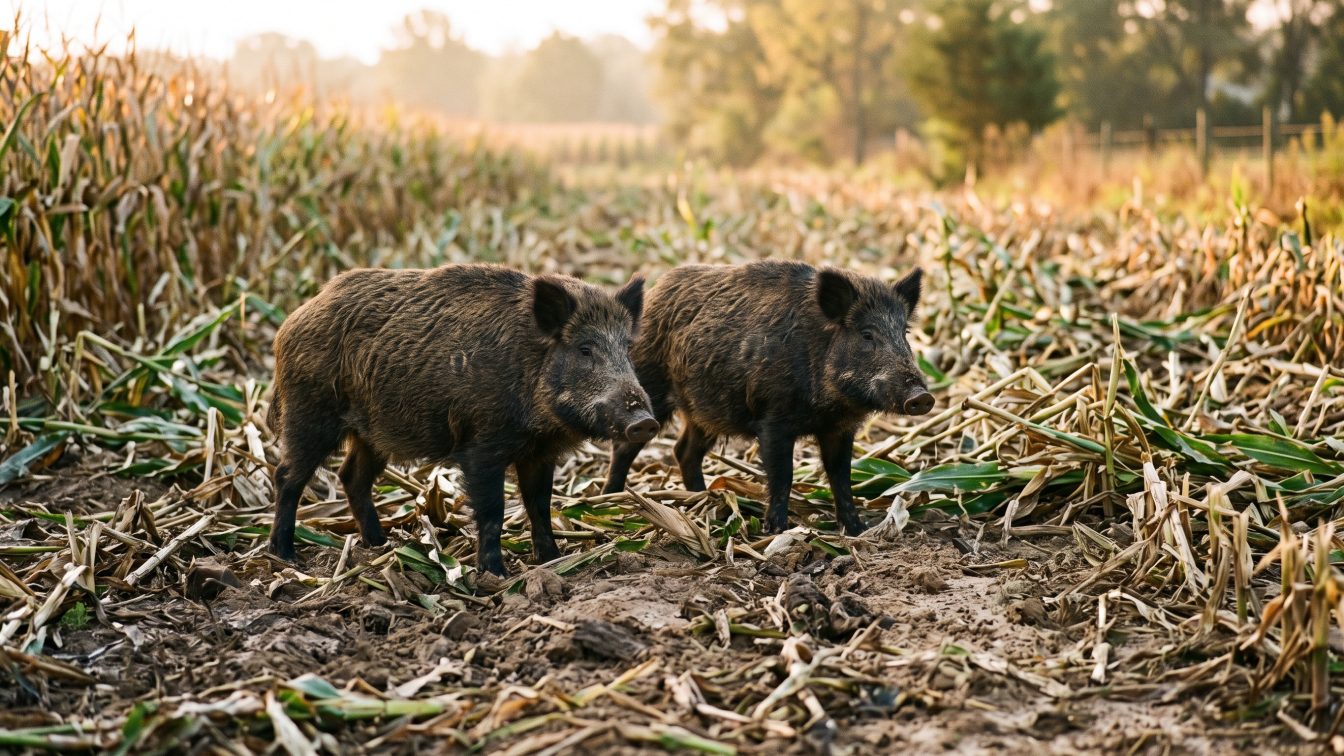
Table of contents
Summary of this article
- Feral hogs cause an estimated $2.5 billion to $3.4 billion in property damage each year in the U.S., including more than $800 million in crop losses, according to USDA figures cited by The Conversation.
- Coordinated trapping produced a dramatic, measurable result. In counties where neighboring landowners worked together, crop insurance claims for corn damage dropped from an average of 70 acres per policy to just 10 acres, a statistically significant reduction.
- The core problem is the escape pathway. Because feral hogs roam across many privately owned properties, trapping on one parcel alone just pushes them next door. Only coordinated, cross-property control removes them at the source.
- The scale is enormous and growing fast. An estimated 7 million feral pigs roam at least 35 states; they breed year-round and populations can double in just four months.
- Federal funding is expanding. A $75 million pilot under the 2018 Farm Bill received a $105 million extension through 2029, with researchers recommending a focus on corn-producing counties and stronger landowner outreach.
Somewhere in America right now, a herd of feral hogs is rooting through a cornfield, tearing up soil, snapping stalks, and turning a season’s work into muddy wreckage. By morning, they’ll be gone, likely onto a neighbor’s land, where they’ll do it all over again.
Multiply that scene across at least 35 states and roughly 7 million wild pigs, and you get a staggering price tag: between $2.5 billion and $3.4 billion in damage every year, according to U.S. Department of Agriculture estimates cited by The Conversation. But new research points to a strategy that’s actually working, and it hinges on a simple, powerful idea: neighbors acting together.
If you eat food grown in this country, care about land and water health, or worry about the resilience of our food supply, this matters to you. And the fix follows a core building-biology principle: you can’t solve a problem by chasing its symptoms. You have to control it at the source and close the pathway it uses to spread.
The scale of the problem
Feral swine are not a minor nuisance. They’re one of the most destructive invasive animals in the country, and their numbers tell the story.
An estimated 7 million feral pigs roam at least 35 states. That figure comes from 2016 data, the most recent available, and the true number today is likely much higher. Here’s why: feral hogs breed year-round, and each year a female can produce up to two litters of four to 12 piglets. Whole populations have been estimated to double in as little as four months.
That reproductive speed is the engine behind the damage. A problem that can double in a single season doesn’t wait for you to get around to it. It compounds.
The exposure pathways: how hogs cause harm
In building biology, an “exposure pathway” is the route by which harm reaches the thing you’re trying to protect. Feral hogs don’t have just one pathway, they have several, hitting multiple systems at once.
Crop destruction does the headline damage. Hogs cause more than $800 million in crop losses each year, with corn the single most commonly damaged crop. They eat, then trample, uproot and churn fields into unusable ground.
Disease spread to livestock. Feral hogs carry and transmit diseases to farm animals. A wild herd moving through a property can expose a rancher’s cattle or pigs to illness, turning a wildlife problem into an animal-health crisis.
Water quality degradation. When hogs root through land and wallow in streams and ponds, they stir up sediment, erode banks, and foul water. That degraded water then affects wildlife, livestock, and the people downstream.
Fence and infrastructure damage. Hogs tear up the fences and roads that farms depend on to operate. Every broken fence is a repair cost and another gap for livestock to wander through or predators to enter.
Environmental and habitat damage. Beyond farms, feral swine wreck wildlife habitats, damage recreational parks, and disrupt native plant ecosystems.
Each pathway is a separate route of harm, and together they explain how a single invasive animal racks up billions in costs. Protecting against feral hogs means blocking these pathways, and every one of them traces back to the same origin: hogs roaming freely across the landscape.
Why trapping one field doesn’t work
Here’s the frustrating part that makes feral hogs so hard to beat. They roam across large areas of privately owned land, paying no attention to property lines.
That creates a trap of its own. If one landowner spends the time and money to trap and remove hogs, but the neighbors don’t, the pigs simply relocate, and then drift right back once the pressure lifts. The individual effort accomplishes almost nothing.
Economists have a name for what happens next: the free-rider problem. Basic economic theory predicts that each landowner will wait for someone else to shoulder the cost of control, hoping to benefit without paying. When everyone reasons that way, nobody acts, and the hogs keep multiplying. The problem grows precisely because the rational move for any single person is to do nothing.
From a building-biology standpoint, that is the heart of it. Trapping one property treats a symptom. It moves the problem around without removing its source. As long as there’s open, uncontrolled land next door, the escape pathway stays wide open and the hogs keep coming back.
The source-control fix: coordinated trapping
The solution is to close that pathway across the whole landscape at once. Instead of one farmer trapping in isolation, neighboring landowners coordinate, trapping across property lines so the hogs have nowhere to slip away to.
That’s genuine source control. You’re not chasing hogs from field to field; you’re removing them from an entire area before they can relocate and rebuild. When the surrounding land is under coordinated pressure, the escape route disappears, and trapping actually reduces the population instead of just shuffling it.
A federal program set out to test exactly that. In the 2018 Farm Bill, Congress committed $75 million to encourage private landowners to step up together against feral hogs. Starting in 2020, the USDA funded landowners’ purchases of trapping equipment, on-farm trapping efforts, and restoration of land the hogs had damaged. The pilot ran in selected counties across 10 hard-hit states: Alabama, Arkansas, Florida, Georgia, Louisiana, Mississippi, North Carolina, Oklahoma, South Carolina, and Texas.
The measurable result
The most convincing part of this story is a number.
A research team of agricultural economists at the University of Tennessee and the University of Arkansas evaluated the program using federal crop insurance data. They compared crop damage in counties where the coordinated program was active against counties where it wasn’t, both before and after the effort began.
The difference in cornfields was striking. Among counties reporting wildlife crop damage, those without the coordinated program had crop insurance claims for corn damage averaging 70 acres per policy. In counties where hog eradication was coordinated, that average dropped to just 10 acres per policy, roughly an 85% reduction, and a statistically significant one.
That’s a measurable threshold that proves the principle. Close the escape pathway across property lines, and the damage doesn’t just shift, it falls dramatically. Given the scale of corn production across the study region, a drop from 70 to 10 acres per policy represents a meaningful rescue of both crops and money.
The researchers found no significant difference for soybeans, wheat, cotton, and peanuts, likely because corn is the crop hogs damage most. The clearest win showed up exactly where the hogs concentrate their appetite.
There’s good reason to think the study even understates the benefit. Some farmers absorb damage too minor to file an insurance claim, so those losses never enter the data. And the analysis didn’t measure reductions in non-crop damage, the fences, roads, livestock disease, parks, and water quality that hogs also harm. The real payoff is almost certainly larger than the numbers show.
Where this is headed
Evidence was strong enough to keep the investment going. The pilot, originally slated to end in 2023, received $105 million more to spend through 2029. Grant applications are now open for the first $35 million of that funding, and a Farm Bill moving through Congress would add $150 million more and extend the effort through 2031.
The research also points to how to spend it well. Because the corn result was the clear winner, focusing efforts on corn-producing counties could yield more damage reduction per dollar. And because the pilot launched during the COVID-19 pandemic, which shut down the community meetings and public outreach that build participation, there’s likely untapped potential in simply getting more neighbors to join in. Coordination only works when enough people coordinate.
No one expects to eradicate feral hogs entirely; they’re too widespread and reproduce too fast. But the data makes one thing clear: with the right design and sustained investment, coordinated control can make a real difference for farmers and the land.
What one landowner can do about a neighbor’s hogs
You may not own a cornfield, but the lesson here reaches well beyond agriculture.
Support coordinated, source-level solutions. The takeaway from the hog program is that shared problems need shared responses. Whether it’s invasive species, water quality, or land health, fixes that close the pathway across a whole area beat scattered individual efforts every time.
Understand the free-rider trap. Many environmental problems stall because everyone waits for someone else to act. Recognizing that pattern, and backing programs and policies that fund collective action, is how communities break the deadlock.
If you own or manage land, don’t go it alone. Talk to your neighbors and local extension office about coordinated control. A trap on your property alone just relocates the problem; a coordinated effort removes it.
Value the food-security payoff. Every acre of corn saved is food that stays in the supply and money that stays with farmers. Reducing hog damage strengthens the resilience of the whole system you depend on.
Feral hogs are a hard, fast-breeding, billion-dollar problem. But the research delivers a genuinely hopeful message: when neighbors stop waiting on each other and act together, they close the pathway the hogs exploit, and the damage drops from 70 acres to 10. That’s source control in action, and it’s the difference between chasing the problem forever and actually shrinking it.
Sources
- The Conversation. Controlling wild pigs can work if it's a group effort (2026) (August 2026):
Questions people ask
How much damage do feral hogs cause in the U.S.?
The USDA estimates feral hogs cause between $2.5 billion and $3.4 billion in property damage each year, according to The Conversation. That includes more than $800 million in crop losses, plus damage to fences, roads, livestock, parks, water quality, and wildlife habitat.
How many feral pigs are there, and how fast do they spread?
An estimated 7 million feral pigs roam at least 35 states, based on 2016 data, and the number is likely higher today. They breed year-round, producing up to two litters of four to 12 piglets a year, and populations can double in as little as four months.
Why is trapping feral hogs on one property not enough?
Feral hogs roam across large areas of privately owned land and ignore property lines. If one landowner traps them but neighbors don't, the hogs simply move next door and return later. This is a version of the free-rider problem, where everyone waits for someone else to act, so nobody does and the hogs keep multiplying.
How well does coordinated trapping work?
Very well, according to research from the University of Tennessee and University of Arkansas. In counties where landowners coordinated hog control, crop insurance claims for corn damage dropped from an average of 70 acres per policy to just 10 acres, a statistically significant reduction of roughly 85%.
What is the federal government doing about feral hogs?
The 2018 Farm Bill funded a $75 million pilot program across 10 states, starting in 2020, that paid for trapping equipment, on-farm trapping, and land restoration. It received a $105 million extension through 2029, and pending legislation would add $150 million more and extend it through 2031.
Which crop is most affected by feral hogs?
Corn is the crop most commonly damaged by feral swine. That's likely why the coordinated program showed a statistically significant reduction in corn damage but no significant difference for soybeans, wheat, cotton, and peanuts. Researchers suggest focusing future efforts on corn-producing counties for the biggest return.
Have questions about the environment inside your home?
Air quality, mold, EMF, light and water all shape how a house feels and how the people in it feel. Whatever your concern is, the first step is finding out what is there.
Our certified team of environmental professionals and advocates can help.