


Avoiding plastic for a week cut some chemicals in urine by a third
In a 7-day randomized trial, 3 chemicals fell by a third or more when adults ate from a supply chain built to avoid plastic. One chemical didn't move, and the control group went up.
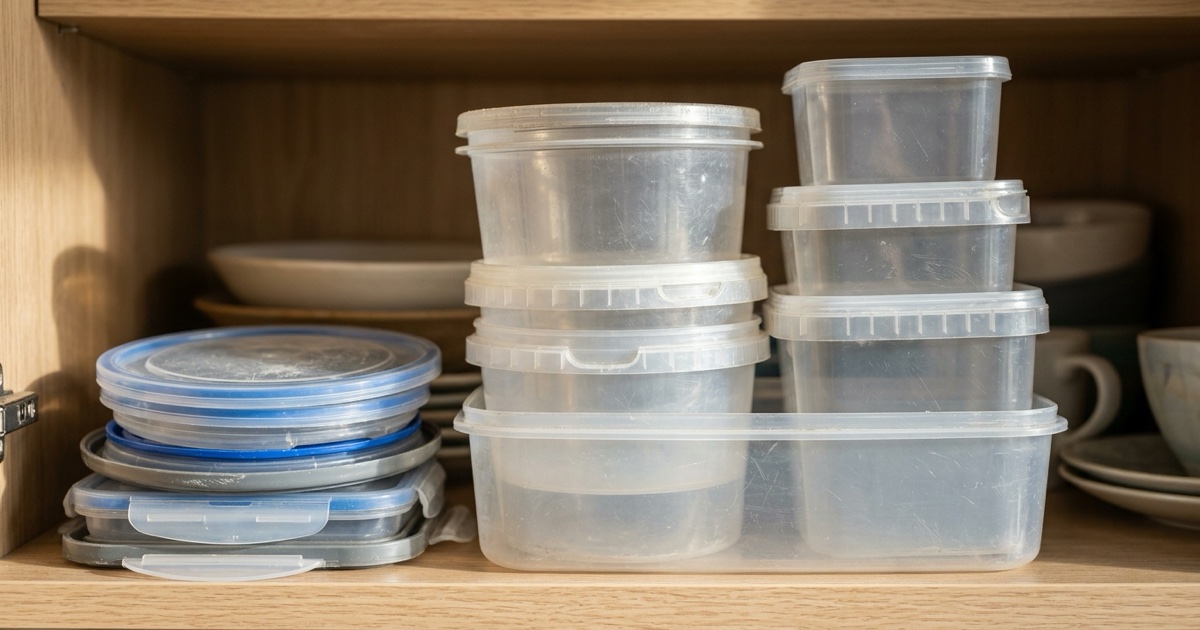
Table of contents
- What happened when 60 people gave up plastic for a week?
- Which chemicals moved, and by how much?
- Why did the group that changed nothing go up?
- Do microplastics in a placenta cause miscarriage?
- Is bottled water the source?
- Who decides what plastic may touch your food?
- What can you change in a kitchen this week?
Summary of this article
- The PERTH Trial, Nature Medicine, April 21, 2026: a 211-adult cohort plus a nested seven-day randomized trial in 60 people.
- Cutting plastic contact with food dropped urinary mono-n-butyl phthalate 37.5 percent, monobenzyl phthalate 53.5 percent and bisphenol A 59.7 percent against the control.
- DEHP metabolites did not fall. The authors call that unexpected and offer a slow washout as one explanation.
- The no-intervention control's own levels rose 40.2 and 54.5 percent, which is why the trial reports differences rather than before-and-after numbers.
- The placenta study is a 31-woman case-control in eBioMedicine, September 2025: 273 versus 226 micrograms per gram, p = 0.011.
- Its logistic regression identified no predictors of miscarriage, so there is no odds ratio and no risk estimate.
- The FDA allows nine phthalates in food-contact materials and released a scientific evaluation of eight of them on May 27, 2026.
What happened when 60 people gave up plastic for a week?
Three chemicals in their urine dropped by a third or more. One week did that.
Not seven months, and not a lifetime of careful shopping. Seven days of eating food somebody else had already sorted out for them, cooked in a kitchen stripped of plastic before they walked into it.
Harray and colleagues ran it in two parts. First they followed 211 Australian adults, recruited between November 2022 and September 2023, and then they pulled 60 of those same people into a seven-day trial and sorted them at random into five groups of 12.
One group ate low-plastic food. A second got plastic-free pots, tubs and boards on top of that, and a third swapped nothing but soap, shampoo and makeup. A fourth did all three. Last group changed nothing at all, and that’s who everybody else got compared against.
Meals came from more than 100 producers who kept plastic out at every step, paddock to plate in that trial’s own words, so people cooked and ate off glass, steel and wood for a week without once having to read a label. No cans. Nothing highly processed, no supplements. All 60 finished.
Calories didn’t change and nobody lost weight. Blood work came back flat, body fat too, and nobody reported feeling worse.
We think design is why you’re reading about this one rather than another scare story. Trials like it are rare, and these authors say so plainly, that hardly anyone has tested whether changing what you touch every day lowers what a lab finds in you afterwards.
Which chemicals moved, and by how much?
Three fell and one refused. Two phthalates dropped 37.5 and 53.5 percent in the group that changed both food and kitchenware, and BPA dropped 59.7.
Phthalates make stiff plastic bendy. BPA hardens it, and it lines the inside of cans we open without thinking. Both clear out of your body fast, which is the whole reason a single week is long enough to see anything at all.
Every group against that control, as they report it.
| Chemical | Food only | Food and kitchenware | Products only | All three |
|---|---|---|---|---|
| Mono-n-butyl phthalate | down 31.5% | down 37.5% | down 35.3% | down 44.1% |
| Monobenzyl phthalate | down 46.7% | down 53.5% | not reported | not reported |
| Bisphenols | total down 58.5% | BPA down 59.7% | bisphenols, no change | total down 50.5% |
Two notes on reading that, and we put both here because a table shaped like this one invites a wrong read. The bottom row is not one thing measured one way, because two cells are a total across bisphenols and one is BPA on its own, so each is labeled rather than left to look alike. And “not reported” means silence in that paper. It doesn’t mean a figure came back flat.
Now set food-only against products-only, which is what news coverage compared, and watch it fall apart. Soap, shampoo and makeup alone moved one phthalate 35.3 percent, a shade more than food alone managed at 31.5. Bisphenols went the other way entirely, with food moving them 58.5 percent, and personal-care products did nothing anybody could measure.
So those two routes aren’t ranked. They reached different chemicals, and one clean sentence survives it. Bisphenols here answered to what touched food rather than to what went on skin.
DEHP wouldn’t budge. Its breakdown products drifted upward instead, which the authors call unexpected, offering a slow washout that seven days never finishes as one possible reason.
Why did the group that changed nothing go up?
Because these chemicals come and go on their own. Those 12 people changed nothing for a week, and one phthalate in them climbed 54.5 percent anyway, and another rose 40.2.
Nobody did anything to them. It simply moved.
We would call that the most useful sentence in this whole subject, and it’s why differences get reported against a control instead of before-and-after figures, which makes for a duller headline and a far more honest trial. Your own number bounces from one day to the next, so a single test tells you almost nothing.
It also sizes the effect honestly. This trial didn’t empty anybody out. It pushed a moving quantity downward, for one week, in 36 people whose meals arrived at their door from producers somebody else had already lined up for them.
Plastic reaches people through more than a plate, which is the other thing a control catches. Nose rinses in that wider group picked up BPA in 61.8 percent of samples and DEHP in 30.6 percent, from sources no amount of glass in your cupboard is ever going to touch.
Do microplastics in a placenta cause miscarriage?
No study has shown that, and a paper being cited for it never tested it.
Thirty-one women. That’s the whole study, and we had to read that line twice.
Wang and colleagues collected chorionic villi from 31 women in their first trimester, at hospitals in Zhejiang Province, China. Chorionic villi are early placental tissue, the part that meets a mother’s blood. Thirteen had a healthy pregnancy ended for social reasons. Eighteen had a miscarriage nobody could explain.
Each sample got burned and its polymers identified by their mass, a method that covers 11 kinds of plastic.
Microplastics turned up in all 31. Four polymers dominated, and PVC was the biggest share at roughly 51 percent. Miscarriage cases averaged 273 micrograms of plastic per gram of tissue against 226 in comparison cases, and that gap came in at p = 0.011. Swapping the label does not always swap the chemistry: BPA-free replacements drive the same metabolic disease.
What that supports is existence, plus a difference between two small sets of women recruited at hospitals in one Chinese province, and those two claims want keeping well apart, because it’s the second one doing all the work in every headline you’ve read about it. It can’t show that one produced the other.
Their own paper carries the clearest evidence for that, and we would point anyone arguing about this straight at it, PMID 40972227. Wang’s team ran a regression to see whether plastic predicted miscarriage, adjusting for age, body size and lifestyle. Their final model found no predictors at all, which they put down to a small sample.
So we have no odds ratio to quote. No risk estimate of any kind.
Miscarriage is common, and that belongs in all of this. That paper cites 10 to 20 percent of pregnancies a woman knows about, with a cause unexplained in a large share of them. Nothing here tells a woman why hers happened, and none of it was built to.
Is bottled water the source?
Same study found more plastic in frequent bottled-water drinkers, and could not tie it to any outcome. They carried more polyethylene and a heavier load overall than occasional drinkers did.
Frequent seafood eaters ran higher across four polymers. Both splits are tiny.
Both are worth knowing, and we’d stay careful with each, because neither rests on a big sample. Bottled water split 19 occasional drinkers against 12 frequent ones. Seafood split 20 against 11.
That paper prints one more sentence about those habits, and we would underline it. The habits showed no difference between those who miscarried and those who carried to term. Whatever bottled water does to a tissue sample, it isn’t what separated those two sets.
Wang and colleagues are direct about how hard sourcing gets. Plastic is everywhere, a survey about your own habits invites you to misremember, and no single behavior could be pinned down at this sample size. Diet may buffer as well as remove. Research suggests vitamins and essential minerals help against endocrine-disrupting chemicals.
Who decides what plastic may touch your food?
FDA does, and it’s checking its own homework. Nine phthalates are allowed to touch your food in America, and eight of them sit under review right now.
Industry got that list shortened. A 2018 petition from the Flexible Vinyl Alliance showed nobody was using 25 substances anymore, and permission for all 25 was pulled in May 2022. Twenty-three were phthalates. Nine survived: eight that soften plastic, one that helps build it. None may go straight into food.
Then comes a line worth stopping on. Safety work behind those permissions rested on data gathered between 1961 and 1985, and FDA says so on its own page.
Treat permission as a legal fact rather than a fresh verdict on safety. Two different things, and that 1961 line is where a regulator admits as much about its own.
FDA scientists released a scientific evaluation of those eight remaining softeners on May 27, 2026, and proposed lumping four together, DEHP, DCHP, DIOP and DINP, so a later review can weigh them as one. Comments closed July 26, 2026. That later review hasn’t happened yet.
One number is moving our way. Federal scientists have sampled American urine for these chemicals since 1999, and the phthalate they find most of dropped from 120 micrograms per gram of creatinine in 2003-2004 to 34.7 in 2015-2016.
What can you change in a kitchen this week?
Start with heat and cans, and you can do both tonight. NIEHS puts diet first: for most people, food and drink account for most of their BPA.
Its list runs five items, and we’d start at the top of it.
- Don’t microwave polycarbonate food containers.
- Cut back on canned food.
- Choose glass, porcelain or stainless steel where you can, especially for hot food or liquids.
- Use BPA-free baby bottles.
- Check for recycle code 3 or 7, since not every plastic marked that way contains BPA.
None of that’s an order. Whoever wrote it called those steps a personal choice rather than health instruction, and we’ll keep them framed that way. One line in there matters more than how old anything in your cupboard is: how much BPA leaches out may depend more on how hot a liquid or bottle is than on age.
That cohort points the same way from another angle. Each extra canned item somebody ate in a day tracked with a 14.3 percent rise in BPA in their urine. Cans again, caught by a different instrument.
None of this prevents a disease, and nobody has shown that it does, so we’re not going to pretend otherwise. It lowers something a lab can see, which is a much smaller claim and the one this evidence supports.
Those five groups hand you a priority order for free. Food moved the most chemicals. Kitchenware added to it. Soap and shampoo alone moved one thing. So we’d change what touches hot food first, then what touches acidic, fatty or watery food, then everything else.
One last thing, said plainly. Nobody we opened publishes a price for switching a kitchen, so we won’t invent one. Microwaving in glass costs nothing at all. Everything past that depends on how many containers you already own.
Sources
- Nature Medicine. Harray AJ, Lucas AD, Herrmann SE, et al. Low-plastic diet and urinary levels of plastic-associated phthalates and bisphenols: the randomized controlled PERTH Trial (2026) Nature Medicine 32:1871-1883, published April 21, 2026. Registry ACTRN12622001252707
- eBioMedicine (Lancet Discovery Science). Wang P, Li G, Shou H, et al. Microplastic abundance in placental chorionic villi detected by pyrolysis-gas chromatography/mass spectrometry in cases of spontaneous miscarriage during early pregnancy (2025) eBioMedicine 120:105918, doi 10.1016/j.ebiom.2025.105918, PMID 40972227
- US Food and Drug Administration. Phthalates in Food Packaging and Food Contact Applications (2026) Page content current as of 06/24/2026; scientific evaluation released May 27, 2026
- National Institute of Environmental Health Sciences. Bisphenol A (BPA) topic page (2026)
- US Environmental Protection Agency. Report on the Environment, Urinary Phthalates Level indicator, built on CDC NHANES 1999-2000 through 2015-2016 (2026)
Questions people ask
Does cutting plastic contact with food lower plastic chemicals in the body?
For some of them, yes, and quickly. The PERTH Trial, published in Nature Medicine on April 21, 2026, ran a seven-day randomized intervention in 60 Australian adults. Urinary mono-n-butyl phthalate fell 37.5 percent, monobenzyl phthalate 53.5 percent and bisphenol A 59.7 percent against a no-intervention control.
Which plastic chemical did not respond to the low-plastic diet?
DEHP. Its metabolites did not decrease in the PERTH Trial, and the trend ran upward. The authors call the result unexpected and suggest a slow washout of DEHP that seven days would not finish, among other explanations.
Do microplastics in the placenta cause miscarriage?
No study has shown that. The eBioMedicine paper of September 2025 compared 18 unexplained miscarriages with 13 normal pregnancies and found more plastic in the miscarriage group, 273 against 226 micrograms per gram. Its logistic regression identified no predictors, so no risk estimate exists.
How large was the placenta and miscarriage study?
Thirty-one women in total, recruited mainly from urban hospitals in Zhejiang Province, China, and all in the first trimester. Thirteen were controls and 18 had an unexplained miscarriage. The authors call the work preliminary evidence and ask for larger samples.
Does bottled water raise microplastic levels?
In that study, women who drank bottled water frequently had more polyethylene and a higher total microplastic load in placental tissue. Frequent seafood eaters showed higher levels across four polymer types. Neither habit differed between the miscarriage group and the comparison group.
How many phthalates are allowed in US food packaging?
Nine. The FDA allows eight as plasticizers and one as a monomer in food-contact polymers, and none may be added directly to food. A final rule dated May 19, 2022 revoked authorization for 25 substances, 23 of them phthalates.
What can I change in my kitchen to reduce BPA exposure?
NIEHS lists five steps as a personal choice: do not microwave polycarbonate containers, reduce canned food, choose glass, porcelain or stainless steel for hot food and liquids, use BPA-free baby bottles, and check for recycle codes 3 or 7. NIEHS says diet is the main exposure route.


Have questions about the environment inside your home?
Air quality, mold, EMF, light and water all shape how a house feels and how the people in it feel. Whatever your concern is, the first step is finding out what is there.
Our certified team of environmental professionals and advocates can help.