


A flesh-eating fly wiped out in the U.S. is back in Texas, and pets are at risk
Female screwworm flies lay eggs in open wounds, which can put even a small unnoticed cut on an animal at risk. Multiple Texas cases are now confirmed, including one in a dog.
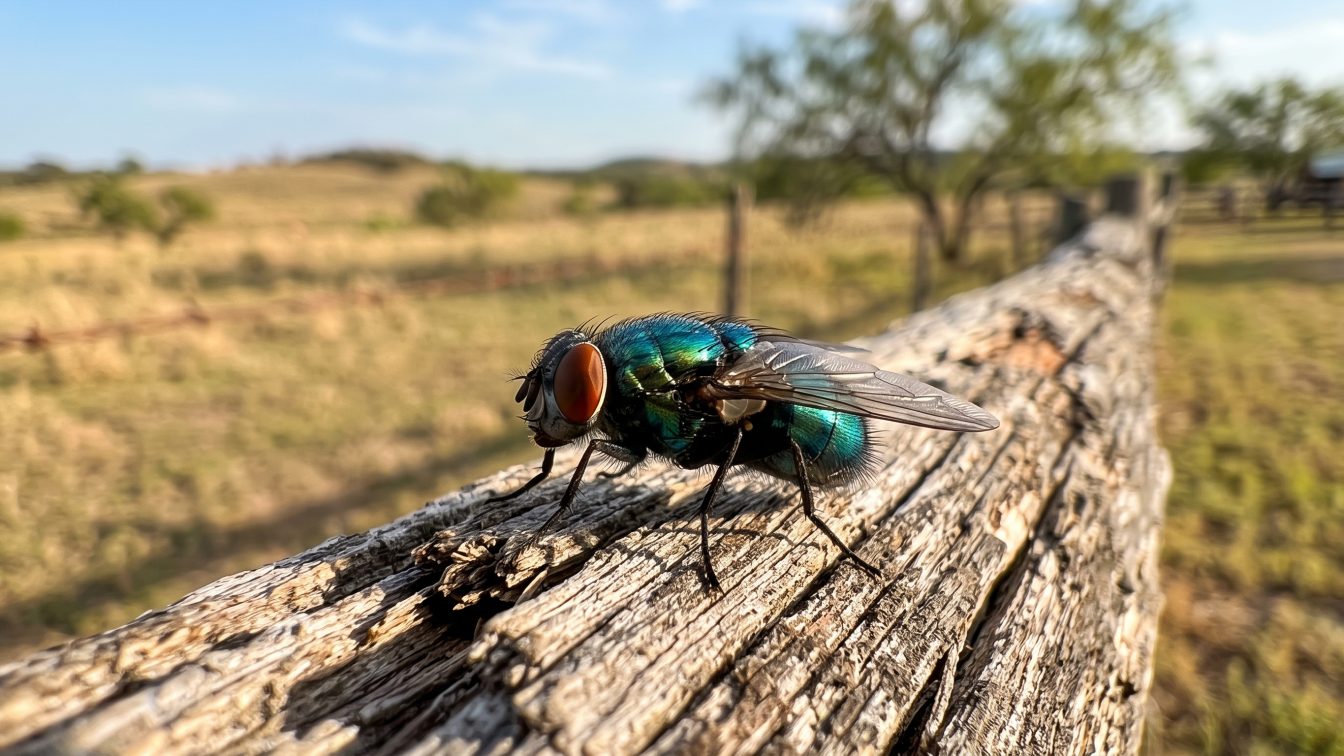
Table of contents
Summary of this article
- The New World screwworm, eradicated from the U.S. by 2004, has returned, with multiple cases confirmed in Texas including one in a dog, according to NBC News reporting by Evan Bush (June 7, 2026).
- It's a blowfly, not a worm. Females are attracted to rotting, untended wounds and lay 200 to 300 eggs; the larvae have mouth hooks that tear into flesh and burrow deeper.
- Infections are usually fatal without treatment. Unless larvae are removed and the animal receives larvicide and antibiotics, screwworm infestations typically kill. It threatens livestock, wildlife, pets, and, rarely, humans.
- The proven fix is source control at the reproductive level. Because females mate only once, releasing mass-produced sterile males creates reproductive dead ends; this drove the screwworm to the Panama Canal by 2004.
- Containment lapsed, and the response is delayed. Northern sterile-fly plants closed over time, and the USDA's new $750 million Texas facility, targeting 300 million sterile flies per week, won't be operational until late 2027. A widespread outbreak could cost Texas alone about $1.8 billion a year.
For more than half a century, the United States waged an expensive, relentless war on a fly that eats living flesh. By 2004, the country had driven the New World screwworm all the way down to the Panama Canal, hundreds of miles from its borders. Few pest-eradication campaigns in American history went better.
Now it’s back. The U.S. Department of Agriculture has confirmed multiple cases in Texas, including one found in a dog. NBC News science reporter Evan Bush detailed the return on June 7, 2026.
If you own pets, keep livestock, or spend time outdoors in the warm South, this matters to you directly. The screwworm is a threat to any warm-blooded animal, and understanding it comes down to a core building-biology idea: the most effective protection stops a hazard at its source and closes off the pathway it uses to reach you and your animals.
A fly whose larvae feed on living tissue
First, a clarification that changes how you protect against it: the screwworm is not a worm. It’s a species of blowfly native to the warmer parts of the Americas.
The danger comes from how it reproduces. Adult females are attracted to rotting, untended wounds on warm-blooded animals. There, a single female lays 200 to 300 eggs. When those eggs hatch, the larvae, which look like screws, giving the pest its name, go to work. They have special mouth hooks that tear into an animal’s flesh and burrow deeper as they feed.
“The larvae that emerge from the eggs consume the flesh of warm-blooded animals,” Texas A&M entomology professor Phillip Kaufman told NBC News. “It’s a pest of all of our livestock, most of our wildlife and our companion animals, our cats, our dogs and ourselves.”
As the larvae multiply, a small wound becomes an open, rotting sore, and the smell can attract more flies. Unless the larvae are removed and the animal is treated with larvicide and antibiotics, the infection is typically deadly. In humans, infections are extremely painful but uncommon, and they’re hard to miss. “It’s eating your tissue, whether that be muscle or fat or skin,” Kaufman said. “There is little to no way that you would not know that you have this problem.”
The exposure pathway: it starts with a wound
Building biology asks a simple question of any hazard: how does it reach the thing you’re protecting? For the screwworm, the answer is unusually clear, and that clarity is your biggest advantage.
The exposure pathway is the open wound. The fly is drawn specifically to rotting, unkept injuries. That means the entry point is not random, it’s a cut, a scrape, a surgical site, a tick bite, or even the raw navel of a newborn animal. No open wound, no ideal target.
Two conditions widen this pathway:
Warm climate. The screwworm can’t survive cold winters. It can range into the Midwest when it’s warm enough, but it can’t overwinter there. As Kaufman put it, “South Texas and South Florida never get cold enough to kill it off.” Those regions are the fly’s foothold, and warming conditions extend how far and how long it can spread.
Animals with untended injuries. Livestock, wildlife, and outdoor pets accumulate small wounds constantly. An injury left uncleaned and unmonitored is an open invitation.
Understanding this pathway tells you exactly where to intervene. You can’t easily change the climate, but you have real control over the wounds on your own animals.
Source control, the way the U.S. won before
The screwworm’s return is alarming, but there’s genuine reassurance in the fact that we’ve beaten it once, and the method was a masterclass in source control.
Source control means stopping a problem at its root rather than cleaning up the damage afterward. Instead of trying to treat every infected animal across a continent, scientists attacked the fly’s ability to reproduce at all.
The strategy exploits one biological fact: female screwworms mate only once. So the U.S. built factories that mass-produced male flies, sterilized them with radiation, and released them into the wild by the hundreds of millions each week. When a wild female mates with a sterile male, she produces no offspring. She has used her single mating on a reproductive dead end.
Flood a region with enough sterile males, and it becomes nearly mathematically impossible for wild females to find a fertile mate. The population crashes because it can’t replace itself. “It is a tremendous strategy,” said Chad Cross, a parasitology professor at Texas Tech’s veterinary school. “It has worked and will continue to work moving forward.”
It worked spectacularly. U.S. cases reached zero in 1982, and the campaign kept pushing the fly south through Mexico and Central America. “It took us until about 2004 to eradicate it all the way down past the Panama Canal,” Kaufman said.
How containment lapsed
Here’s the hard lesson in why the fly is back. Source control isn’t a one-time victory, it’s a system you have to maintain.
As the eradication line moved south, the U.S. and its partners closed the sterile-fly facilities in areas the screwworm had already been cleared from. “As they open the new plants further south, they close the northern plants, and so the Texas plant closed, and then Mexico, and then the Nicaragua plant, leaving us only with the plant in Panama,” Kaufman said. “That plant is showing its age.”
For about two decades, the roadless rainforest of the Darién Gap between Panama and Colombia held the line. Then, in 2023, an outbreak began spreading north, to Panama and Costa Rica, then Mexico, and now the U.S. “Why did it get out?” Kaufman said. “No one really knows.”
The building-biology point is unavoidable: the barrier that kept the fly out was dismantled once the immediate threat was gone. When the maintenance of a source-control system stops, the pathway it was blocking reopens.
The measurable thresholds that define the risk
Numbers make this threat concrete, and they show why timing is everything right now.
200 to 300 eggs per female. A single fly can seed a devastating infestation, which is why one untended wound is so dangerous.
300 million sterile flies per week. That’s the target output of the USDA’s new facility, roughly three times what’s possible today and similar to peak 1960s production.
$750 million. What the USDA is spending to build that new Texas facility.
Late 2027. The earliest the facility will be operational, and it will take longer still to reach full volume. Until then, the risk of an outbreak is high.
$1.8 billion a year. The estimated cost to the Texas economy alone from a widespread outbreak, factoring in livestock deaths, veterinary services, treatments, and extra labor.
The gap between the threat arriving now and the main production facility coming online in late 2027 is the window of greatest danger. That’s precisely when individual prevention matters most.
What to do about a wound in screwworm country
While federal agencies rebuild the large-scale source-control system, the exposure pathway, the open wound, is something you can control yourself. Every uninfested wound is one the fly can’t use.
Inspect your animals regularly. Check pets and livestock for cuts, scrapes, and sores, especially in warm weather. Pay attention to surgical sites, tick and insect bites, and the navels of newborns.
Clean and cover wounds promptly. A cleaned, treated, covered wound is far less attractive to a fly than a raw, rotting one. Source control works at the level of one animal, or one person.
Know the warning signs. Watch for a wound that seems to grow, a foul smell, visible larvae, or an animal that’s agitated, off its feed, or licking and biting one spot. Early detection is the cheapest, most effective response.
Act fast if you suspect it. Screwworm is a reportable pest. Contact your veterinarian or state agriculture authorities immediately, do not wait. Treatment means removing larvae and using larvicide and antibiotics, and speed saves the animal’s life.
Be extra vigilant in South Texas and South Florida. These regions never get cold enough to kill the fly off, so the risk is highest and most persistent there.
We drove this fly out once with patience, science, and a system we chose to maintain, until we didn’t. The rebuilt defense is coming, but not until late 2027. In the meantime, the most powerful protection is the oldest one: keep your animals’ wounds clean, watch them closely, and close the door the screwworm needs to get in.
Sources
- NBC News, Evan Bush. The U.S. fought the flesh-eating screwworm for decades. Now it begins again (2026) (June 7, 2026):
Questions people ask
What is the New World screwworm?
It's a blowfly native to the warmer parts of the Americas, not an actual worm. Adult females are attracted to open, rotting wounds on warm-blooded animals, where they lay 200 to 300 eggs. The hatching larvae have mouth hooks that tear into living flesh and burrow deeper, according to NBC News.
Why is its return in the U.S. a big deal?
The U.S. spent more than 50 years and hundreds of millions of dollars eradicating the screwworm, reaching zero cases in 1982 and pushing it past the Panama Canal by 2004. Its confirmed return in Texas, including a case in a dog, represents a failure in containment and revives a fight the country had already won.
Is the screwworm dangerous to pets and people?
Yes to pets, rarely to people. It threatens all warm-blooded animals, including cats and dogs, and infections are typically fatal without treatment. Human infections are extremely painful but uncommon, and they're hard to overlook because the larvae consume tissue.
How is the screwworm controlled?
The proven method is the sterile insect technique. Because females mate only once, scientists mass-produce and release sterilized male flies. Wild females that mate with them produce no offspring, collapsing the population. This drove the screwworm out of the U.S. and Central America previously.
Why did the screwworm come back?
As the eradication line moved south, northern sterile-fly production plants were closed, leaving only an aging facility in Panama. The barrier weakened, and in 2023 an outbreak began spreading north from the Darién Gap through Central America and Mexico into the U.S. The exact cause of the breakout isn't known.
How can I protect my animals right now?
Inspect pets and livestock regularly for wounds, especially in warm weather and in South Texas and South Florida. Clean, treat, and cover injuries promptly, watch for growing sores, foul odor, or visible larvae, and contact a veterinarian or state agriculture authorities immediately if you suspect an infestation.
Have questions about the environment inside your home?
Air quality, mold, EMF, light and water all shape how a house feels and how the people in it feel. Whatever your concern is, the first step is finding out what is there.
Our certified team of environmental professionals and advocates can help.