


Your Gas Stove Leaks More With the Knobs Off Than While You Cook
Researchers measured 53 American kitchens and found more than three-quarters of a gas stove's methane escaped while every knob was off. Your burner runs 20 minutes a day. The fittings run all 24 hours.
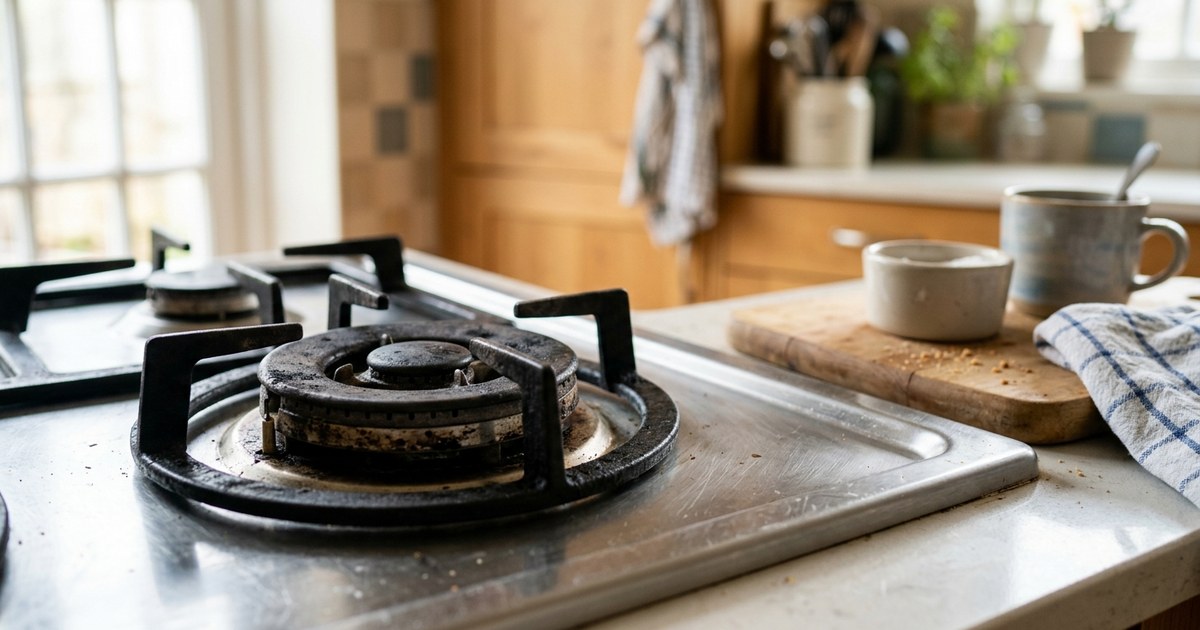
Table of contents
- What if you smell gas right now, or your alarm is going off?
- Does a gas stove leak when it’s off?
- How much escapes unburned?
- Do official figures underestimate this?
- Is there any limit for nitrogen dioxide inside a house?
- What can you check in your own kitchen?
- What if you rent, or your hood vents nowhere?
- What’s worth doing first?
Summary of this article
- Lebel and colleagues measured 53 US homes in three states, burning, lighting and doing nothing, and more than three-quarters of the methane came out during the off state.
- Stoves emit 0.8 to 1.3 percent of the gas they use as unburned methane, and gas stoves sit in more than 40 million US residences.
- Methane is a leak and nitrogen dioxide is exhaust. A hood does nothing about a seeping fitting, and sealing a fitting does nothing about combustion products.
- Families who don't use a range hood, or who have poor ventilation, can pass the 1-hour national NO2 standard of 100 ppb within a few minutes of cooking, and a smaller kitchen gets there faster.
- That 100 ppb figure is an outdoor standard enforced against states. No federal rule sets a limit for nitrogen dioxide or fine particulate inside a home.
- In 58 kitchens in Santiago and Bogota, methane during combustion ran 8 to 16 times higher than the defaults inventories assume, and about half of all methane came from leaks that inventories exclude entirely.
- The nitrogen oxides in those same kitchens matched the assumptions fine, which is the control that makes the methane gap credible.
- If you rent, the fan is somebody else's decision and the window is yours. Open one on the same wall, use the back burners, and put the leak question to your landlord or board in writing.
Nobody is in your kitchen right now. Every knob is off, your dinner finished hours ago, and no burner has been lit since.
Gas is moving anyway. More than three-quarters of what a gas stove puts into a house escapes just like this, with nothing switched on and nobody standing there.
What if you smell gas right now, or your alarm is going off?
Get everybody outside first, then call 911 from outside. Don’t stay indoors to make that call, and don’t touch any switches on your way out.
Everything after that covers slow leaks which never announce themselves, and we’d still rather you closed this page than read another line with an alarm sounding. A strong gas smell is a different situation. So is a carbon monoxide alarm. Both are emergencies, and neither one waits while you read.
Carbon monoxide gives less warning than any of it. Natural gas at least carries a smell somebody added on purpose. Carbon monoxide carries none, because it is colorless and odorless, and people have died in their sleep without ever knowing it was in a room with them.
What it does instead is make people feel ill. Headache, dizziness, weakness, nausea, chest pain, confusion. They get described as flu-like, and that is what makes them dangerous, because feeling fluish in February in a house with a gas appliance gets explained away by everybody in it.
One pattern is worth watching for. If more than one person feels ill at once, or a dog does too, and everybody picks up within an hour of going outside, take it seriously. We’d rather over-warn you here than hand you a careful sentence you have to read twice at four in the morning.
Now look at your ceiling. Whatever is mounted up there watches for smoke, and it may watch for carbon monoxide as well. Nothing on it is watching for methane. Which is why a gas leak gets found by somebody with an instrument in hand rather than by a box on your ceiling, and why a slow one can go unnoticed in a house for years.
Does a gas stove leak when it’s off?
Yes, and that is most of it. We didn’t expect that either. Lebel and colleagues measured 53 homes, watching each stove in three separate states: burning, lighting, and doing nothing at all with every knob turned off. Doing nothing produced more than three-quarters of a stove’s methane, and they published that in 2022.
Most of us picture a stove as dead until it’s lit. Risk arrives with a flame and leaves with it.
That is not how a gas line works. Fittings, connections and valve seats pass a little gas continuously, whether anybody is cooking, or asleep upstairs, or two states away for a week with the house shut and dark.
Your burner runs maybe 20 minutes a day. A leak runs all 24. So a slow seep adds up to more than any flame does, in the room where you eat.
Sit with that a moment, because it moves this problem out of whichever box you had it in. Cooking habits. Oven hours. Whether anybody remembers to hit that fan. None of those govern what turned out to matter most, and we were as surprised by that as anyone.
A stove that’s off is still plumbed into a gas line. So a useful question covers your other 23 hours rather than 20 minutes with a flame on.
How much escapes unburned?
Lebel’s group put it at 0.8 to 1.3 percent of everything a stove uses, across those same 53 homes.
One percent sounds trivial. We thought so too. It isn’t, and climate accounting has nothing to do with why.
A stove losing 1 percent has a small leak that never stops, in the room where your family eats dinner. That percentage describes an appliance. It says nothing about how much is in air where you’re standing, which depends on how big your kitchen is, how well it vents, and how long a fitting has been seeping.
More than 40 million American homes cook on gas, and most of us have never once thought about a fitting under a countertop. Per house that is a small figure. Across a country it is not.
Lebel’s group also checked nitrogen oxides in 32 of those kitchens, and that behaved nothing like the methane did. Methane is a leak. Nitrogen dioxide is exhaust. Sealing a fitting won’t touch the exhaust, and running a hood won’t touch a valve seeping at midnight, which is worth knowing before anybody spends money on either.
| Methane | Nitrogen dioxide | |
|---|---|---|
| Where it comes from | fittings, connections, valve seats | burning gas |
| When | all 24 hours, mostly with the knobs off | only while a burner is lit |
| What fixes it | a plumber with an instrument | a hood that vents outside |
| What doesn’t | your range hood | sealing a fitting |
Do official figures underestimate this?
Badly, on methane. Morales-Betancourt and colleagues measured 35 kitchens in Santiago and 23 in Bogota, put every one through those same three phases, and published in Atmospheric Chemistry and Physics in 2026. Methane given off during combustion came in between 8 and 16 times higher than the default values inventories assume when nobody has measured locally.
Read that carefully, because the scope matters. The 8 to 16 covers what comes off during combustion, and it is not the whole story. Their bigger finding is that around half of all the methane came from continuous and episodic leaks, which inventories leave out altogether.
Then there’s the control, and it’s what makes any of this believable. Same instruments, same kitchens, and the nitrogen oxides came back in line with what inventories already assume. Methane is the one that came back wrong.
Robert Jackson and Colin Finnegan are authors on both papers, so the method carried straight across from those 53 American homes.
When a default and a measurement disagree that badly, trust whoever held the instrument. Those kitchens are in Chile and Colombia, so no figure there describes yours. What travels is the direction of the error, and the reason for it: nobody was counting the hours a stove spends doing nothing.
Is there any limit for nitrogen dioxide inside a house?
None. A national limit does exist, at 100 parts per billion over an hour, and EPA enforces it against states, for air over a whole region. It stops at your front door.
People assume a pollutant limited outdoors must be covered indoors too. It isn’t. No federal agency sets a figure for nitrogen dioxide inside a home, and none for fine particulate either, while the appliance most likely to produce both of them stands in the room where you eat.
We’d rather name that hole than paper over it with a number nobody has published.
Lebel and colleagues made that gap real rather than theoretical. Families who don’t use a range hood, or who have poor ventilation, can pass 100 ppb within a few minutes of switching a burner on, and a smaller kitchen gets there faster.
Building biology handles it another way. Rather than a fixed indoor figure, SBM-2024 asks you to compare air in a room you sleep in against clean air outside your door.
Code is a floor and precaution aims at a ceiling. Treating those as one thing is the most common mistake in air quality writing.
What can you check in your own kitchen?
Three things, answering three different questions. A leak at your fittings. Combustion products while a burner runs. Particulate over a week.
A leak is what your nose won’t catch. That added smell is dosed for a big escape rather than a slow seep, so a connection can pass gas under a countertop for years and never once smell like anything. Somebody finds it with an instrument put against your fittings and your shutoff valve, and it takes an afternoon rather than a lifestyle change. Since the stove produced most of that methane while nobody was cooking, this is also the check that matches where your problem lives.
Combustion products get read live, while somebody cooks. A figure climbing on a screen during dinner settles arguments that no paragraph ever will. Check your hood in that same hour, because that fan matters more than people give it credit for.
Particulate wants the opposite of a live reading. It wants one position, held for a week, ideally beside a bed, because that is eight straight hours breathing one room’s air.
That’s the part worth having somebody measure properly rather than chasing yourself. A device carried around a house all week records a hallway, a countertop and whoever walked past it, which is a record of your walking rather than your air.
A week in one position beats a single number taken mid-argument.
What if you rent, or your hood vents nowhere?
Then the fan is somebody else’s decision and the window is yours. Most gas cooking in this country happens in housing where the person breathing it can’t replace the appliance or cut a duct through an outside wall.
Think about where gas stoves are. Pre-war apartments in New York and Chicago, where the kitchen is an alcove off the living room and the hood over the range is a charcoal box that never vented anywhere. Rented duplexes. Condos where the exterior wall belongs to the association. Manufactured homes on propane, with a galley kitchen the width of a hallway.
None of those readers can act on most published gas-stove advice, which is written for somebody who owns a detached house and can call a contractor.
Two things work in a unit you don’t own, and a third belongs to whoever owns it. Open a window on the same wall while you cook, even three inches, because cross-ventilation beats a recirculating fan every time. Cook on the back burners, closer to whatever extraction exists. Run the fan anyway, since a charcoal hood still moves air across a room even when it returns it. And put the leak question in writing to your landlord or your board, because a gas fitting is their liability and not your improvement project.
Where the appliance isn’t yours to replace, work on the air around it instead. Smaller lever, and a real one.
What’s worth doing first?
Run your fan every time the hob is lit, and check that it vents outside instead of pushing air through a charcoal pad and back into a room.
Cheapest thing you can do, and it handles the exhaust half of this. A recirculating hood moves grease and noise around and leaves nitrogen dioxide where it was. Plenty of houses have one, and plenty of owners think it counts as ventilation.
Lebel and colleagues put a working hood between a kitchen and that 100 ppb figure, which is why we lead with it and not with a machine you have to buy.
Filtration is second, and it works on particulate rather than gases. A unit sized for your room and left running does real work. That same unit on low in the wrong room does almost nothing.
A leak is third, and it belongs to a plumber. A fitting either passes gas or it doesn’t. Instrument first, wrench second. That order saves people money, and we have watched plenty of them do it backwards.
Fan first. Filter second. Check before you buy either. Buying the wrong machine confidently is how most people’s indoor air research ends, and an afternoon with an instrument tells you which of three problems you have.
We’re not telling you to rip out your stove. We’re telling you that the argument everybody has about gas cooking is happening at the wrong hour of the day.
So whatever you decide about dinner, remember where most of this happens. Empty kitchen. Every knob off. Gas moving anyway.
Sources
- Environmental Science & Technology. Methane and NOx Emissions from Natural Gas Stoves, Cooktops, and Ovens in Residential Homes (2022)
- Atmospheric Chemistry and Physics. Measurement Report: Methane and NOx emissions from natural gas cooking stoves, the case of Chile and Colombia (2026)
- US EPA. NAAQS Table (2026)
Questions people ask
Do gas stoves leak when they are turned off?
Yes, and that is most of it. Researchers measured 53 US homes across three states of use and found more than three-quarters of the methane came out during steady-state-off, with every knob closed and nobody cooking. Fittings, connections and valve seats pass gas continuously.
How much gas does a stove leak?
Between 0.8 and 1.3 percent of everything it uses, released as unburned methane, from those 53 measured homes. Per house that is small. Across the more than 40 million US residences with gas stoves it is not.
Will a range hood fix a gas stove leak?
No, and this is where people spend money in the wrong place. A hood works on combustion products while a burner is lit. A leak happens at a fitting at midnight with nothing switched on. Different problem, different fix, and the fix for a leak is a plumber with an instrument.
Can cooking on gas push nitrogen dioxide past the legal limit?
Indoors there is no legal limit to pass. The researchers found that families who don't use a range hood, or who have poor ventilation, can surpass the 1-hour national standard of 100 ppb within a few minutes of stove use, particularly in smaller kitchens. That standard is written for outdoor air and enforced against states.
Is there a federal limit for air quality inside a home?
No. EPA sets outdoor standards, including 100 ppb for nitrogen dioxide over an hour, and enforces them against states across whole regions. Nothing in US rules sets a figure for nitrogen dioxide or fine particulate inside a private house.
What can I do if I rent and cannot replace the stove?
Open a window on the same wall while you cook, even a few inches, because cross-ventilation beats a recirculating hood. Use the back burners, closer to whatever extraction exists. Run the fan anyway. And put the leak question to your landlord or board in writing, because a gas fitting is their liability.
Does a smoke alarm detect a gas leak?
No. What is mounted on your ceiling watches for smoke, and possibly carbon monoxide, and nothing on it watches for methane. A slow gas leak gets found by somebody with an instrument at your fittings, which is why one can go unnoticed in a house for years.

Have questions about the environment inside your home?
Air quality, mold, EMF, light and water all shape how a house feels and how the people in it feel. Whatever your concern is, the first step is finding out what is there.
Our certified team of environmental professionals and advocates can help.