


Most new homes studied had their required ventilation fan switched off
Field teams found the whole-house ventilation fan running in just 18 of 70 new California homes, and only 12 had a label explaining the switch. The fans themselves were moving more air than code required.
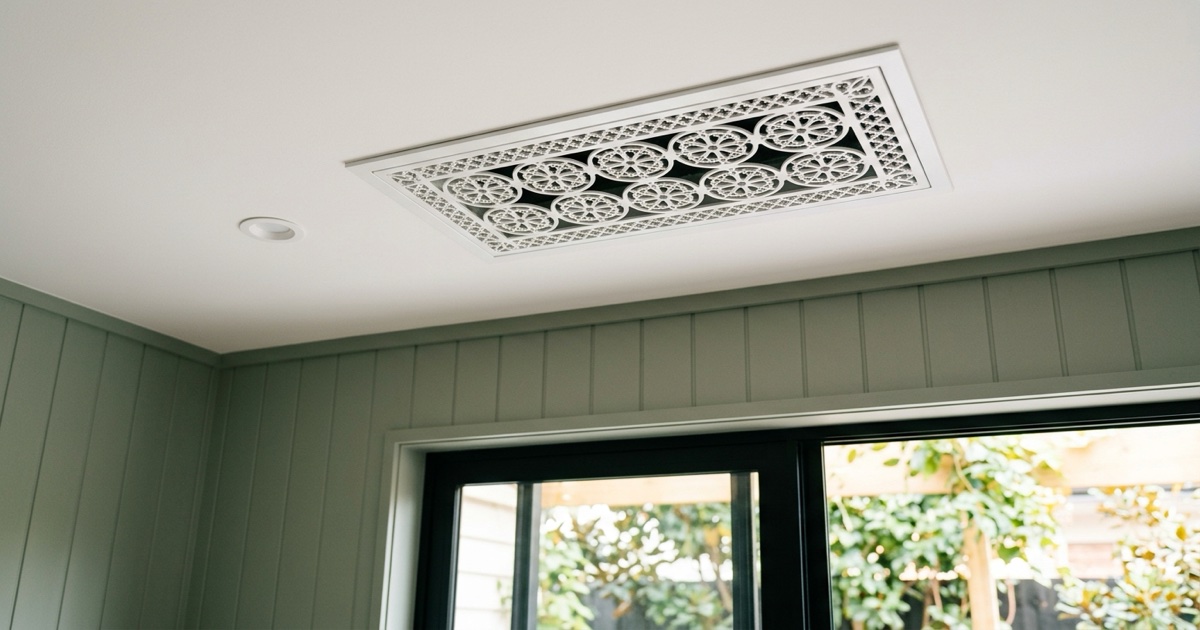
Table of contents
Summary of this article
- Berkeley Lab field teams found the required whole-house ventilation fan running in 18 of 70 new California homes. In 52, it had been switched off.
- Only 12 of the 70 homes had a label explaining what the switch controlled.
- The equipment was not at fault. Those fans moved 50 percent more air on average than California's code required.
- In 43 homes the ventilation system was a continuous exhaust fan in the laundry room. Nine used a bathroom fan, three an attic fan. It looks like a bathroom fan and gets treated like one.
- ASHRAE 62.2 Table 4.1a gives 105 cubic feet per minute for a three-bedroom home of 2,001 to 2,500 square feet. The Census Bureau put the median new single-family home in 2025 at 2,142 square feet.
- Washington state asks 55 cfm of that same three-bedroom house. One house, two legitimate answers.
- ASHRAE 62.2 states on its own front page that compliance is voluntary until a jurisdiction makes it mandatory. Washington wrote it into code, federal weatherization has required it since 2017, and HUD requires manufactured homes to label the control.
- Berkeley Lab judged at least one filter very dirty in 18 of 67 homes, and 19 of 85 recorded filters had gone more than a year without a change.
Berkeley Lab sent field teams into 70 new California homes and found the required whole-house ventilation fan running in 18 of them. In the other 52, somebody had switched off a fan built to run day and night.
Only 12 of the 70 homes had a label explaining what the switch did.
The equipment was not the problem. Those fans moved 50 percent more air on average than California’s code required, and teams still arrived to find most of them silent.
Here is what the standard actually asks for, why the switch keeps getting turned off, and what to check in a specific house.
The fan does not look like a ventilation system
In 43 of those homes, the whole-house ventilation system was a continuous exhaust fan in the laundry room. Nine used a bathroom fan. Three used one in the attic.
So it looks like a bathroom fan, sounds like a bathroom fan, and gets treated like one. It is also the only thing pulling stale air out of a house built to hold air in.
An unlabelled switch in a hallway that turns on no light gets flipped once during the first week and left down. That is the whole mechanism behind 52 silent fans.
What a house is supposed to get
ASHRAE 62.2 is the one American standard aimed at air inside homes. Table 4.1a gives 105 cubic feet per minute for a three-bedroom home of 2,001 to 2,500 square feet, so the arithmetic is already done.
That band covers a large share of new American housing. The Census Bureau put the median new single-family home completed in 2025 at 2,142 square feet, out of 1,005,000 built.
The table comes from one calculation: 3 cubic feet per minute for every 100 square feet of floor, plus 7.5 for each person the home is assumed to hold.
Then a real code sits beside it. Washington asks 55 cfm of that same three-bedroom house. One house, two answers, both legitimate, and worth seeing both rather than trusting whichever one a builder worked to.
The standard is voluntary almost everywhere
The front page of ASHRAE 62.2 states that compliance “is voluntary until and unless a legal jurisdiction makes compliance mandatory through legislation.” Air that does not move shows up in performance: thinking scores fell 15% at 945 ppm in a closed bedroom.
Washington wrote it into code. The federal weatherization program has required it since 2017. Manufactured homes have their own HUD rule, which requires the ventilation control be labeled with its function and even suggests the wording: “Leave on unless outdoor air quality is very poor.”
A mobile home gets told. A site-built house next door has nobody checking. Everywhere outside those three cases it is a well-researched suggestion, in a house whose fan was switched off years ago.
What to check in your own house
Find the unlabelled switch. If a hallway or laundry switch turns on no light and nothing obvious happens, that is the likely candidate. Label it once it is identified.
Run the kitchen fan, then walk outside and look for the hood. If nothing is blowing out of a wall or a roof, that air is going somewhere other than outside.
Check the filters while you are up there. Berkeley Lab’s teams judged at least one filter “very dirty” in 18 of 67 homes, and of 85 filters recorded, 19 had gone more than a year without a change.
Read the standard yourself. ASHRAE publishes read-only copies on its own site at no cost, so the row for a specific floor area and bedroom count can be looked up directly.
In most of the country, the household is the only inspection this system will ever get.
Sources
- ASHRAE. ANSI/ASHRAE Addendum i to ANSI/ASHRAE Standard 62.2-2022, Ventilation and Acceptable Indoor Air Quality in Residential Buildings (2022) ANSI approved 8 November 2022
- ASHRAE. ANSI/ASHRAE Standard 62.2-2013, Sections 4.1.1 to 4.1.3 and Equation 4.6 (2013) published excerpt distributed by ICC
- ASHRAE. ANSI/ASHRAE Addendum m to ANSI/ASHRAE Standard 62.2-2013, revised Table 4.1a Ventilation Air Requirements (2015)
- ASHRAE. ANSI/ASHRAE Standard 62.2-2010, Section 5 and Tables 5.1 and 5.2, local exhaust rates (2010) published excerpt distributed by ICC
- ASHRAE Washington Office. Standard 62.2-2022 fact sheet, scope and government use (2025)
- U.S. Department of Energy. Weatherization Assistance Program Notice 22-7, Health and Safety Frequently Asked Questions (2022) WPN 22-7
- U.S. Department of Housing and Urban Development. Manufactured Home Construction and Safety Standards, Light and ventilation (2026) 24 CFR 3280.103
- Washington State Legislature. WAC 51-51-1505, Section M1505 Mechanical ventilation, Equation 15-1 and Table M1505.4.3(1) (2026)
- Lawrence Berkeley National Laboratory. Chan WR, Kim Y-S, Less BD, Singer BC, Walker IS. Ventilation and Indoor Air Quality in New California Homes with Gas Appliances and Mechanical Ventilation (2020) LBNL-2001200R1
- Energy and Buildings. Chan WR, Joh J, Sherman MH. Analysis of air leakage measurements of US houses (2013) volume 66, pages 616-625
- U.S. Census Bureau. Characteristics of New Housing, Highlights of 2025 (2026)
Questions people ask
How many new homes had the ventilation fan running?
18 of 70. Berkeley Lab field teams visited 70 new California homes and found the required whole-house ventilation fan switched off in 52 of them.
Was the equipment faulty?
No. Those fans moved 50 percent more air on average than California's code required. The problem was that they had been switched off.
Why would someone switch it off?
Only 12 of the 70 homes had a label explaining the switch. An unlabelled switch that turns on no light gets flipped once in the first week and left down.
What does the ventilation system look like?
In 43 of those homes it was a continuous exhaust fan in the laundry room. Nine used a bathroom fan and three an attic fan. It looks and sounds like a bathroom fan, and it is the only thing pulling stale air out of the house.
How much air is a house supposed to get?
ASHRAE 62.2 Table 4.1a gives 105 cubic feet per minute for a three-bedroom home of 2,001 to 2,500 square feet. It comes from 3 cfm per 100 square feet of floor plus 7.5 per assumed occupant.
Do all states use that figure?
No. Washington asks 55 cfm of the same three-bedroom house. Both are legitimate, which is why it is worth seeing both rather than assuming a builder used one of them.
Is ASHRAE 62.2 legally binding?
Its own front page says compliance is voluntary until a jurisdiction makes it mandatory through legislation. Washington wrote it into code, the federal weatherization program has required it since 2017, and HUD requires manufactured homes to label the control. Elsewhere it is a suggestion.
What should I check?
Find the unlabelled switch and label it. Run the kitchen fan and check outside that something is actually blowing out of a wall or roof. Check the filters, since Berkeley Lab found 19 of 85 had gone over a year without a change.
Have questions about the environment inside your home?
Air quality, mold, EMF, light and water all shape how a house feels and how the people in it feel. Whatever your concern is, the first step is finding out what is there.
Our certified team of environmental professionals and advocates can help.