


Hard Water Is a Nuisance, and a Softener Puts Sodium in Every Glass You Pour
A softener doesn't take hardness out, it trades calcium for sodium: about 8 parts per million for every grain, so water at 10 grains comes out at 80. EPA's guidance level is 20.
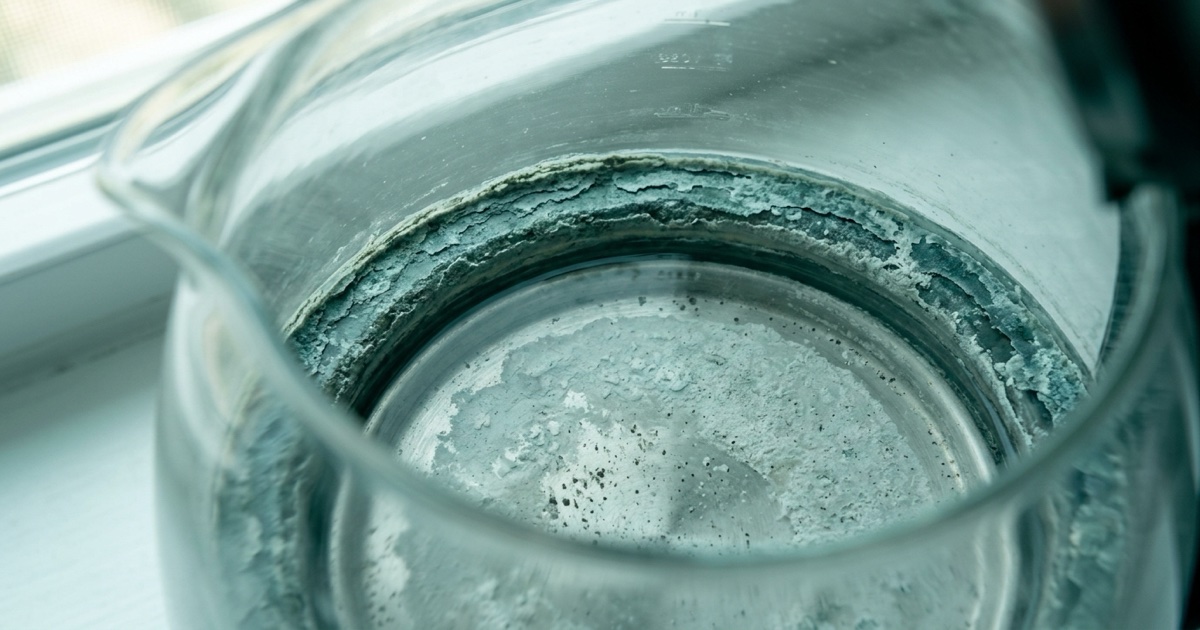
Table of contents
Summary of this article
- USGS states that hardness is a property of water that is not a health concern, but it can be a nuisance.
- Hardness has no maximum contaminant level, so it is absent from EPA's legally enforceable primary standards.
- It is also absent from the 15 non-enforceable secondary standards, which EPA sets for taste, color and odor.
- Hardness appears on EPA's secondary standards page only as a noticeable effect of total dissolved solids.
- USGS calls 0 to 60 parts per million soft. The Water Quality Association scale splits that range in two.
- NebGuide G1491 says softening adds about 8 parts per million of sodium per grain per gallon of hardness removed.
- EPA's guidance level for sodium in drinking water is 20 parts per million, for people restricted to 500 milligrams a day.
- CDC states that water softeners do not remove parasites, bacteria or viruses. G1491 adds lead, nitrate and pesticides.
Is hard water bad for you?
No. Hardness is dissolved calcium and magnesium, and USGS says it in one line, that hardness is “not a health concern, but it can be a nuisance.”
You already know what it feels like. Soap turns filmy in your hands instead of lathering. Glasses come out of a dishwasher spotted. There’s a chalky crust inside your kettle and a gray ring on your shower door, and none of that’s doing anything to you.
Nebraska’s extension service says it more bluntly, in a guide called G1491. Hard water is “considered a nuisance problem, but removing hardness ions isn’t necessary for health reasons.”
So the honest answer to what people type into a search bar is dull. Your water heater has a problem. You don’t.
Here’s the part that isn’t dull. Whatever you buy to fix hard water doesn’t take hardness away. It trades it. Calcium goes out, salt comes in, and how much salt is arithmetic nobody prints on the tank.
How much salt does a softener put in your water?
About 8 parts per million of sodium for every grain per gallon of hardness it removes. Sharon Skipton and Bruce Dvorak wrote that rate into G1491, alongside a description of the machine plain enough that you could stand in your own basement and follow it.
A tank of small plastic beads, loaded with sodium. Your hard water runs through, calcium and magnesium stick to those beads, and sodium comes off them into your water. When beads fill up, a salt brine washes them clean, and what came out of your water goes down a drain.
Nothing is filtered in the way you’d expect a filter to work. Calcium out. Sodium in. Two things leave, one thing takes their place, and that’s what you drink.
Skipton and Dvorak run that arithmetic on paper for you. Water at 10 grains per gallon comes out of that tank carrying about 80 parts per million of sodium. Eighty, out of a machine sold on a promise of taking things away.
Ten grains isn’t an extreme case. It falls inside a hard band on both scales further down this page, and both scales keep going above it.
Now set 80 beside what EPA publishes about sodium in drinking water. Two figures, neither of them a law.
One is about taste. Water between 30 and 60 parts per million is unlikely to taste salty to most people. The other is 20 parts per million, a guidance level written for people held to 500 milligrams of sodium a day, and it binds nobody.
So 80 is above that taste range, and 4 times that guidance level. Both figures are quoted from documents we’ve named. Putting them next to each other is ours.
There’s a larger number in that same 2003 advisory, taken from a review published in 1977. Home softeners can push sodium in drinking water past 300 parts per million.
Who checks the sodium a softener adds?
Nobody, and the reason is where a softener stands in the pipe. Sodium gets monitored where water enters the mains running toward your street, and those results go to state and local health officials. Your softener works at the far end of that pipe, past your meter, in your own basement, on an ordinary Tuesday, with nobody in the room.
So nobody comes to check. That’s our reading of where sodium monitoring stops rather than a sentence anybody wrote, and it is worth saying which of the two it is.
Which matters most to whoever in the house has been told to watch salt. A softener is a household appliance that raises sodium in every glass poured from a treated tap, and no monitoring program anywhere is looking at it. The usual answer is a hard-water tap at the kitchen sink, plumbed around the softener, so drinking water never passes through the resin at all.
What does a softener leave in your water?
Everything that isn’t hardness. G1491 names bacteria, hydrogen sulfide, silt or sand, lead, nitrate and pesticides as things water softening doesn’t remove, and adds a long tail of other compounds behind them.
Watch a kitchen a month after installation. Somebody has quietly stopped buying bottled water for the children, because theirs is treated now.
It isn’t. Not in the way they mean.
Stop on lead for a second. It’s what people mean when they say bad water, it’s why anybody looks at their pipes at all, and a softener runs straight past it.
CDC keeps a shorter version of that same list. Parasites, bacteria, viruses. A softener leaves all three where they are.
Which is the whole confusion in one sentence. People buy a softener and believe they bought a filter. What they bought is a scale and soap-scum machine, and it’s very good at that job.
Some units do more, depending on what’s in the box. A softener may also pull out iron, manganese, heavy metals, nitrates, arsenic, chromium, selenium or sulfate, so check a label for what yours claims, because two boxes on one shelf don’t do the same work.
One more line worth knowing before you shop. Some softeners take out fluoride too, which is there to prevent cavities.
The swap itself drags a little iron and manganese along with calcium and magnesium, as much as 5 to 10 parts per million of them. That’s an honest description of an appliance, not a complaint about one.
Is there a legal limit for hard water?
There’s no legal limit on hardness, and no guideline either. We went looking for one. It’s missing from the enforceable half of drinking water rules, and missing from the half nobody enforces.
Type “safe hardness limit” into anything and figures come back at you, every one of them a word for what water is like, borrowed from a table that somebody drew. None of them are rules.
Take enforceable first. Those rules cover germs, disinfectants and what they leave behind, a list of chemicals, some PFAS, and radioactive elements. Calcium, magnesium and hardness are on none of them.
Then there’s a courtesy half. EPA writes guidelines there for 15 substances, states outright that it doesn’t enforce them, and explains they exist for taste, color and odor rather than for health.
Hardness isn’t one of those 15 either. It appears on that page once, inside somebody else’s row. Total dissolved solids carries a guideline of 500 parts per million, and hardness is listed as one of five things you would notice above it, alongside deposits, colored water, staining and salty taste.
Hardness is filed there as a symptom of something else. It has no figure of its own anywhere in federal drinking water rules.
That has a consequence you can feel. A violation needs a rule to break first, and hardness has none, so a system pumping rock-hard water is out of compliance with nothing. Nobody wrote that sentence for us. It follows from what federal records track, which is missed monitoring, failed treatment and broken limits.
Your utility owes you a Consumer Confidence Report by July 1 every year, and what belongs in it’s written around regulated contaminants. Hardness isn’t one. Plenty of systems print it anyway, because customers ask and it costs them nothing, and a report leaving it out is still complete.
Which hardness scale should you use?
Two published scales disagree about where soft water ends. One is federal. The other was drawn by a trade group whose members make and sell water treatment equipment.
You’ll probably meet the second one first. It arrives laminated, on a card, turned around on your kitchen counter by somebody with a van outside.
| Word for it | USGS | Water Quality Association |
|---|---|---|
| Soft | 0 to 60 | 0 to 17 |
| Slightly hard | no such band | 17 to 60 |
| Moderately hard | 61 to 120 | 60 to 120 |
| Hard | 121 to 180 | 120 to 180 |
| Very hard | above 180 | 180 and over |
Both columns are in parts per million.
Read them from the bottom and they nearly agree. Read them from the top and they split. Federal geologists draw one soft band running all of the way to 60, and that second column cuts the same stretch in two, calling anything above 17 slightly hard.
So water one scale calls soft picks up a hardness word on the other, and a house at 40 gets a problem it didn’t have this morning. Same water. Two words for it.
That second column is Table I of G1491, and a line above it credits the Water Quality Association. WQA describes itself as a not-for-profit association for the residential, commercial, and industrial water treatment industry, with more than 2,500 member companies making, supplying, selling and distributing water quality improvement products.
Draw your own conclusion about who gains from an extra band at the soft end. It may be nothing at all. It’s still worth knowing whose table you’re looking at when somebody turns one around on your kitchen counter.
Neither scale is a limit. Both describe what natural water is like, and neither one says safe or unsafe, because neither is about health.
Softener conversations happen in grains per gallon rather than parts per million, and one grain works out to roughly 17 parts per million. That’s why 10 grains falls inside a hard band on either table.
How hard is your water?
Three ways to find out, in order of usefulness. Ask your utility. Pay a lab. Then, last, look at a national map that warns you against using it for your address.
Start with a phone call. Hardness isn’t a required line in your annual report, but plenty of systems publish it on a water quality page anyway, and whoever answers that phone knows.
Nobody publishes anything about your water if you’re on a private well. Labs test for hardness, so do some city and county health departments, and so do plenty of water treatment dealers. Dip strips and home kits exist, and G1491 warns that a strip may or may not give you something you can decide on.
Read that twice if whoever offers you a free test is also selling you a softener.
Then there’s that map. Federal geologists built a national picture of hardness on 1975 water-year data, and hung a warning on it that matters at your address. Those figures are “not designed to be used to make local decisions” or decisions at the scale of individual homeowner property. Go to your local health agency, your water utility, or a softener vendor instead, which is a strange sentence to find on a government page and an honest one.
At national scale that map does tell you something. A separate federal sampling of about 2,100 private wells found hard water common across east-central and western parts of this country.
What does hard water cost you?
Money, and mostly through your water heater. Heat pulls calcium and magnesium out of solution, scale builds on hot surfaces inside, heating slows, and energy use climbs.
You’ve seen what it looks like, only not in there. That chalky shell inside your kettle is the same material, and inside a heater it’s growing on whatever gets hot.
That’s the part with a bill attached. Scale shortens equipment life, raises what it costs you to heat water, drops efficiency in an electric heater, and clogs pipes given long enough.
Everything else is laundry and glassware. Clothes go dingy and gray. Glasses spot. Film builds on shower doors and curtains. And soap keeps meeting calcium and making scum, so you use more of it every wash.
Federal rules sort problems like this into three drawers. Bad tastes and odors, effects that leave a person unharmed but are still unwanted, and damage to your equipment. Read those three and notice what’s missing from all of them.
So buy a softener if you want one. Scale wrecks water heaters, detergent costs money, and a machine keeping your heater alive can be worth its salt and its price. We’d call that an ordinary decision about an appliance, made the same way you’d decide about a dishwasher.
It’s simply not a health decision, and sodium runs the other way from what people assume. If somebody under your roof is on a restricted-sodium diet, Skipton and Dvorak give you the plumbing answer, and it’s cheap on the day the installer is standing there. Run one cold line to your kitchen tap that goes around the softener. Hard water for drinking and cooking. Soft water for everything else.
Sources
- U.S. Geological Survey. Hardness of Water, Water Science School (2018)
- U.S. Environmental Protection Agency. National Primary Drinking Water Regulations (2026)
- U.S. Environmental Protection Agency. Secondary Drinking Water Standards: Guidance for Nuisance Chemicals (2026)
- U.S. Environmental Protection Agency. Drinking Water Advisory: Consumer Acceptability Advice and Health Effects Analysis on Sodium (2003) EPA 822-R-03-006
- U.S. Environmental Protection Agency. Safe Drinking Water Information System (SDWIS) Federal Reporting (2026)
- U.S. Environmental Protection Agency. CCR Information for Consumers (2026)
- Centers for Disease Control and Prevention. About Home Water Treatment Systems (2024)
- University of Nebraska-Lincoln Extension. Water Softening (Ion Exchange), by Sharon O. Skipton and Bruce I. Dvorak (2026) NebGuide G1491
- Water Quality Association. About WQA (2026)
- National Institute of Diabetes and Digestive and Kidney Diseases. Eating, Diet, & Nutrition for Kidney Stones (2026)
Questions people ask
Is hard water bad for your health?
No. USGS states that hardness is a property of water that is not a health concern, but it can be a nuisance. NebGuide G1491 from University of Nebraska-Lincoln Extension puts it the same way: hard water is a nuisance problem, and removing hardness ions isn't necessary for health reasons.
Does EPA set a limit for water hardness?
No. Hardness carries no maximum contaminant level under the National Primary Drinking Water Regulations, which are the legally enforceable standards. It is also not one of the 15 contaminants covered by the non-enforceable National Secondary Drinking Water Standards.
What counts as hard water?
USGS classifies 0 to 60 parts per million as soft, 61 to 120 as moderately hard, 121 to 180 as hard, and more than 180 as very hard. That is a description of natural water, not a safety threshold.
Does a water softener remove lead?
No. NebGuide G1491 states that water softening does not remove bacteria, hydrogen sulfide, silt or sand, lead, nitrate or pesticides. CDC separately lists parasites, bacteria and viruses among what softeners do not remove.
How much sodium does a water softener add to the water?
NebGuide G1491 puts it at about 8 parts per million of sodium for every grain per gallon of hardness removed. Its worked example: water that was 10 grains per gallon comes out at about 80 parts per million of sodium.
Is softened water safe to drink on a low-sodium diet?
EPA 822-R-03-006 sets a guidance level of 20 parts per million of sodium in drinking water, developed for people restricted to 500 milligrams of sodium a day. NebGuide G1491 advises those on restricted sodium diets to account for softened water and consult their physician, and describes running a cold line to the kitchen tap that bypasses the softener.
How do I find out how hard my water is?
Ask your utility, because hardness is not a required line in the Consumer Confidence Report but many systems publish it anyway. On a private well, use a certified lab. USGS says its national hardness map is not designed for decisions at the scale of an individual property.
Have questions about the environment inside your home?
Air quality, mold, EMF, light and water all shape how a house feels and how the people in it feel. Whatever your concern is, the first step is finding out what is there.
Our certified team of environmental professionals and advocates can help.