


SpaceX wants up to 1 million satellites, and the metal comes back to Earth
Scientists told NBC News that vaporized spacecraft from re-entry could seed the upper atmosphere with metal particles if the company puts AI computing in orbit at that scale. The fallout wouldn't stay in space.
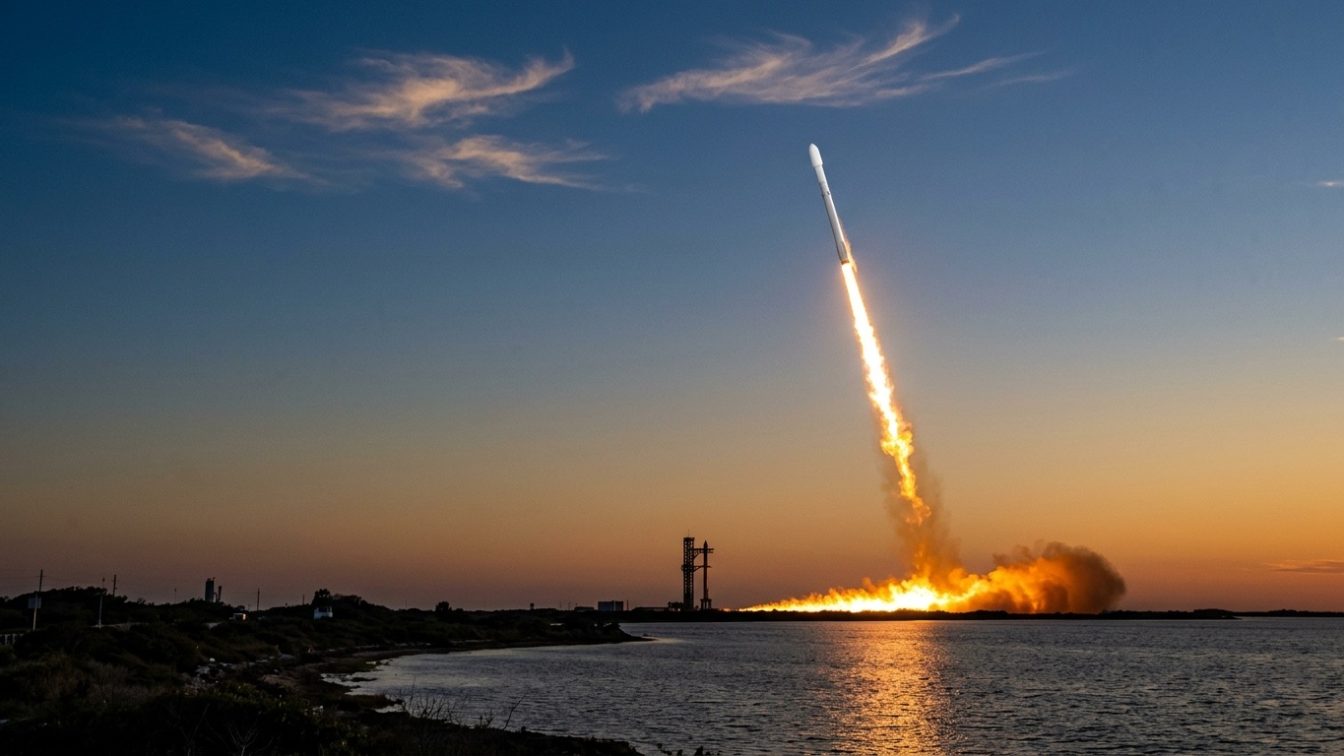
Table of contents
Summary of this article
- SpaceX has proposed launching up to 1 million data center satellites, NBC News reported on July 28, 2026, to run artificial intelligence computing in orbit rather than on the ground.
- Scientists warn the plan could turn Earth's atmosphere into a "fire pit." When satellites reach the end of their lives, they burn up on re-entry and vaporize their materials into the upper atmosphere.
- The core exposure is metallic particle pollution. Vaporized spacecraft material, aluminum and other metals, would be deposited high in the atmosphere at a scale never tested before.
- Three atmospheric risks are named: disruption of atmospheric chemistry, including the ozone layer; scattering and blocking of sunlight by reflective particles; and interference with ground-based telescopes.
- This is a shared, unfilterable exposure. Unlike a router or a power plant, atmospheric pollution cannot be avoided by distance, filtration, or relocation. It reaches every person under the sky.
- The response is civic, not domestic: demand a full environmental impact statement before mega-constellations are approved, support satellite-disposal and dark-sky regulation at the FCC and internationally, and back astronomical and dark-sky protections locally.
SpaceX has proposed launching up to 1 million data center satellites, NBC News reported on July 28, 2026. Scientists interviewed for the report warn the plan could pump Earth’s atmosphere full of vaporized spacecraft material and, in the words summarized by NBC News, turn it into a “fire pit.”
The pitch is a solution to a problem this series has already documented. Data centers on the ground drain water, strain power grids, and pollute the air of the communities that host them. Moving them to orbit promises to escape all of that: constant solar power, no neighbors, no municipal water. The problem, scientists say, is that the escape is an illusion. What goes up comes down, and at the scale of a million satellites, what comes down is a new kind of pollution deposited into the one environment every person on Earth shares.
This is where a building-biology lens shifts. The earlier articles in this batch dealt with exposures you can measure at your pillow or filter in your bedroom. This one cannot be filtered, moved away from, or sealed out. The exposure is the atmosphere itself.
What SpaceX is actually proposing
Start with the scale, because the number is the story.
SpaceX has floated a plan for as many as 1 million data center satellites, according to NBC News. For comparison, roughly 10,000 to 12,000 active satellites currently orbit Earth in total, from all countries and companies combined. The proposal would multiply the entire history of the space age by a factor of about 100, in a single class of hardware, for a single purpose.
That purpose is artificial intelligence. AI computing demands enormous, continuous power and generates enormous heat. On the ground, that means the grid stress, water consumption, and diesel-generator pollution documented across this series. In orbit, the appeal is direct: sunlight is nearly constant above the atmosphere, so solar panels can run around the clock, and the cold vacuum of space offers a heat sink no earthbound cooling tower can match.
The logic is that the machines disappear from the neighborhood. Scientists say the machines do not disappear from the planet’s systems.
Why satellites become atmospheric pollution
A satellite is not permanent. It has a working life, often a handful of years, after which it fails, runs out of fuel, or is deliberately deorbited to make room for newer hardware. What happens next is the concern.
When a satellite re-enters the atmosphere, it does not land intact. It burns. Friction with the air heats the spacecraft to thousands of degrees, and most of it vaporizes, turning solid metal into gas and fine particles high in the atmosphere. For a single satellite, this is a minor event. For a constellation that must be continuously replaced to stay operational, it becomes a steady, permanent stream of vaporized metal entering the upper atmosphere.
Run the arithmetic on a million satellites. A constellation that size, with hardware lasting only a few years, would require constant launches to replace failing units, and constant re-entries as the old ones burn up. The result is a continuous deposition of spacecraft material, dominated by aluminum, into a region of the atmosphere that has never before absorbed pollution at anything close to this rate.
That is the “fire pit” scientists describe: not a fire on the ground, but an atmosphere seeded with the ash of a machine fleet that must burn and be rebuilt indefinitely.
The three atmospheric risks
The concern is not aesthetic. Scientists interviewed by NBC News point to three distinct effects, each reaching the environment that human health depends on.
Disrupted atmospheric chemistry. The upper atmosphere is not empty. It hosts the ozone layer, which absorbs the sun’s ultraviolet radiation before it reaches the surface. UV exposure at ground level is linked to skin cancer, eye damage, and harm to crops and ecosystems. Metallic particles from vaporized satellites can participate in chemical reactions in this layer, and researchers warn that depositing aluminum and other metals at unprecedented scale could interfere with the chemistry that keeps the ozone layer intact. The shield that protects everyone under it is the system at risk.
Blocked and scattered sunlight. Reflective particles suspended high in the atmosphere scatter incoming sunlight. At small scale, this is negligible. At the scale of a continuous metal-particle stream, scientists raise the prospect of measurable interference with how much sunlight reaches the surface, a variable that governs temperature, weather patterns, and the photosynthesis every food crop depends on. This is planetary-scale tampering with an input no one voted to change.
Blinded telescopes. The satellites do not have to fail to cause harm. In orbit, they reflect sunlight, and a constellation of a million would flood the night sky with moving points of light. Astronomers fear the proposed data center satellites could interfere with observations by ground-based telescopes, NBC News reported. Beyond the loss to science, ground-based astronomy is one of the systems that tracks asteroids and monitors the sky for hazards. Drowning it out has consequences beyond the observatory.
Why this exposure is different
Every prior exposure in this series shared one feature: you could put distance between yourself and it. Move the bed from the panel. Filter the air from the power plant. Wire the router and switch it off. The building-biology playbook is built on source control and distance.
Atmospheric pollution breaks that playbook. You cannot move away from the sky. You cannot filter the stratosphere. You cannot relocate to a house with a cleaner ozone layer. The atmosphere is a single shared system, and a change to it applies to every person underneath it at once.
This is the largest possible version of the principle building biology applies to a home: an exposure does not stay at its source. A satellite burns up over the ocean, and its vaporized metal circulates through an atmosphere that belongs to no country and shields the entire planet. The “no neighbors in space” pitch inverts the truth. In the atmosphere, everyone is the neighbor.
What individuals and communities can do
Source control still applies, but the source is a launch program, and the lever is public and regulatory, not domestic. The action moves from the bedroom to the comment period.
1. Demand a full environmental impact statement. A project that proposes to alter the upper atmosphere warrants formal environmental review before it proceeds, not after. In the United States, that means a full environmental impact statement (EIS) examining the cumulative effect of mass satellite re-entry on atmospheric chemistry. Residents, scientists, and advocacy groups can demand this review through the FCC, which licenses satellite constellations, and through public comment on federal actions. The earlier the review, the more it can shape.
2. Support satellite-disposal and dark-sky regulation. The FCC sets rules for how satellites are licensed, operated, and deorbited, and international bodies coordinate the use of orbital space. Advocating for enforceable disposal standards, limits on constellation size, and requirements to account for atmospheric deposition puts the burden on the operator to prove the plan is safe rather than on the public to prove harm after the fact.
3. Back astronomical and dark-sky protections. Support for ground-based astronomy, dark-sky ordinances, and organizations defending observation from light and satellite pollution keeps the systems that detect these problems funded and functioning. The telescopes threatened by the constellation are also the instruments that would measure its effects.
4. Treat it as an environmental decision, not a tech announcement. The framing matters. A million-satellite constellation is often reported as a business or engineering story. Insisting it be evaluated as what it is, a planetary-scale environmental intervention, is itself a form of civic pressure that shapes how regulators and the public respond.
The bottom line
SpaceX has proposed up to 1 million data center satellites, NBC News reported on July 28, 2026. The plan promises to solve the ground-level costs of AI by moving the machines to orbit. Scientists warn it trades those costs for a larger one: a continuous stream of vaporized metal deposited into the upper atmosphere as the constellation burns and rebuilds itself, with risks to the ozone layer, to sunlight reaching the surface, and to the telescopes that watch the sky.
This is the one exposure in this series that no household fix can touch. You cannot measure it at your pillow or filter it in your bedroom. The atmosphere is the largest shared room there is, and it reaches every person under it. The response is public: demand the environmental review before the launches, support the rules that govern orbital disposal and dark skies, and insist a planetary intervention be judged as one. When the source is in orbit and the fallout is atmospheric, the only source control available is the decision to launch, and that decision is still open.
Sources
- NBC News (Jean Lee). "SpaceX plan to launch 1 million data center satellites could turn atmosphere into a 'fire pit,' scientists say." July 28, 2026.
- The Conversation. "5 ways data centers endanger their local communities and the country as a whole."
Questions people ask
What did SpaceX actually propose?
SpaceX has proposed launching up to 1 million data center satellites, NBC News reported on July 28, 2026. The goal is to run artificial intelligence computing in orbit, where solar power is nearly constant and the cold of space can absorb the heat the machines generate, rather than in ground-based data centers that drain local water and power.
Why do scientists call it a "fire pit"?
Satellites have limited lifespans, and when they fail they burn up on re-entry, vaporizing their metal into the upper atmosphere. Scientists interviewed by NBC News warn that continuously replacing and re-entering a constellation of a million satellites would seed the atmosphere with a steady stream of vaporized spacecraft material, the effect they summarize as turning the atmosphere into a "fire pit."
What are the main environmental risks?
Scientists point to three. Vaporized metals can disrupt the chemistry of the upper atmosphere, including the ozone layer that blocks ultraviolet radiation. Reflective particles can scatter and block sunlight reaching the surface. And the satellites themselves reflect sunlight, flooding the night sky and interfering with ground-based telescopes, according to NBC News.
How is this different from a data center on the ground?
Ground-based data centers create local exposures, water drawdown, grid stress, air pollution, noise, that residents can measure, filter, or move away from. A satellite constellation's pollution enters the atmosphere, a single shared system that no one can filter, avoid by distance, or relocate away from. It reaches everyone under the sky at once.
Can I protect my household from this?
Not through the usual building-biology tools. There is no filter for the stratosphere and no distance from the atmosphere. Protection is collective rather than individual, which is why the recommended actions are civic: demanding environmental review, supporting orbital-disposal and dark-sky regulation, and treating the proposal as an environmental decision.
What can communities actually do about it?
Demand a full environmental impact statement examining mass satellite re-entry before constellations are approved; support FCC and international rules on satellite disposal, constellation size, and dark-sky protection; back ground-based astronomy and dark-sky organizations; and insist the proposal be evaluated as a planetary-scale environmental intervention rather than a routine technology announcement.



Have questions about the environment inside your home?
Air quality, mold, EMF, light and water all shape how a house feels and how the people in it feel. Whatever your concern is, the first step is finding out what is there.
Our certified team of environmental professionals and advocates can help.