


Thinking Scores Fell 15% at 945 ppm. A Closed Bedroom Hits 4,000 by Morning
Outdoor air is about 428 ppm. A closed, unventilated bedroom reaches 2,000 to 4,000 ppm overnight. The 5,000 ppm limit everyone quotes is an OSHA workplace rule written for factories.
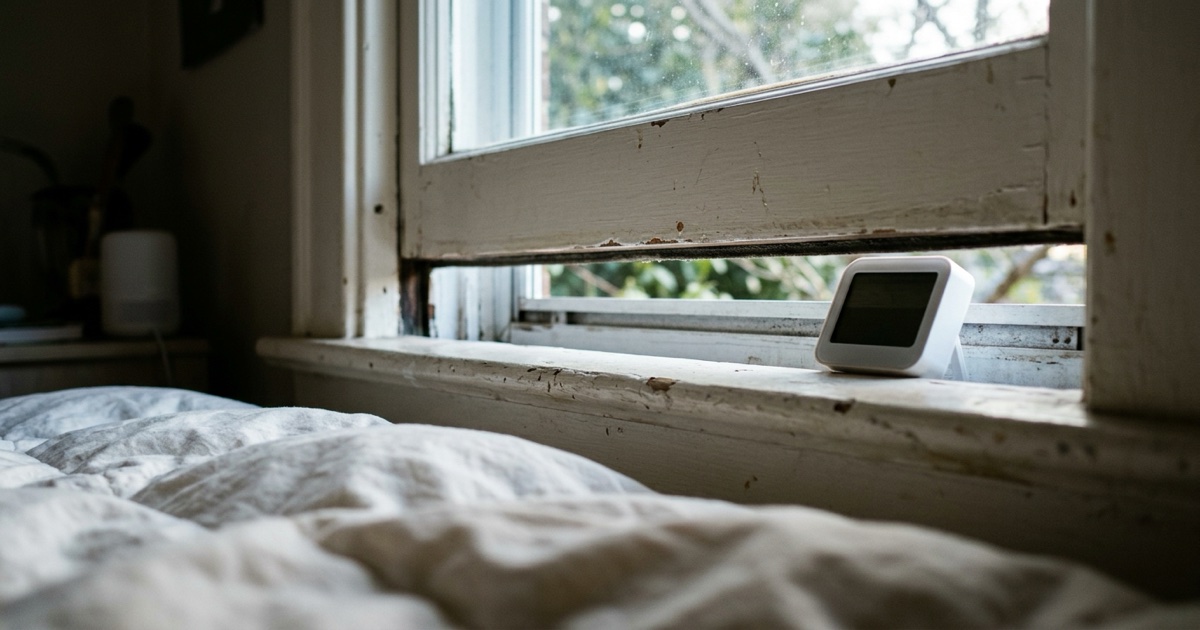
Table of contents
Summary of this article
- A closed, unventilated bedroom reaches 2,000 to 4,000 ppm of carbon dioxide after one night, according to the SBM-2024 guidelines for sleeping areas. Outdoor air sits near 428 ppm.
- Nothing has to break for that to happen. Two people breathing in a shut room for eight hours does it, and a tighter, better-built house climbs faster.
- The 5,000 ppm figure quoted in most articles is an OSHA workplace limit for adult workers on an eight-hour shift. No federal agency sets a health-based carbon dioxide standard for a home.
- Allen and colleagues, in Environmental Health Perspectives in 2016, found decision-making scores 15% lower at about 945 ppm than near 550. At about 1,400 ppm scores fell 50%.
- SBM-2024 grades sleeping areas an order of magnitude lower than OSHA: under 700 ppm no anomaly, 700 to 1,000 slight, 1,000 to 1,500 severe, above 1,500 extreme.
- The bedroom is the worst room in the house for this. It has the longest uninterrupted occupancy and the most reasons to be sealed shut.
- Carbon dioxide is not toxic at these levels. It is a marker: when it climbs, air is not moving, and everything else the room emits climbs with it.
- The fix is usually free. A door left ajar, a window on the latch, or a ventilation fan that nobody has switched on since the builder left. No air purifier removes a gas.
Outdoor air sits at about 428 ppm of carbon dioxide, the global average NOAA’s Global Monitoring Laboratory recorded for May 2026. A closed, unventilated bedroom after one night reaches 2,000 to 4,000 ppm, according to the SBM-2024 building biology guidelines for sleeping areas.
That is five to ten times the air outside the window, and nothing has to go wrong for it to happen. Two people breathing in a shut room for eight hours does it on its own.
Here is where the number comes from, why the limit everyone quotes does not apply to a house, what the research says happens to thinking well below that limit, and what it costs to fix.
Nothing breaks for this to happen
A bedroom is closed at eleven and opened at seven. In between, two adults exhale into it continuously and very little comes in to replace what they use.
Every reason for shutting the door is a good one and none of them is about air. Traffic noise. Cold in January. Air conditioning in July. Privacy. A baby who wakes at any sound. Each one reduces how much air moves through the room.
A tighter, better-built house climbs faster, because less air leaks past the door frame and window seals. The bedroom is the worst room in the house for this for two reasons: it has the longest uninterrupted occupancy of any room, and it has the most reasons to be sealed.
Eight hours a night, repeated for years, is the longest continuous stretch anyone spends breathing one room’s air.
The 5,000 ppm limit was written for factories
OSHA caps carbon dioxide at 5,000 ppm averaged across an eight-hour shift, and California’s workplace rule uses the same figure. No federal agency publishes a health-based standard for a home. Nothing covers a bedroom, and nothing covers a child’s.
That 5,000 figure appears constantly in articles about houses, and it describes a different situation entirely: a working adult, on the clock, for eight hours, who then leaves through a door.
The practical problem is that it reads as reassurance. Someone buys a monitor, watches a bedroom sit well under 5,000 all night, and concludes there is nothing to look at.
Thinking changes far below any workplace limit
Allen and colleagues, writing in Environmental Health Perspectives in 2016, put office workers through a day of decision-making tests at controlled carbon dioxide levels.
Scores came out 15 percent lower at about 945 ppm than on days near 550. At about 1,400 ppm scores fell 50 percent, and every further 400 ppm tracked a 21 percent drop.
Both of those figures sit far below the 5,000 ppm workplace ceiling, and both sit inside the range a closed bedroom passes through in the dark.
What the building biology bands actually say
SBM-2024 grades sleeping areas rather than workplaces, and its bands sit an order of magnitude lower than OSHA’s: under 700 ppm is no anomaly, 700 to 1,000 is slight, 1,000 to 1,500 is severe, and above 1,500 goes in an extreme column.
Set that against the measured overnight range of 2,000 to 4,000 ppm and the gap is the story. A bedroom does not drift toward the top band; it starts the night below the bottom one and ends above the top.
Carbon dioxide itself is not toxic at these levels. It is useful as a marker. When it climbs, air is not moving, and everything else the room gives off climbs with it.
The fix is usually free
A door left ajar moves more air than most people expect. Shut, in a newer tight house, the only air moving is what squeezes past the frame. Open a hand’s width, and the bedroom is connected to a whole floor.
A window on the latch does more and costs heat. A small permanent gap over a whole night costs less than throwing a window wide for ten minutes in the morning.
If the house has a ventilation fan, this is the job it was installed to do. A fan nobody has touched since the builder left is doing nothing.
A carbon dioxide monitor is inexpensive, and it should sit near the pillow rather than on a dresser across the room. That reading beats every figure in this article, because it is one specific room on one specific night.
None of this involves an air purifier. Carbon dioxide is a gas, not a particle, and no filter removes it.
Where you sleep changes what is possible
A bedroom with a window that opens is a two-inch problem. A basement bedroom with one small hopper window, an interior room in a converted apartment, or a bedroom in a tight new build with no operable window at all are different problems, and the answer there is the mechanical ventilation the house was supposed to include.
In a rental, a door left ajar does more than any purchase will.
Five numbers, and telling them apart is the skill
A bedroom starts the night at 428 and ends somewhere between 2,000 and 4,000. It crosses 700, then 945, in the dark, with nobody awake to notice, and wherever it has reached when the alarm goes off is where it stops.
Only one of those five figures is legally enforceable, and it was written about a building other than a house.
Open a door, find the ventilation switch, and measure if you want to know rather than guess. It costs nothing, requires no testing, and can be done tonight.
Sources
- Occupational Safety and Health Administration. Annotated PELs, Table Z-1 (2026)
- Environmental Health Perspectives. Allen JG, MacNaughton P, Satish U, Santanam S, Vallarino J, Spengler JD. Associations of Cognitive Function Scores with Carbon Dioxide, Ventilation, and Volatile Organic Compound Exposures in Office Workers (2016)
- NOAA Global Monitoring Laboratory. Trends in Atmospheric Carbon Dioxide, global means (2026)
- Institute of Building Biology + Sustainability (IBN). Building Biology Evaluation Guidelines for Sleeping Areas, SBM-2024, Standard Point B6 (2024) SBM-2024, 9th edition
Questions people ask
What is a normal carbon dioxide level in a bedroom?
A closed, unventilated bedroom reaches 2,000 to 4,000 ppm after one night, according to SBM-2024. Outdoor air sits near 428 ppm, the global average NOAA recorded for May 2026, so a shut bedroom runs five to ten times outdoor air by morning.
Is there a legal limit for carbon dioxide in a house?
No. OSHA caps it at 5,000 ppm averaged over an eight-hour shift, and California uses the same figure, but both are workplace rules. No federal agency publishes a health-based standard for a home or a child's bedroom.
Does carbon dioxide in a bedroom affect thinking?
Allen and colleagues, writing in Environmental Health Perspectives in 2016, found decision-making scores 15% lower at about 945 ppm than at about 550. At roughly 1,400 ppm scores fell 50%, with every further 400 ppm tracking a 21% drop. All of those levels sit far below the 5,000 ppm workplace limit.
What level do building biologists aim for?
SBM-2024 treats under 700 ppm as no anomaly, 700 to 1,000 as slight, 1,000 to 1,500 as severe, and above 1,500 as extreme. Those bands are for sleeping areas, and they sit an order of magnitude below the workplace figure.
Why does it matter if carbon dioxide is not toxic at these levels?
Because it works as a marker. Rising carbon dioxide means air is not moving through the room, and everything else the room gives off is accumulating alongside it.
How do I lower carbon dioxide in my bedroom?
Leave the door ajar, which connects the room to the rest of the floor and moves more air than most people expect. A window on the latch does more and costs heat. If the house has a ventilation fan, check that it actually runs.
Will an air purifier help?
No. Carbon dioxide is a gas rather than a particle, and no filter removes it. A purifier addresses a different problem entirely.
Where should a carbon dioxide monitor go?
Near the pillow rather than on a dresser across the room, and read it before making coffee rather than during the day. That measurement beats any published figure, because it is one specific room on one specific night.
Have questions about the environment inside your home?
Air quality, mold, EMF, light and water all shape how a house feels and how the people in it feel. Whatever your concern is, the first step is finding out what is there.
Our certified team of environmental professionals and advocates can help.