


Dead coral decided which reefs recovered and which collapsed
Across 10 ecosystems hit by extreme events, dead coral skeletons either sheltered the next generation or helped seaweed take over. The same remains shaped recovery in 9 of the 10 systems studied.
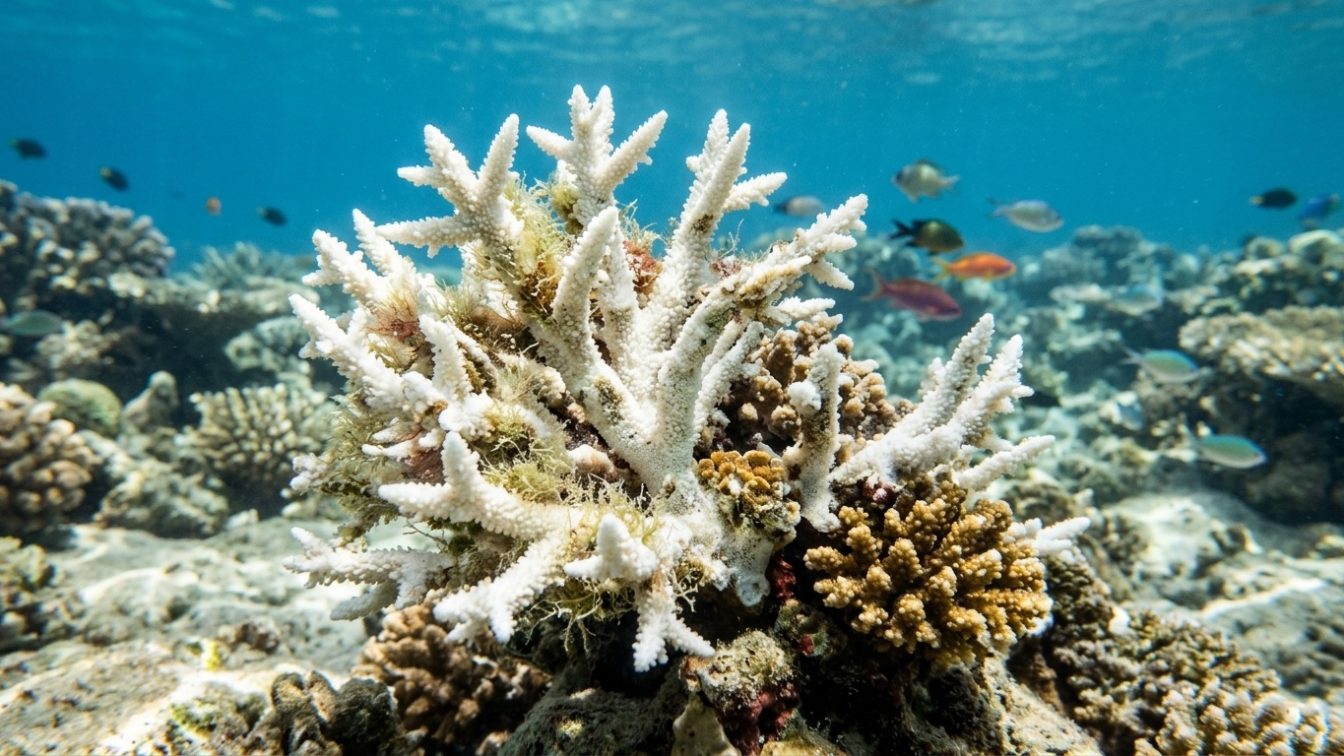
Table of contents
Summary of this article
- A study published in Science Advances, covered by The Conversation, examined 10 ecosystems hit by extreme events and found that dead "foundation species" significantly affected recovery in 9 of the 10. The kelp forest was the only exception.
- Foundation species are abundant, structure-building organisms, corals, trees, oysters, mangroves, grasses, that create the physical framework entire communities depend on.
- Because they are abundant in life, they remain abundant in death, and their remains shape what grows back. Ecologists call this "ecological memory."
- In roughly half the cases studied, dead remains blocked recovery. In the other cases, they fueled it.
- On the coral reefs of Moorea, dead skeletons gave competing seaweed a foothold, preventing coral from returning. In the mangroves of the Florida Everglades, storm-blown leaf litter fed new root growth and sped recovery.
- Humans can manage the outcome: felling dead trees into nurse logs, using prescribed burns to clear dead grass, depositing dead oyster shells onto mud flats, and stabilizing or removing coral rubble.
- As extreme events grow more frequent, deciding what to do with dead material, remove it, stabilize it, or leave it, becomes a practical lever for recovery.
A dead coral skeleton is not neutral. On some reefs it becomes the scaffold new coral grows back on. On others it becomes the perch that competing seaweed uses to take over and shut coral out for good. Same object, opposite outcomes.
A study published in Science Advances, covered by The Conversation, set out to measure which way that balance tips. The researchers examined 10 ecosystems across the United States that had been struck by wildfires, hurricanes, marine heat waves, and pest outbreaks. In 9 of the 10, the remains of dead organisms significantly changed how the living recovered. Only the kelp forest showed no measurable effect.
That finding rewrites a common assumption. The dead do not simply disappear after a disaster. They stay, and they shape what happens next.
What a Foundation Species Is
The study focused on foundation species. These are the abundant, structure-building organisms that create the physical framework an entire community depends on, trees, grasses, oysters, mangroves, and corals. A coral reef is built by coral. A forest is built by trees. Remove the foundation species and the habitat itself collapses, taking everything that lived in it.
Foundation species exist everywhere, from the deep ocean to mountain summits. And here is the point the study turns on: because these organisms are abundant while alive, they remain abundant after they die. A forest that loses its trees is left with a landscape of dead wood. A bleached reef is left with a field of coral skeletons. The remains are not a footnote. They are a major physical presence that lingers for years.
Ecological Memory: The Past Shaping the Present
Ecologists have a name for this. They call it “ecological memory”, the way remnants of the past influence how an ecosystem looks and behaves in the present.
The comparison the researchers draw is to human memory. Traumatic events leave the strongest marks. Fires, storms, heat waves, and disease outbreaks kill plants and animals on a wide scale, and they leave behind the most abundant, longest-lasting physical remains. Those remains carry forward. They set both the pace and the direction of recovery, either steering an ecosystem back toward what it was or pushing it into something entirely new.
The study quantified how often this happens. In 9 of 10 ecosystems, dead foundation species measurably increased or decreased the living ones that followed. In roughly half of the cases, the dead hampered recovery. In the other half, they promoted it. The dead were rarely bystanders.
When the Dead Block Recovery
The clearest example of dead material shutting down recovery comes from the coral reefs of Moorea, in the South Pacific.
A marine heat wave causes coral bleaching. Under heat stress, coral expels the algae living in its tissue, turns white, and, if the heat persists, dies. What is left behind is a standing field of coral skeletons. Those skeletons do not stay empty. Their nooks and crannies give seaweed, which competes with coral for reef space, exactly the foothold it needs. The seaweed proliferates, overgrows the dead structure, and takes over the reef. Coral cannot return to space the seaweed now occupies. The reef becomes, in the researchers’ words, a ghost town of dead skeletons overgrown by seaweed.
The same blocking pattern appears on land. In the tropical montane rainforest of Puerto Rico, hurricanes strip the canopy and blanket the forest floor with branches and leaves. That layer of debris chokes off the sunlight seedlings need. Fewer seedlings emerge to replace the trees the storm killed, and the forest’s recovery slows.
In both cases the dead physically stands in the way. It is an exposure pathway in reverse: instead of releasing a contaminant, the remains occupy the space and block the light that new life requires.
When the Dead Fuel Recovery
The opposite outcome is just as real. In several of the ecosystems studied, dead organisms accelerated the return of the living.
The mangrove forests of the Florida Everglades benefit from storm debris. During a hurricane, leaf litter is blown and washed out of the canopy and settles into the dense network of roots below. That litter delivers a pulse of nutrients that boosts new root production and speeds the forest’s recovery. The debris that buries a Puerto Rican rainforest floor feeds a Florida mangrove.
The hemlock forests of New England show the same benefit through a different mechanism. An outbreak of the woolly adelgid, a tree-killing pest, left wide swaths of standing dead hemlock. Unlike the bare skeletons on a bleached reef, these dead trees help new hemlock saplings grow by maintaining a favorable climate on the ground below them. The standing dead shelters the living young.
The difference between the Moorea reef and the New England hemlocks is the entire question the study addresses. In one, the dead structure invites a competitor. In the other, the dead structure protects the successor. Reading which way a given ecosystem will tip is what turns this science into a tool.
The Building-Biology Lens: Managing the Source
Environmental health rests on a simple principle: to change an outcome, you manage the source. The Science Advances findings extend that principle to disaster recovery. After an extreme event, the dead material is the source that will shape what grows back, and humans can manage it deliberately.
The researchers describe several methods already in use.
On land, standing dead trees are sometimes felled to create “nurse logs”, decaying trunks that release nutrients and provide soft, low-competition ground where new seedlings establish more easily. Dead grass litter is cleared through prescribed burning to create better conditions for new grass to grow, a technique used on tallgrass prairie.
On the coasts, the interventions are direct. Dead oyster shells are collected, often from restaurants, dried, and deposited onto mud flats, where free-floating baby oysters attach and grow. The shells become the foundation for a new colony. On reefs, the rubble of dead coral skeletons is either stabilized to create solid ground for new coral to settle, or removed outright to deny seaweed the foothold that would otherwise lock coral out.
Each of these is a decision about the source. Leave the dead material, stabilize it, or remove it, and that choice tips recovery one way or the other.
Why This Matters Now
The frequency of the disturbances driving these die-offs is rising. Marine heat waves, larger wildfires, and stronger storms all produce more dead foundation species, more often. That makes the management of dead material a recurring decision rather than a rare one.
The timing lesson is sharp on the coast. A mangrove hit by frequent storms recovers more slowly, because recovery takes years and each new storm resets the clock before the last recovery finishes. A reef left as bare skeleton gives seaweed time to entrench. The window to steer the dead toward regeneration, rather than letting it default to blockage, narrows the longer it stays unmanaged.
The value of the study is that it replaces a reflex with a decision. The reflex is to see a burned forest or a white reef as a finished loss. The decision is to recognize the dead as an active force and to manage it: fell it into a nurse log, burn it, stabilize it, or clear it, depending on what the ecosystem needs. Nine out of ten ecosystems responded to what happened to their dead. That is nine out of ten chances to intervene.
The Takeaway
The dead decide a great deal about the living. A study in Science Advances found that in 9 of 10 ecosystems hit by extreme events, the remains of dead foundation species significantly shaped recovery, blocking it in about half the cases and fueling it in the rest. A coral skeleton can scaffold a new reef or hand it to seaweed. A fallen tree can smother seedlings or shelter them.
The practical conclusion is the one that runs through all of environmental health: manage the source. After a disaster, the dead material is that source, and what people choose to do with it, remove the rubble, stabilize the substrate, seed the mud flat with old shells, fell the snag into a nurse log, helps decide whether an ecosystem rebuilds or collapses. Death, in nature, is rarely the end of the story. It is the material the next chapter gets built from. Restoration works on the same logic in an estuary: Apalachicola Bay’s oyster reefs fell from 2,000 acres to under 100, and four reefs reopened this year.
Sources
Questions people ask
What did the Science Advances study find?
Researchers examined 10 ecosystems across the United States that had been hit by extreme events such as wildfires, hurricanes, marine heat waves, and pest outbreaks. In 9 of the 10, the remains of dead "foundation species" significantly affected how the living recovered, either increasing or decreasing them. The kelp forest was the only ecosystem that showed no measurable effect, The Conversation reported.
What is a foundation species?
A foundation species is an abundant, structure-building organism that creates the physical framework an entire community depends on. Examples include trees, grasses, oysters, mangroves, and corals. Because they are abundant while alive, they remain abundant after they die, so their remains have a major and lasting influence on the ecosystem.
What is "ecological memory"?
Ecological memory is the way remnants of the past shape how an ecosystem looks and behaves in the present. Traumatic events like fires, storms, and heat waves leave the most abundant, longest-lasting remains, and those remains set the pace and direction of recovery.
How can dead organisms block an ecosystem's recovery?
Dead remains can physically occupy space or block resources that new life needs. On the coral reefs of Moorea, dead coral skeletons gave competing seaweed a foothold, allowing it to overgrow the reef and prevent coral from returning. In a Puerto Rican rainforest, hurricane debris on the forest floor blocked the sunlight seedlings needed to grow.
How can dead organisms help recovery instead?
In the mangrove forests of the Florida Everglades, storm-blown leaf litter settled into the roots and delivered a pulse of nutrients that sped new root growth. In New England hemlock forests, standing dead trees helped new saplings by maintaining a favorable climate on the ground below them.
What can humans do to manage dead material after a disaster?
People can fell standing dead trees into "nurse logs" that nourish new growth, use prescribed burning to clear dead grass litter, deposit dead oyster shells onto mud flats where young oysters attach, and stabilize or remove coral rubble so new coral can settle instead of seaweed. Each choice steers recovery in one direction or the other.
Why does this matter more now?
Marine heat waves, wildfires, and storms are becoming more frequent, producing more dead foundation species more often. That makes managing dead material a recurring decision, and it gives people repeated opportunities to steer ecosystems toward recovery rather than collapse.
Have questions about the environment inside your home?
Air quality, mold, EMF, light and water all shape how a house feels and how the people in it feel. Whatever your concern is, the first step is finding out what is there.
Our certified team of environmental professionals and advocates can help.