


Gray whales are starving to death and washing up on Washington beaches
Twenty-one have died on Washington shores since March, most of them emaciated, after Arctic sea ice melting early cut off the amphipods the whales fatten on before their long fast south.
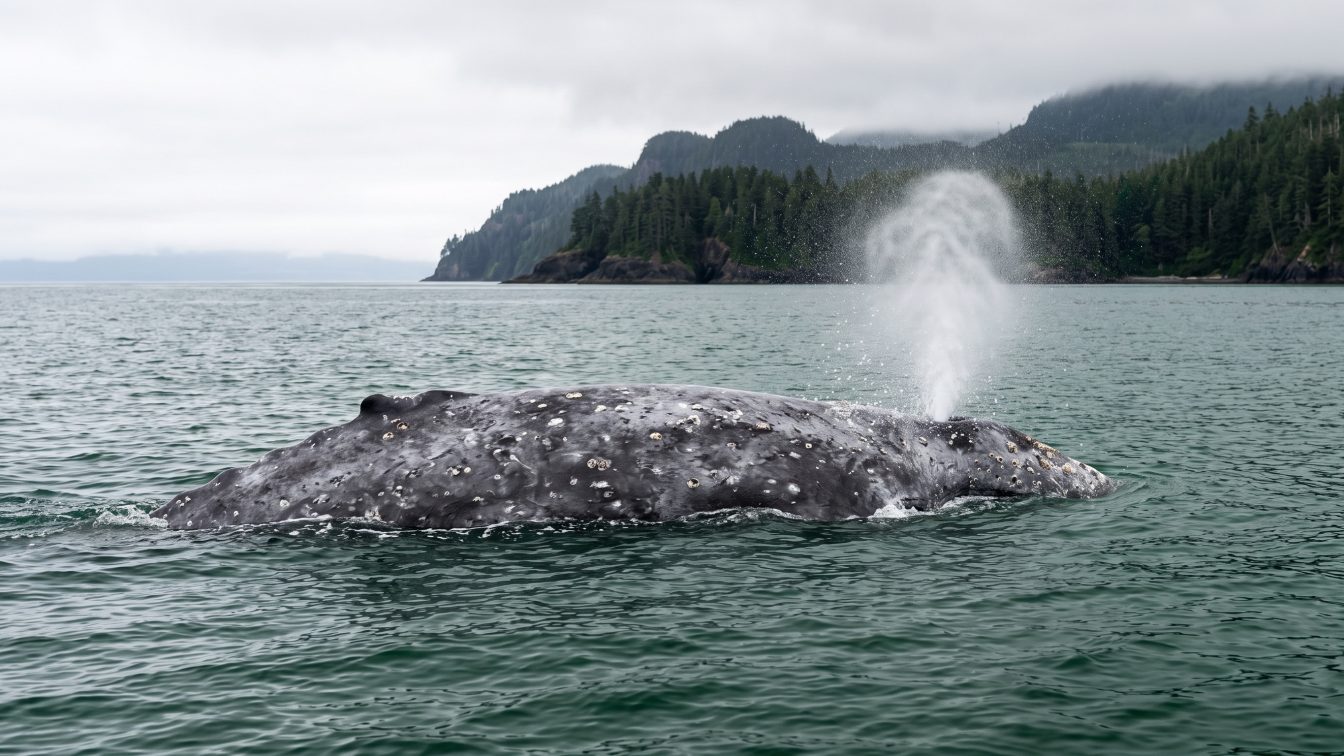
Table of contents
Summary of this article
- Since March 2026, 21 dead gray whales have washed up on Washington state shores, according to research biologist John Calambokidis of the Cascadia Research Collective, NBC News reported on May 25, 2026.
- NOAA estimates the eastern North Pacific gray whale population has fallen from 27,430 a decade ago to about 12,950 last summer.
- The immediate cause of death is starvation. Most stranded whales were thin and weak, and some showed navigational problems before dying.
- The root cause is earlier Arctic sea ice melt, which breaks the food chain that delivers the whales' main prey, shrimplike amphipods on the seafloor.
- Gray whales feed for four to six months in the Arctic, then fast for six to eight months, making the Arctic feeding grounds their single most important food source.
- NOAA declared an "unusual mortality event" for gray whales in 2019; a brief rebound in 2023 was followed by continued decline that Calambokidis described as "boom, bust, bust, bust."
- The exposure pathway runs from carbon emissions to Arctic warming to food-chain collapse to beach strandings, which makes emissions the source to control.
Since March 2026, 21 dead gray whales have washed up on Washington state shores, said John Calambokidis, research biologist and founder of the Cascadia Research Collective. Most were emaciated. Some behaved strangely before they died, including apparent trouble finding their way.
“I am alarmed,” Calambokidis said, NBC News reported on May 25, 2026.
The count behind that word is precise. NOAA estimates the eastern North Pacific gray whale population has dropped from 27,430 a decade ago to about 12,950 last summer. That is more than half gone in ten years, in a species that was once one of the great conservation wins in American history.
The carcasses on the sand are the visible end of a chain that starts thousands of miles north, in Arctic sea ice that melts earlier every year. Follow that chain and you can see what might fix the problem, and what never will.
A recovery coming undone
Gray whales were nearly wiped out once. In the 19th and early 20th centuries, commercial whaling cut the eastern North Pacific population to as low as about 1,000 animals, and possibly a few hundred, said Josh Stewart, an assistant professor at Oregon State University’s Marine Mammal Institute who has led research into the whales’ decline.
Then the law changed. After whaling restrictions took hold and the Marine Mammal Protection Act granted federal protection, gray whales bounced back faster than nearly any other whale species. They came off the endangered list in 1994.
Now that gain is slipping away. “We’re significantly lower in abundance than when the species was delisted from the Endangered Species Act, so we are in uncharted territory from a recovery perspective,” Stewart said. He doesn’t think the whales face extinction. He does think hard-won progress is being lost.
NOAA has tracked the decline formally since 2019, when it called the wave of deaths an “unusual mortality event.” The population briefly ticked up in 2023, and some scientists suspected a natural boom-and-bust cycle. It didn’t hold.
“We thought we were seeing a bit of rebound, but it was so short-lived,” Calambokidis said. He described the real trajectory as “boom, bust, bust, bust.”
One meal, one shot
To see why these whales are starving, follow their year.
Most eastern North Pacific gray whales swim north every spring and summer to the Arctic. There they eat amphipods, tiny shrimplike creatures that live in the seafloor mud. The whales feed for four to six months, Stewart said. For the next six to eight months, they mostly fast as they travel south to winter in the lagoons off Mexico, where they breed and raise calves.
That schedule gives them no room for error. The Arctic is where they get almost all their food for the whole year. A whale that fails to fatten up in the Arctic gets no second chance before the long fast begins.
A bad summer usually comes due the following spring. “Right now, as they migrate north, is when they’re skinniest,” Stewart said. “It’s the longest since they’ve last eaten, and it’s when they’re the most sensitive and most vulnerable to dying from starvation.” The whales dying on Washington beaches from March through May land right in that window.
How early ice melt breaks the food chain
Here is how the system used to work, according to Stewart. Algae grew on the underside of sea ice. As the ice melted, that algae sank to the seafloor. There it dissolved and fed a rich seabed, feeding the amphipods buried in the mud. Gray whales then sucked up mouthfuls of that mud and strained out the amphipods inside.
Timing held it all together. The ice-algae dropped at just the right moment to feed the seafloor.
That timing is now off. Sea ice melts earlier in the year, researchers think, letting sunlight reach the water sooner. Earlier sunlight feeds phytoplankton and other species higher in the water, which soak up nutrients that once sank to the bottom. Fewer nutrients reach the seafloor. Fewer amphipods survive there. The whales show up to less food than they used to find.
“We know it’s a food supply issue,” Calambokidis said. “We know the Arctic has gone through dramatic changes because of climate change.”
Stewart put the long view plainly: “I don’t think we’re ever going to see an Arctic that can support 25,000 gray whales again, at least not in my lifetime.”
From carbon to the beach
The dead whale on the sand starts as carbon in the air. Emissions warm the planet, and the Arctic warms faster than most places. That heat melts sea ice earlier. Early melt throws off the timing that once dropped algae onto the seafloor. The seafloor grows fewer amphipods. The whales starve. Weakened and disoriented, they reach the spring migration too depleted to finish it, and some die on Pacific beaches.
The strandings are the last link. They’re the symptom. The cause is upstream, in the ice.
Starvation also drives the whales into dangerous places. “As these animals become malnourished, they become more desperate, and I also think they become debilitated and less aware of their surroundings and they lose their navigational sense,” Calambokidis said. This season, one whale swam up Washington’s Willapa River and died there, possibly hunting for food to finish its trip.
You can’t stop a dead whale on a beach by doing anything on that beach. It can only be stopped far upstream, by slowing the warming that melts the ice.
Some whales don’t rely on the Arctic
The decline hasn’t hit every whale.
A small group of about a dozen whales, sometimes called Sounders, skips the standard Arctic route to eat ghost shrimp in northern Puget Sound before heading farther north. A larger group, the Pacific Feeding Group of more than 200 whales, spends summers in coastal waters off Northern California, Oregon, Washington, and southern Canada. Both groups have held up better than the wider population.
They eat from more places. These whales don’t stake their whole year on one Arctic feeding ground, so a collapse there doesn’t starve them.
“It gives us some indication that there may be other foraging strategies other gray whales will be able to take up to weather environmental storms long term,” said Elliott Hazen, a research ecologist at NOAA’s Southwest Fisheries Science Center.
What you can do
The cause is global, but your choices still count, both for the root problem and for the whales in front of you.
Cut carbon where you can. Arctic warming is driven by carbon. Your energy use, how you get around, and your support for emissions cuts all push against the source at the top of the chain.
Report a stranded whale, don’t approach it. Contact your regional marine mammal stranding network or NOAA. Trained responders collect the data that tracks the unusual mortality event and pins down cause of death.
Keep your distance and leash your dog. A weak or dead whale is a public safety and disease risk. Give it wide space, and keep pets well back.
Back long-term monitoring. Groups like the Cascadia Research Collective document the decline animal by animal. That record is what lets scientists see a “boom, bust, bust, bust” pattern instead of a random bad year.
Don’t disturb whales in the water. Boaters should keep clear of migrating whales, which are already at their weakest on the spring trip north.
The takeaway
Twenty-one dead gray whales in three months is the visible edge of a decline that has cut the eastern North Pacific population from 27,430 to about 12,950 in a decade, according to NOAA. The whales are starving because the Arctic food chain they depend on is breaking. Sea ice melts earlier, algae no longer reaches the seafloor on schedule, and the amphipods the whales eat are getting scarcer.
The deaths on the beach trace back to carbon emissions and a warming Arctic. That’s where a fix has to happen too. As Calambokidis put it, this is fundamentally “a food supply issue” driven by “dramatic changes because of climate change.” The beach is where the story ends. The Arctic is where it starts.
Sources
Questions people ask
How many gray whales have died recently?
Since March 2026, 21 dead gray whales have washed up on Washington state shores, according to research biologist John Calambokidis of the Cascadia Research Collective, NBC News reported on May 25, 2026. Most were emaciated, and some showed navigational problems before dying.
How much has the gray whale population declined?
NOAA estimates the eastern North Pacific gray whale population has fallen from 27,430 a decade ago to about 12,950 last summer, a decline of more than half. NOAA declared an "unusual mortality event" for the species in 2019.
Why are the whales dying?
The immediate cause is starvation. The root cause is earlier Arctic sea ice melt, which breaks the food chain the whales depend on. Ice algae no longer reaches the seafloor on the right schedule to feed amphipods, the shrimplike creatures that are the whales' main prey.
How does melting ice reduce the whales' food?
Ice algae used to fall to the seafloor as sea ice melted, fertilizing the seabed and feeding amphipods in the sediment. With ice melting earlier, sunlight reaches the water sooner, promoting phytoplankton that absorb nutrients before they sink. Fewer nutrients reach the seafloor, so fewer amphipods survive.
Why do the whales strand on beaches instead of just being thinner?
Gray whales feed for four to six months in the Arctic, then fast for six to eight months. A whale that fails to fatten up starves during the long migration. Malnourished whales also lose their navigational sense, which is why some end up in odd places, including one that swam up Washington's Willapa River and died.
Are all gray whales declining?
No. A small group known as the Sounders and a larger Pacific Feeding Group of more than 200 whales feed in coastal waters instead of relying solely on the Arctic. Both have been more resilient, suggesting diversified feeding strategies offer protection against the Arctic food collapse.
What can I do to help?
Reduce carbon emissions, which drive the Arctic warming at the root of the problem. Report stranded whales to NOAA or your regional stranding network rather than approaching them, keep your distance and leash pets, support long-term monitoring efforts, and avoid disturbing migrating whales in the water.

Have questions about the environment inside your home?
Air quality, mold, EMF, light and water all shape how a house feels and how the people in it feel. Whatever your concern is, the first step is finding out what is there.
Our certified team of environmental professionals and advocates can help.