


Some Florida coral can still survive the disease killing reefs
Mote researchers found that some mountainous star coral can resist the disease that has been killing Florida and Caribbean reefs since 2014. The team tested 154 genetically distinct corals and found a spectrum of resistance.
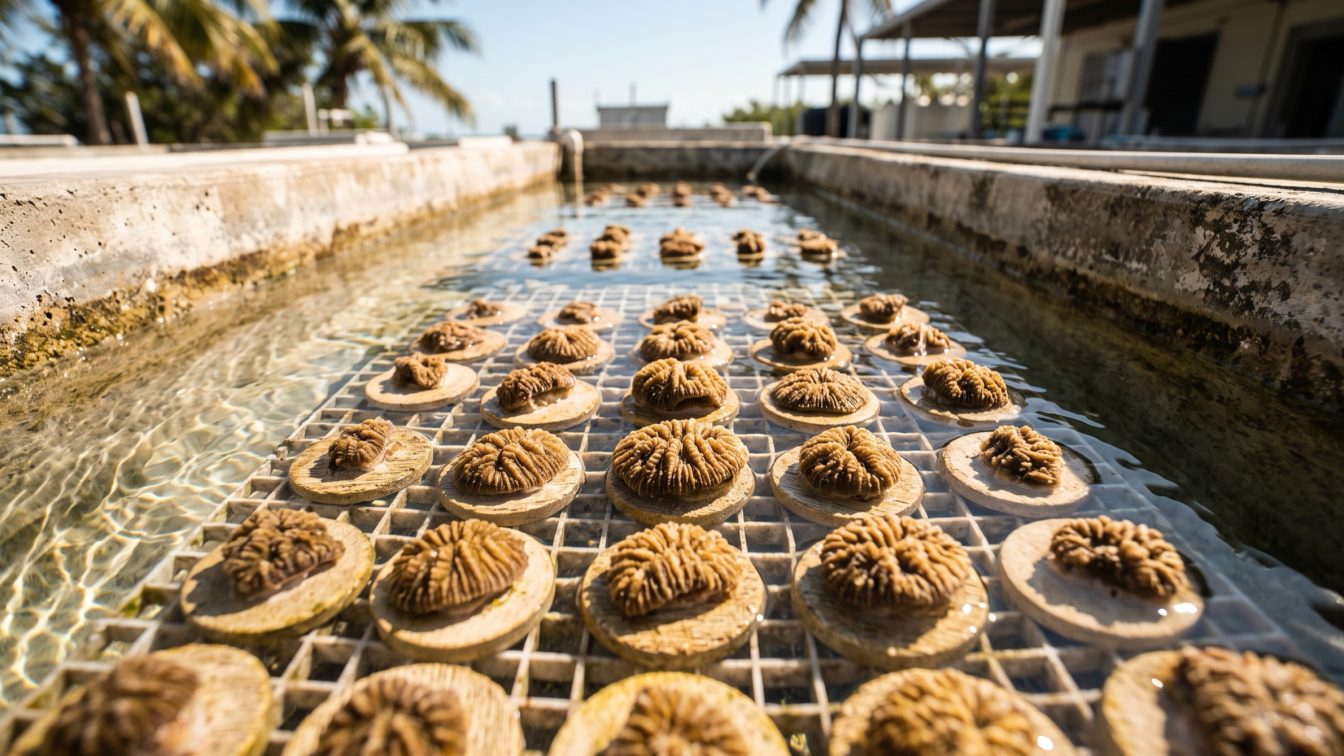
Table of contents
Summary of this article
- Mote Marine Laboratory scientists identified mountainous star coral that resists stony coral tissue loss disease (SCTLD). They evaluated 154 genetically distinct genotypes across four experiments, published in July 2026 in Scientific Reports, according to WUSF reporting by Steve Newborn.
- SCTLD is one of the most destructive coral diseases ever documented. First found off Miami in 2014, it has killed countless corals across Florida and the Caribbean.
- The team found a whole spectrum of resistance. By placing healthy coral fragments next to diseased lesions and timing infection and death, researchers found some corals stayed healthy the entire time while others resisted longer.
- The results guide restoration. Mote scientist Sara Williams says the findings will inform which corals get planted, so more resistant corals survive the next disease wave and build more resilient reefs.
- Resistance alone isn't enough. Ocean heat and acidification are compounding threats, and researchers collected over 2,500 samples to understand why some corals resist. Future genetic splicing to transfer resistance genes is a hope, not yet a reality.
Since 2014, a disease has been eating its way through Florida’s coral reefs. It starts as a lesion on the coral and spreads across the colony, stripping away living tissue until the coral is dead. It has a name that sounds clinical because it is: stony coral tissue loss disease, or SCTLD. First spotted off Miami, it has since killed countless corals across Florida and the Caribbean, making it one of the most destructive coral diseases ever documented.
Now there’s a genuine piece of good news. Researchers at Sarasota’s Mote Marine Laboratory have identified corals that resist it. WUSF reporter Steve Newborn detailed the finding on July 14, 2026, based on a study published that month in the journal Scientific Reports.
For anyone who lives on Florida’s coast, swims off its beaches, or depends on the shoreline staying put during a storm, this matters more than it might sound. The discovery is a working example of a core building-biology principle applied to an entire ecosystem: the most effective way to protect something is to control the problem at its source, before it spreads.
What the disease does, and why it’s so hard to stop
To understand why resistance is such a breakthrough, it helps to understand the exposure pathway, how the disease reaches and kills a coral.
SCTLD is a contagious disease that moves from coral to coral through the water. A healthy colony sitting near an infected one can pick up the infection, develop a lesion, and lose tissue rapidly. Because it spreads through the water and affects many coral species, it behaves less like an isolated illness and more like a wildfire moving across the reef.
That is what makes it so devastating. You cannot easily quarantine a wild reef. You cannot pull every colony out of the ocean. Once the disease is in the water, healthy corals are constantly exposed, and the ones that get sick often die. For years, the disease has had the upper hand precisely because there was no way to break that exposure pathway at scale.
How Mote tested for resistance
The Mote team asked a direct question: when corals are exposed to this disease, do some survive better than others? And if so, which ones?
To find out, they evaluated 154 genetically distinct mountainous star corals, a major reef-building species that happens to be highly vulnerable to SCTLD, which makes it a priority for restoration. Across four experiments, they ran what amounts to a controlled exposure test.
“We would take healthy fragments of 154 genotypes, and we would take those healthy fragments and stick them right along the disease lesion of those diseased fragments,” Mote research scientist Sara Williams explained. “And then we would just wait and see when those healthy fragments got the disease. So how quickly did they get the disease, and then after that, how quickly did it take for them to die.”
This is a study built around measurable thresholds. The researchers weren’t guessing at “healthy” versus “sick.” They tracked two specific timing measurements for each genotype: how quickly infection took hold, and how quickly death followed. Those numbers turn a vague idea, resistance, into something you can rank and compare across 154 individuals. To dig deeper into why the differences existed, the team collected over 2,500 samples.
The finding: a spectrum, not a switch
The result was not a simple yes or no. Resistance turned out to be a spectrum.
“Some of them stayed healthy the entire time, or if they did get the disease, they didn’t get it as quickly as the other corals in the experiments, or it took longer for them to die,” Williams said.
That range is the whole point. Because different genotypes responded so differently, the researchers can now sort them, identifying the corals that shrugged off the disease, the ones that resisted for a long time, and the ones that succumbed fast. That ranking is the raw material for a smarter restoration strategy.
Source control, written in genetics
Here is where the building-biology lens sharpens the story. Recovery shows up elsewhere in Florida water too, where seagrass came back once jet skis stopped launching.
Source control means stopping a problem where it starts rather than cleaning up after it. In a home, that might mean sealing off a moisture source instead of repeatedly treating the mold it causes. On a reef, you cannot filter the disease out of the entire ocean. But you can change what goes onto the reef in the first place.
That is exactly the plan. “What we can do is take the results from this study to inform which corals we put on the reef,” Williams said. “So that way if we put more resistant corals out, hopefully, those corals are going to survive the next disease wave and continue to grow and build more resilient reefs.”
Think about what that does to the exposure pathway. If most corals on a restored reef are highly susceptible, the disease spreads through them like fire through dry brush. But if the corals being planted are naturally resistant, the disease has fewer easy hosts. It spreads slower, kills fewer colonies, and the reef as a whole survives. You are not treating the disease after it strikes. You are engineering the reef so the disease can’t take hold as easily, source control through genetics.
By breeding and transplanting these naturally resistant corals, the goal is to build reefs that are tougher from the very start.
The honest caution: resistance isn’t a cure-all
The Mote researchers are careful not to oversell it, and that honesty matters.
Disease resistance is one factor in rebuilding a reef rather than the only one. Even a disease-proof coral still has to survive the other pressures bearing down on Florida’s reefs. Hotter water stresses coral and drives the bleaching that has killed reefs in recent summers. And ocean acidification, the gradual drop in seawater pH as the ocean absorbs more carbon dioxide, makes it physically harder for corals to build their skeletons. That threat will only increase.
In building-biology terms, this is a reminder that fixing one exposure pathway doesn’t fix them all. A coral bred to resist disease can still be cooked by a marine heat wave or weakened by acidifying water. Real resilience means addressing the stack of stressors, not just the one you’ve made progress on. Resistance buys the reef a fighting chance against disease; it does not exempt it from the climate.
What could come next
Williams pointed to a more ambitious possibility on the horizon: genetic splicing, the idea of transferring the genes that convey disease resistance into other coral species on the reef.
“It’s not something that we’re able to do right now, but is it possible in the future? I hope so,” she said.
If it ever becomes feasible, it would extend the source-control approach beyond a single species, spreading resistance across the reef’s genetic library. For now, it remains a hope rather than a tool. The near-term work is the practical, hands-on process of breeding the resistant genotypes already identified and planting them where they can do the most good.
Why a healthy reef protects you
None of this is abstract if you live near the coast. A coral reef is not just scenery. It is living infrastructure.
A healthy reef sits offshore like a submerged breakwater, absorbing wave energy before it reaches land. That reduces erosion and blunts storm surge, real protection for coastal homes and communities during hurricanes. Reefs also keep water clearer and support the fisheries that define Florida’s coastal economy. When a reef degrades, the shoreline behind it loses a layer of defense right when storms are getting stronger.
So a project that makes reefs more likely to survive the next disease wave is, indirectly, a project that helps keep the coast intact. Resistant coral means a more durable breakwater.
What this means for you
You can’t breed coral in your backyard, but you can support the conditions that let this work succeed:
Reduce the stressors that compound disease. Cut nutrient runoff near the coast by following local fertilizer bans and keeping vegetated buffers along waterways. Excess nutrients feed algae that crowd and stress reefs, making them more vulnerable to everything else.
Protect the reefs directly. Never touch or anchor on coral, and choose reef-safe sunscreens that avoid oxybenzone and octinoxate. Physical and chemical stress add to the burden a disease-resistant coral still has to survive.
Watch the measurable signs. This study succeeded because it turned resistance into numbers, time to infection, time to death. When you evaluate any environmental fix, look for the same rigor: specific thresholds that show whether it’s actually working.
Support restoration and the science behind it. Programs that breed and plant resistant corals depend on funding and public backing. So does the research that identifies which corals to use.
Florida’s reefs have taken a decade of losses from a disease that seemed unstoppable. The Mote finding doesn’t erase that. But it hands restoration teams something they didn’t have before: a way to choose corals that can survive. Instead of planting reefs and hoping they dodge the next outbreak, scientists can now build reefs designed to withstand it, fixing the vulnerability at its genetic source. For a coastline that leans on its reefs for protection, that’s a bet worth backing.
Sources
- WUSF, Steve Newborn. Disease-resistant coral found that could help restore Florida's reef (2026) (July 14, 2026):
Questions people ask
What is stony coral tissue loss disease?
Stony coral tissue loss disease (SCTLD) is a contagious coral disease first discovered off Miami in 2014. It spreads through the water from coral to coral, forming lesions that strip away living tissue until the colony dies. It affects many species and has killed countless corals across Florida and the Caribbean, making it one of the most destructive coral diseases ever documented.
What did Mote Marine Laboratory discover?
Researchers at Sarasota's Mote Marine Laboratory identified mountainous star corals that resist SCTLD. In a study published in July 2026 in Scientific Reports, they evaluated 154 genetically distinct genotypes across four experiments and found a spectrum of resistance, some corals stayed healthy the entire time, while others resisted longer than the rest.
How did they test for resistance?
Scientists placed healthy coral fragments right next to diseased lesions, then measured two things for each of the 154 genotypes: how quickly the healthy fragment became infected and how quickly it died. They also collected over 2,500 samples to understand why some corals become infected while others resist.
How will this help restore Florida's reef?
The results tell restoration teams which corals to plant. As Mote scientist Sara Williams explained, putting more resistant corals on the reef means more of them survive the next disease wave, building reefs that are more resilient from the start. The plan is to breed and transplant these naturally resistant genotypes.
Is disease resistance enough to save the reefs?
No. Mote researchers caution that resistance is only one factor. Corals still face hotter water, which drives deadly bleaching, and ocean acidification, which makes it harder for them to build their skeletons and will only increase. Real resilience requires addressing these compounding threats, not just disease.
Why should I care about coral reefs if I don't dive?
Reefs act as natural offshore breakwaters, absorbing wave energy that would otherwise erode shorelines and worsen storm surge during hurricanes. They also keep water clearer and support fisheries. A reef that survives disease is a stronger line of defense for the coastal communities behind it.
Have questions about the environment inside your home?
Air quality, mold, EMF, light and water all shape how a house feels and how the people in it feel. Whatever your concern is, the first step is finding out what is there.
Our certified team of environmental professionals and advocates can help.