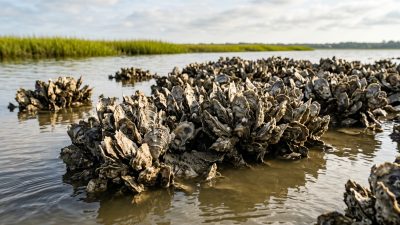
Apalachicola Bay lost almost all of the oyster reefs it once had
Apalachicola Bay once produced more than 90% of Florida's oysters, but its reef base has collapsed from 2,000 acres to…


The National Oceanic and Atmospheric Administration reports that about 40% of the US population lives in a coastal county, and Americans eat roughly 20 pounds of seafood per person each year.
The animals in the water off our coasts live in the same environment that feeds and surrounds tens of millions of households. When something goes wrong in that water, marine life feels it first, and what happens to those animals often tells you what is heading toward you.
Marine life is the exposure you read rather than breathe. You do not take it into your body the way you do air or tap water, but the condition of the fish, shellfish, and coastal animals nearby is one of the clearest signals you have about the health of the water that touches your life.
Because the water is connected. The rivers that carry pollution to the ocean are the same ones that supply drinking water inland, and contaminants that build up in fish can reach anyone who eats seafood. The health of marine life reflects the health of the whole water system.
Marine animals cannot leave the water or filter their exposure, so they react quickly to pollution. The EPA uses the presence, health, and diversity of fish and invertebrates as a direct measure of water quality, because when the animals decline, the water usually is not safe.
An area of water where oxygen has dropped too low to support most marine life. It forms when nutrient pollution feeds algae that die and decompose, using up the oxygen. NOAA measured the Gulf of Mexico dead zone at about 6,700 square miles in 2024, larger than Connecticut.
Through biomagnification. A pollutant enters tiny organisms first, then concentrates as it moves up the food chain. Large predator fish end up with far higher doses than the water around them, which is why species like shark and swordfish carry the most mercury.
Because methylmercury can harm a developing brain and nervous system. The FDA and EPA advise limiting high-mercury fish like shark, swordfish, and king mackerel, and choosing lower-mercury options like salmon, shrimp, and canned light tuna instead.
A warning issued by a state when testing finds mercury, PCBs, or other contaminants in fish from a specific lake, river, or coastal area. The EPA maintains a national listing, and checking it before eating local catch is the best way to avoid contaminated fish.
Yes. Studies have found microplastics in tap water, bottled water, and marine life. The plastic breaking down in the ocean is part of the same pollution stream that reaches household taps, which is one reason reducing single-use plastic matters beyond the coast.
Read the fish advisories for waters where you fish, choose lower-mercury seafood for children and pregnant women, and check beach and shellfish closures before you swim or harvest. Reducing lawn fertilizer, chemical disposal, and plastic use protects both marine life and the source of your own drinking water.
Marine animals cannot leave the water they live in, and they cannot filter their exposure the way people can. They breathe through gills, feed straight from the ecosystem, and take in whatever the water carries, so a contaminant that would take years to register in a person can show up fast in a local population.
That sensitivity makes marine life an early warning system. The bald eagle case on land had a marine parallel in the shellfish beds and fish kills that first alerted regulators to industrial pollution in the mid-1900s. The EPA still relies on the condition of aquatic life to judge water quality, using the presence, health, and diversity of fish and invertebrates as a direct measure of whether a body of water is clean. When the animals disappear, the water rarely stays safe for long.
Most of what harms marine life starts on land. The EPA identifies nutrient pollution, nitrogen and phosphorus from farm runoff, lawns, and wastewater, as one of the most widespread and costly problems in US coastal waters. Those nutrients feed algae, the algae die and decompose, and the decomposition strips oxygen from the water.
The result is a dead zone, an area where oxygen falls too low to support most marine life. NOAA measured the dead zone in the Gulf of Mexico at about 6,700 square miles in 2024, an area larger than Connecticut, fed largely by runoff carried down the Mississippi River. Plastic adds a second layer of damage. Researchers estimate that millions of tons of plastic enter the ocean each year, breaking into microplastics that fish and shellfish mistake for food. Chemical pollution from oil spills, industrial discharge, and stormwater rounds out the picture, poisoning habitat and killing animals across every level of the food web.
A pollutant rarely stays where it lands. It enters the smallest organisms first, then concentrates as it moves up each level of the food chain, a process biologists call biomagnification. By the time a contaminant reaches a large predator fish, the dose can be many times higher than it was in the surrounding water.
Mercury is the clearest case. Coal-burning power plants release it into the air, it settles into oceans and lakes, and bacteria convert it into methylmercury, a form that living tissue absorbs and holds. Small fish take it in, larger fish eat the small ones, and the mercury concentrates at every step. The FDA reports that large, long-lived predators such as shark, swordfish, king mackerel, and bigeye tuna carry the highest levels for exactly this reason. PCBs and other industrial chemicals behave the same way, building up in fatty tissue and rising through the food web to the fish people catch and eat.
The contaminants that build up in marine life reach people mainly through the seafood they eat. The FDA and EPA jointly advise that children and women who are pregnant or breastfeeding limit high-mercury fish, because methylmercury can harm a developing brain and nervous system. The same agencies publish a chart of safer choices, including salmon, shrimp, and canned light tuna, that carry lower mercury while still delivering the nutritional benefits of seafood.
Local catch carries its own risks. Every state issues fish consumption advisories for specific lakes, rivers, and coastal areas where testing has found mercury, PCBs, or other contaminants in local fish, and the EPA maintains a national listing of them. Recreation adds a separate exposure. Swimming, wading, and shellfish harvesting during a harmful algal bloom or after a sewage overflow can expose people to toxins and bacteria directly, which is why health departments close beaches and shellfish beds when testing crosses a threshold.
The water that harms marine life and the water that reaches your home are drawn from the same system. Rivers that carry farm runoff to a coastal dead zone are the same rivers that supply drinking water to cities along their path. Nitrogen that feeds an algal bloom offshore is the same nitrogen that shows up as nitrate in a well downstream.
The connection runs through the watershed. The EPA notes that what enters the water upstream, whether fertilizer, industrial discharge, or stormwater, moves through the same network that supplies the roughly 148,000 public water systems serving more than 300 million Americans. Microplastics complete the loop. Studies have detected them in tap water, bottled water, and marine life alike, a sign that the plastic breaking down in the ocean is part of the same pollution stream flowing through household taps. The state of marine life is not a separate problem from your water. It is the visible edge of the same one.
Read the advisories before you fish or eat local catch, because they tell you exactly which waters and which species carry a problem. The EPA's national fish advisory listing and your state health department both publish current guidance, and following it is the single most effective way to lower your exposure to mercury and PCBs from seafood.
Choose lower-mercury fish for children and pregnant women, using the FDA and EPA advice chart, and vary the seafood you eat rather than relying on one species. Check beach and shellfish closures before swimming or harvesting, since state and local health departments post them online during the season. Cut the pollution that reaches the water in the first place: use less lawn fertilizer, never pour chemicals or medications down a drain, pick up pet waste, and reduce single-use plastic that ends up as microplastic in the food web. Support the watershed you drink from, since the same steps that protect marine life protect the source of your tap water. If you want to understand your own water, read your utility's annual Consumer Confidence Report or test a private well, because the health of the fish nearby and the water in your glass are drawn from the same source.
Apalachicola Bay once produced more than 90% of Florida's oysters, but its reef base has collapsed from 2,000 acres to…
A Florida Atlantic biologist says the ban targets the wrong animals, because the sharks fed at offshore dive sites aren't…
Air quality, mold, EMF, light and water all shape how a house feels and how the people in it feel. Whatever your concern is, the first step is finding out what is there.
Our certified team of environmental professionals and advocates can help.