


The 9.0 Figure on Your Monitor Was Written About the Air Over a Whole State
EPA says on its own site it has no authority over indoor air quality. Its 9.0 describes outdoor air over three years, and you spend 90 percent of your life indoors.
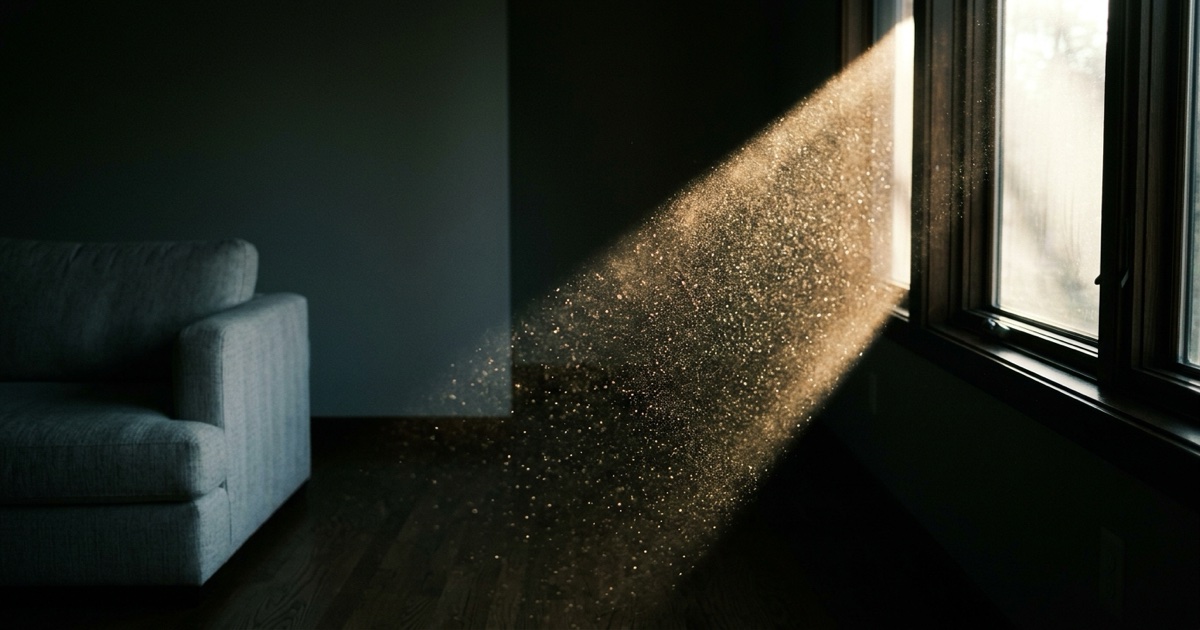
Table of contents
Summary of this article
- EPA's primary annual PM2.5 standard is 9.0 micrograms per cubic meter, in the form of an annual mean averaged over 3 years.
- 40 CFR 50.1 defines ambient air as the atmosphere external to buildings, so the standard names outdoor air in its own definitions.
- EPA states it has no authority to regulate any aspect of indoor air quality; its indoor role is research and public information.
- The 2024 National Academies report found EPA has no regulatory authority over indoor particulate matter, and no single entity does.
- EPA states indoor PM levels have the potential to exceed outdoor levels and the NAAQS, and that less is known about their health effects.
- The AQI is a 24-hour index for particles, and EPA says it is not valid to calculate an AQI value from hourly data.
- The one enforceable US particle limit is OSHA's workplace PEL: 5 milligrams per cubic meter respirable, which is 5,000 micrograms per cubic meter.
- EPA's own benchmark for a home is outdoor air: without smoking or other strong sources, indoor PM should be the same or lower.
Is anybody in charge of the air inside your house?
No. Not one agency in this country, and nobody is quietly working on it either.
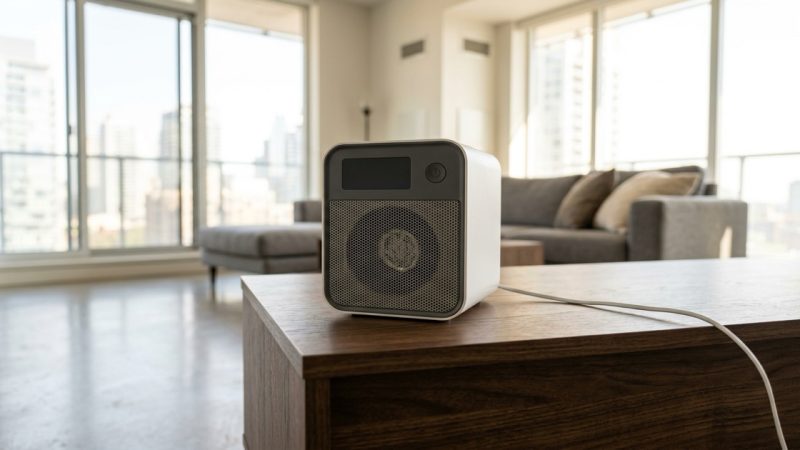
Picture an ordinary Tuesday. Something is searing in a pan, the extractor fan is roaring, and a little monitor up on the shelf slides out of green and stays there glowing orange at you while you plate up dinner.
Nothing in that kitchen broke a rule. None was ever written.
EPA puts that in writing on its own site, saying it has no authority to regulate household products, or any other aspect of indoor air quality. Its work on the inside comes from a law about research and public information. Studying, publishing, advising. Nothing you could exceed.
A committee at the National Academies checked from outside in 2024 and ended up harder. No regulatory authority over indoor particles, they wrote, and went further still, because no single entity anywhere carries the authority to bring down what a population breathes indoors.
Set that beside where your life happens. About 90 percent of it’s spent indoors, and close to 70 percent of that at home.
Which means the air you breathe most of is the air nobody has written a rule for.
Whose air is the 9.0 figure about?
Air in a parking lot. Air in a field. Not the air in your hallway.
Somewhere in your county stands a steel box on a post, in a fenced yard or up on a flat roof, pulling outdoor air through a filter around the clock. Nobody lives in it. That box is what 9.0 micrograms per cubic meter was written for.
Half of that standard is arithmetic, and everybody skips it. An annual mean, averaged again across three years. One rough afternoon can’t move it. Neither can one rough week.
Then a phrase buried in a definitions section decides everything else. Ambient air, federal code says, is the atmosphere external to buildings, where the general public can get at it.
External to buildings. Three words, typed into a rulebook, and they’re the reason none of this reaches your bedroom.
That 9.0 was tightened into place on February 7, 2024, and the same rulemaking left a 24-hour figure at 35 micrograms per cubic meter, shaped as a 98th percentile averaged over three years. So even the short-term one isn’t something you keep tonight up against.
A second annual figure of 15.0 runs alongside on a different job, covering visibility, crops, animals, vegetation and buildings. Looser, and never about lungs.
Why does your monitor go orange over a pan?
Because it borrowed a scale built for whole days outdoors, then aimed it at your dinner.
Go back to that pan. The colors on that little face trace to a national way of summing up outdoor air, and for particles that summary runs on 24 hours. Bands have names and edges. Everything up to 9.0 is called Good, which is the same 9.0 that describes a year of outdoor air across a whole county. A band called Unhealthy for Sensitive Groups starts at 35.5.
Both edges describe a day. Your steak took four minutes.
Guidance on this is blunt, and we would rather quote it than soften it, that it’s not valid to use shorter-term data, hourly for instance, to calculate a value on that scale.
Somebody then answered the gadget question head on, in a federal FAQ, which tells you something about how often people ask it. Applying those colors to realtime sensor data isn’t advised, especially 1-minute readings, because health studies don’t tell us what a single minute of exposure may mean.
Even the current-hour figure published online is no raw reading. It averages the previous 12 hours, leaning on recent ones when air swings about and flattening out when things stay calm, with a floor that works out near a 3-hour average.
One more tell stands in how this hardware gets tested at all. Performance targets for these sensors cover monitoring for use outdoors and at fixed locations. A protocol behind an entire product category was written for a yard.
Which air limits get mixed up?
One figure in this whole subject is legally enforceable, and an inspector with a clipboard can fine somebody over it. Everything else describes the outdoors, or doesn’t exist.
| Figure | What kind it is | Where it applies |
|---|---|---|
| 9.0 micrograms per cubic meter, annual | Outdoor standard, EPA | Outdoor air, annual mean over 3 years |
| 35 micrograms per cubic meter, 24-hour | Outdoor standard, EPA | Outdoor air, 98th percentile over 3 years |
| 5 milligrams per cubic meter respirable | Enforceable limit, OSHA | A workplace, 8-hour shift, adult workers |
| Any limit for a home | None exists federally | Nowhere |
Row three surprises people. OSHA’s Table Z-1 sets a permissible exposure limit for particulates not otherwise regulated, at 15 milligrams per cubic meter of total dust, and 5 for the respirable fraction. Converted into whatever units your monitor prints, that respirable figure is 5,000 micrograms per cubic meter.
So the one limit anybody can be fined over stands hundreds of times above an outdoor standard. It was written for a healthy adult on a shift, in a building where somebody is paid to watch the air, and it makes a poor target for a bedroom.
Sizes get muddled here too. Particles at issue run 2.5 microns across or smaller, which works out under 0.0001 inch.
What should you compare your monitor against?
Outside, and against itself an hour ago.
There’s a usable benchmark sitting on that same federal page, and it’s a comparison rather than a figure. Homes without smoking or other strong particle sources would be expected to keep indoor particles at or below the outdoor level.
Free, and you can run it tonight. Pull an outdoor figure for your area. Look at your room. Ask which of those two is worse. A room running above the street means something inside your house is making particles.
What makes them is short and domestic. Cooking. Candles. Fireplaces. Unvented space heaters and kerosene burners. Cigarette smoke. Some hobbies. Plenty of it comes off living things as well.
Your own baseline is that second comparison, and we’ve come to trust it more than anything printed on a screen. Watch a room on an ordinary evening with nothing going on, and that flat line is your house. A spike climbing while you cook and clearing afterward is your stove. A line that never comes back down is a source you haven’t found yet.
Scale is worth knowing before you start. That same National Academies committee puts indoor sources at roughly half of the fine particles in a home, with the rest drifting in from outdoors, and says those estimates vary widely. Both halves need a plan, and one fix doesn’t cover both.
What do you do when it climbs?
Go at whatever is making particles, before you buy any machine.
Three moves exist, in order: kill a source, get air moving, then filter. Killing the source is what works on most home air problems.
For particles those moves are dull and physical. Run your kitchen fan. Check that it vents outdoors rather than back through a cupboard. Vent stoves, heaters and furnaces outside. Skip an unvented heater indoors. Put candles away on an evening already running high. Change the filters on your heating and cooling system when a manufacturer says to.
Airing out comes second and costs nothing. Open windows and doors. Run a window or attic fan. Open the vent control on a window air conditioner. Make the exits work before you try to remove anything.
One situation flips all of that. Wildfire smoke inverts the advice. Keep windows and doors closed, run a portable air cleaner at its highest fan speed in whichever room your family uses most, and set the HVAC fan to On instead of Auto. Skip frying or broiling food. Skip candles and incense. Then take any window when outdoor air improves, even briefly, and air the house out.
Filtration arrives last for a reason. An air cleaner pulls at particles already loose in a room, and it treats a symptom while a source keeps making more.
And it leaves one household with options another simply does not have. A homeowner can change a range hood, seal a crawl space or replace a stove. A renter can open a window, move a filter and cook on a back burner. Somebody in a studio with one operable window and a landlord’s gas range has the least room of anybody and the highest exposure, which is the shape this whole subject takes once you stop describing a house in general.
Nobody regulates any of it, so the whole distance between those households is unmeasured too.
Where does that leave you?
You have a device measuring something real in one room, and nobody anywhere with the authority to say what that figure means.
We aren’t going to fill that gap with a guess, because the gap is measurable. Fewer studies exist on what indoor particles do to people than on outdoor ones, and those that exist run on far smaller groups. Less is known. That is the federal position in its own words, not our complaint.
So use your monitor as a change detector rather than a judge. Watch it move, find what moved it, and turn that off. Source first, a window second, a filter third.
Which household you are in decides how much of that you can act on. A homeowner can change a range hood, seal a crawl space or replace a stove. A renter opens a window, moves a filter and cooks on a back burner. Somebody in a studio with one operable window and a landlord’s gas range has the least room of anybody and the most exposure, and nobody measures that distance either.
And leave 9.0 where it belongs. It describes outdoor air across a whole county over three years, sampled in a fenced yard by a machine nobody lives with. Your kitchen was never in it. Your kitchen is where you are.
So treat your own monitor as the only instrument pointed at your own air, and treat every published figure beside it as a description of somewhere else. That is a smaller claim than a standard, and it is what anybody can honestly say about one particular house.
Sources
- U.S. Environmental Protection Agency. NAAQS Table (Criteria Air Pollutants) (2026)
- U.S. Environmental Protection Agency. Final Reconsideration of the National Ambient Air Quality Standards for Particulate Matter (PM) (2024)
- Code of Federal Regulations. 40 CFR 50.1, Definitions 40 CFR 50.1(e)
- U.S. Environmental Protection Agency. Indoor Particulate Matter (2026)
- U.S. Environmental Protection Agency. Does EPA regulate volatile organic compounds (VOCs) in household products? (2026)
- U.S. Environmental Protection Agency. Technical Assistance Document for the Reporting of Daily Air Quality - the Air Quality Index (AQI) (2026) EPA-403/B-26-003
- AirNow (U.S. EPA). Using the Air Quality Index (2026)
- U.S. Environmental Protection Agency. Air Sensor Performance Targets and Testing Protocols (2026)
- Occupational Safety and Health Administration. Permissible Exposure Limits - Annotated Tables, Table Z-1 29 CFR 1910.1000
- National Academies of Sciences, Engineering, and Medicine. Health Risks of Indoor Exposure to Fine Particulate Matter and Practical Mitigation Solutions (2024) ISBN 978-0-309-71275-0
- U.S. Environmental Protection Agency. Improving Indoor Air Quality (2026)
- U.S. Environmental Protection Agency. Wildfires and Indoor Air Quality (IAQ) (2026)
Questions people ask
Is the EPA PM2.5 standard 9 or 35?
Both, and both are outdoor standards. EPA's NAAQS table lists 9.0 micrograms per cubic meter as an annual mean averaged over 3 years, and 35 micrograms per cubic meter as a 24-hour value in the form of a 98th percentile averaged over 3 years.
Does EPA set a PM2.5 limit for the air inside a house?
No. EPA states it has no authority to regulate household products or any other aspect of indoor air quality, and that its indoor-air authority comes mainly from Title IV of SARA, covering research and public information.
What is a good indoor PM2.5 reading?
No federal agency publishes one. EPA's usable benchmark is a comparison rather than a number: in homes without smoking or other strong particle sources, indoor PM would be expected to be the same as, or lower than, outdoor levels.
Why does my air monitor show an AQI number?
It has borrowed EPA's outdoor communication scale. AirNow states the particle AQI is a 24-hour index, and EPA's guidance document EPA-403/B-26-003 states it is not valid to use hourly data to calculate an AQI value.
Did the EPA PM2.5 standard change recently?
Yes. EPA strengthened the particulate matter NAAQS on February 7, 2024, setting the primary annual PM2.5 standard at 9.0 micrograms per cubic meter. It did not change the 24-hour PM2.5 standards or the PM10 standards.
Is there any legally enforceable particle limit in the United States?
Yes, in workplaces. OSHA's Table Z-1 sets a permissible exposure limit for particulates not otherwise regulated of 15 milligrams per cubic meter total dust and 5 milligrams per cubic meter respirable, as 8-hour time-weighted averages. That respirable figure is 5,000 micrograms per cubic meter.
Should I open a window when my indoor PM2.5 reading is high?
Usually, yes. EPA lists opening windows and doors among its ventilation strategies. The exception is a wildfire smoke event, where EPA advises keeping windows and doors closed and running a portable air cleaner on its highest fan speed.
Have questions about the environment inside your home?
Air quality, mold, EMF, light and water all shape how a house feels and how the people in it feel. Whatever your concern is, the first step is finding out what is there.
Our certified team of environmental professionals and advocates can help.