The 9.0 Figure on Your Monitor Was Written About the Air Over a Whole State
EPA says on its own site it has no authority over indoor air quality. Its 9.0 describes outdoor air over…


Fine particle pollution kills more than 4 million people worldwide each year, according to the World Health Organization.
That figure makes particulate matter the most dangerous air pollutant to human health, more than ozone, more than any single industrial gas. It is measured in fractions of the width of a human hair, and that tiny size is exactly what makes it so hard on the body.
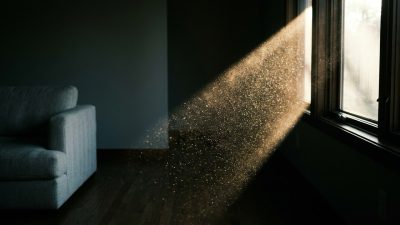
Particulate is the pollution you carry into your lungs with every breath. Some of it you can see as haze or smoke. Most of it you cannot, and the invisible fraction is the one that reaches the parts of the body no particle should touch.
A mix of tiny solid particles and liquid droplets floating in the air. It comes from traffic, industry, wildfire, wood smoke, dust, and cooking, and it is sorted by size into PM10 and PM2.5.
Size. PM10 particles are 10 micrometers or smaller, about the width of dust or pollen. PM2.5 particles are 2.5 micrometers or smaller, roughly 30 times thinner than a human hair.
It travels deeper. Larger particles get caught in the nose and throat, while PM2.5 reaches the deepest part of the lungs and can pass into the bloodstream, which is why the EPA links it to the most serious health effects.
Outdoors it comes from traffic exhaust, power plants, factories, construction, wildfire, and wood smoke. Indoors it comes from cooking, candles, fireplaces, and tobacco smoke.
Short-term exposure can trigger asthma attacks and raise heart attack and stroke risk. Long-term exposure is linked to chronic heart and lung disease, reduced lung function, and earlier death.
Children, older adults, and people with asthma, heart disease, or lung conditions. Their bodies have the least capacity to handle the added strain.
Check the Air Quality Index at AirNow.gov. It reports local particle levels in real time and tells you when to limit outdoor activity and keep windows closed.
A HEPA unit sized for the room captures fine particles, including PM2.5, effectively. Pair it with an upgraded furnace filter and good cooking ventilation, and change the filters on schedule to keep them working.
Particulate matter is a mix of solid particles and liquid droplets suspended in the air. Scientists sort it by size, because size determines where a particle goes once you breathe it in. PM10 covers particles 10 micrometers wide or smaller, roughly the size of a piece of dust or pollen. PM2.5 covers particles 2.5 micrometers or smaller, about 30 times thinner than a human hair.
The sources are everywhere. Traffic exhaust, power plants, factories, construction dust, wood smoke, wildfire, and cooking all send particles into the air. The EPA reports that fine particle pollution comes from both direct emissions and from gases that react in the atmosphere to form new particles, which is why the problem does not stay near its source.
Your nose and throat catch larger particles before they get far. PM10 mostly lands in the upper airways, where it can irritate the eyes, nose, and throat.
PM2.5 slips past those defenses. Particles this small travel deep into the lungs and reach the alveoli, the tiny sacs where oxygen enters the blood. Some pass directly into the bloodstream from there. The EPA identifies PM2.5 as the fraction most closely linked to serious health effects, because it goes where nothing is built to stop it and settles where the body cannot easily clear it.
Outdoor particles do not stay outside. They drift in through open windows, doorways, and the small gaps in every building, so the particle level on your street sets the baseline for the air in your home.
Indoor sources add to that load. Cooking, especially frying and searing, sends fine particles into the kitchen air. Candles, fireplaces, tobacco smoke, and vacuuming stir up more. The California Air Resources Board notes that indoor particle levels rise sharply during cooking and can stay elevated for hours afterward, because the air moves slowly once it is inside and the particles have nowhere to go.
Short-term exposure hits fast. A few hours or days of high particle levels can trigger asthma attacks, worsen bronchitis, and raise the risk of heart attack and stroke in people with existing heart disease, the EPA reports. Emergency room visits and hospital admissions climb on high pollution days.
Long-term exposure does the deeper damage. Years of breathing fine particles is linked to reduced lung function, chronic heart and lung disease, and earlier death. The American Heart Association concluded that long-term PM2.5 exposure increases the risk of dying from cardiovascular disease. Children, older adults, and people with asthma or heart conditions carry the heaviest burden, because their bodies have the least room to absorb the strain.
Watch the air before you plan your day. The Air Quality Index at AirNow.gov reports local particle levels in real time, and it tells you when to limit time outside and keep windows shut.
Cut your indoor sources next. Run the kitchen exhaust fan every time you cook, avoid burning candles and indoor fires, and keep the home smoke free. When outdoor levels spike, close the windows and run a portable air cleaner with a HEPA filter sized for the room, since HEPA filtration captures fine particles down to PM2.5. Change the filter on schedule so it keeps working. Upgrade your furnace or HVAC filter to a MERV 13 rating if the system can handle it, which pulls fine particles out of the air as it circulates through the house.
EPA says on its own site it has no authority over indoor air quality. Its 9.0 describes outdoor air over…
Air quality, mold, EMF, light and water all shape how a house feels and how the people in it feel. Whatever your concern is, the first step is finding out what is there.
Our certified team of environmental professionals and advocates can help.