


PFAS in drinking water was linked to higher rates of 2 childhood cancers
The association appeared in 2 childhood cancers and not in the others the study examined, which sharpens what the finding does and doesn't show. PFAS can reach tap water from firefighting foam, food packaging, and stain-resistant coatings.
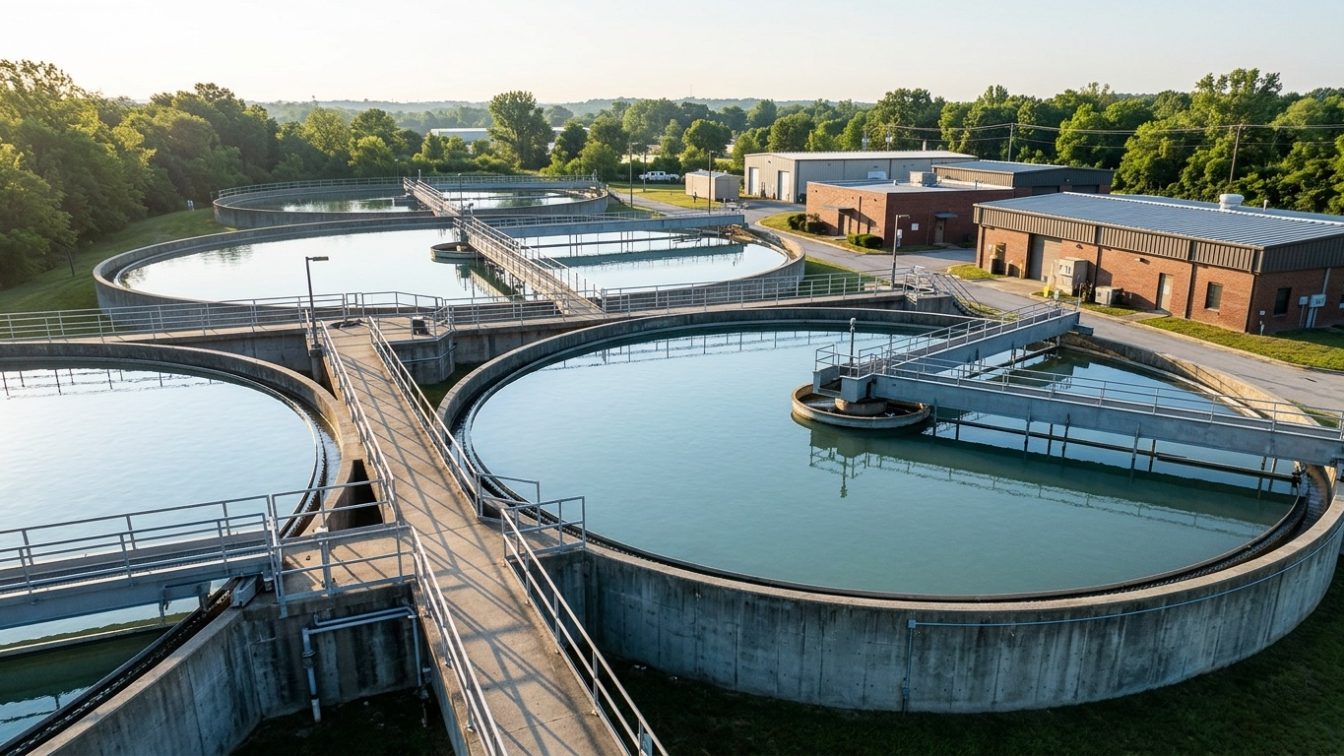
Table of contents
Summary of this article
- A study led by the Joe C. Wen School of Population & Public Health at the University of California, Irvine, found positive associations between PFAS in drinking water and childhood cancer rates, Environmental Health News (EHN) reported on March 13, 2026.
- PFAS (per- and polyfluoroalkyl substances) are "forever chemicals" used in nonstick coatings, firefighting foam, food packaging, and stain- and water-resistant products; they do not break down in the environment.
- Drinking water is the primary exposure pathway for many households, as PFAS leach from industrial sites, military bases, and landfills into groundwater that feeds public and private supplies.
- The U.S. Environmental Protection Agency (EPA) set enforceable drinking-water limits of 4 parts per trillion (ppt) each for PFOA and PFOS, among the lowest limits it has ever established.
- Children drink more water per pound of body weight than adults, which amplifies their relative dose from the same contaminated tap.
- Researchers underscored the importance of continued monitoring, framing the response as a need for intentional and continuous reform rather than a one-time fix.
- Filters certified to NSF/ANSI 53 (activated carbon) or NSF/ANSI 58 (reverse osmosis) are the most reliable household reductions for PFAS.
- Public-water customers can read their Consumer Confidence Report; private-well owners must test on their own, since wells fall outside federal drinking-water rules.
A study led by the Joe C. Wen School of Population & Public Health at the University of California, Irvine, found positive associations between PFAS in drinking water and rates of childhood cancer. Environmental Health News (EHN) reported the finding on March 13, 2026.
The chemicals at the center of the research are PFAS, per- and polyfluoroalkyl substances, a family of thousands of synthetic compounds. The route the study examined is the one nearly every household uses several times a day: the tap.
For anyone with children in the home, the finding reframes a routine act. Drinking water is not a background variable. It is a measurable, controllable exposure pathway, and the research ties contamination in that pathway to the most serious of childhood health outcomes.
What the Study Found
The core result is an association, and the distinction matters. The research found positive associations between PFAS in drinking water and childhood cancer, meaning higher PFAS levels in a water supply tracked with higher cancer rates in the population drinking it.
An association is not the same as proof that PFAS caused each individual cancer. Population studies identify patterns across large groups; they cannot assign a single cause to a single case. But a consistent, positive association between a contaminant and a disease is exactly the signal that drives public-health action, because waiting for absolute certainty means accepting exposure in the meantime.
The researchers were direct about the implication. They underscored the importance of continued monitoring for PFAS in drinking water, the underlying analysis noted, the scientific way of saying the problem does not resolve on its own and requires sustained attention.
What PFAS Are and Why They Persist
PFAS earned the nickname “forever chemicals” for a specific reason. The carbon-fluorine bond that defines them is one of the strongest in chemistry, so the compounds resist breaking down in the environment or in the body.
Manufacturers have used PFAS since the 1940s for their ability to repel water, oil, and heat. They appear in nonstick cookware coatings, firefighting foam, food packaging, stain-resistant carpet and upholstery, and water-repellent fabrics. That utility is also the problem: a chemical engineered to endure does not disappear after it is discarded.
The result is accumulation. PFAS build up in soil, water, and living tissue over time. Once they enter a water supply, they stay, and the people drinking that supply carry a rising body burden with each passing year.
How PFAS Reach Your Tap
The building-biology principle is that exposure follows a pathway, a source, a route, and a person at the end of it. For PFAS, the source is industrial and the route is groundwater.
The chemicals leach into water supplies from identifiable origins: manufacturing plants that produced or used PFAS, military bases and airports where PFAS-based firefighting foam was sprayed for training, and landfills where PFAS-containing products decompose. From those sites, the compounds migrate into groundwater, the underground water that feeds both public utilities and private wells.
Groundwater moves. A contamination source can sit miles from the homes it eventually affects, and the PFAS travel with the water toward wells and intakes. This is why a household with no visible industrial neighbor can still draw contaminated water: the source is upstream in the aquifer, out of sight.
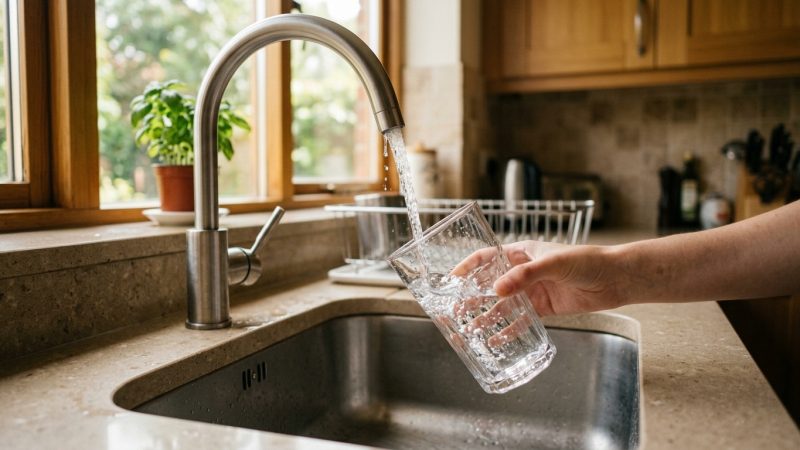
Drinking water is the primary exposure route for many affected households. Unlike a spill or an air release, it operates quietly and continuously, delivering a small dose with every glass, every pot of pasta, every cup of coffee made from the tap.
Why Children Face the Greater Risk
The same contaminated tap delivers a different dose to a child than to an adult. The reason is body size.
Children drink more water per pound of body weight than adults. A toddler’s water intake relative to body mass is far higher than a grown adult’s, so a fixed concentration of PFAS in the water translates into a larger relative dose in a smaller body.
The timing compounds the dose. Childhood is a period of rapid cell division and organ development, and developing systems are generally more vulnerable to chemical interference than mature ones. A contaminant that a fully grown body might process with less consequence can have a greater effect on a body still under construction.
That combination, higher intake per pound, greater developmental sensitivity, is why a drinking-water study focused on childhood cancer carries particular weight. The exposure pathway and the vulnerable population intersect directly at the kitchen faucet.
The Threshold That Defines the Limit
Regulators have set a number, and it is strict. The U.S. Environmental Protection Agency (EPA) established enforceable drinking-water limits of 4 parts per trillion (ppt) each for PFOA and PFOS, two of the most studied PFAS compounds.
Four parts per trillion is difficult to picture, so translate it: roughly 4 drops of a substance in about a trillion drops of water. It is among the lowest limits the EPA has ever set for a drinking-water contaminant, and the low number reflects the agency’s assessment that PFOA and PFOS pose health risks at extremely small concentrations.
That threshold is the practical benchmark for a household. A water report showing PFOA or PFOS above 4 ppt is a signal to act. Below it, the regulatory judgment is that the risk is controlled, though for a contaminant this persistent, lower is always better.
The Fix Is Source Control
In building biology, the most reliable fix is source control, removing a contaminant at its origin or intercepting it before it reaches the body, rather than managing harm after exposure. PFAS in drinking water can be controlled at two points: the utility and the home.
At the utility level, control means treatment and monitoring, the continued monitoring the researchers called for. That is the reform layer, and it operates beyond any single household. But it is slow, and PFAS are already in many supplies now.
At the household level, control is immediate and within reach. A point-of-use filter placed between the contaminated supply and the glass intercepts PFAS before anyone drinks them. It does not remove the source from the aquifer, but it removes the source from the water your child actually swallows, which is the exposure that matters for the child.
Practical Steps You Can Take
You cannot clean an aquifer from your kitchen. You can find out what is in your water and put a certified barrier between it and your family.
Read your Consumer Confidence Report. Every community water system must publish this annual report listing detected contaminants. Under the EPA’s rules, systems monitor and report PFAS. Check whether PFOA or PFOS appears and how the level compares to the 4 ppt limit.
Test a private well. Private wells fall outside federal drinking-water rules, so no one tests them for you. If you draw from a well, especially near a factory, airport, military base, or landfill, have a certified lab run a PFAS panel. It is the only way to know your number.
Install an NSF-certified filter. For PFAS reduction, choose a filter certified to NSF/ANSI 53 (activated carbon) or NSF/ANSI 58 (reverse osmosis). Reverse osmosis is generally the most thorough for PFAS. Verify the certification specifically lists PFOA and PFOS reduction, not all filters that reduce other contaminants remove PFAS.
Filter the water children actually drink and cook with. Prioritize the kitchen tap used for drinking, baby formula, and cooking. Because children take the largest relative dose, protecting that tap delivers the most benefit per dollar.
Maintain the filter on schedule. A spent filter stops working and can release accumulated contaminant back into the water. Replace cartridges and membranes on the manufacturer’s timeline, not when convenient.
Do not rely on boiling. Boiling water does not remove PFAS. Because the water evaporates and the PFAS do not, boiling can slightly concentrate them. Filtration, not heat, is the correct tool.
Reduce non-water sources too. While drinking water is the primary route for many households, PFAS also enter through some food packaging, stain-resistant treatments, and nonstick cookware. Cutting those uses lowers total body burden alongside filtered water.
Why This Matters Now
The study establishes a positive association between PFAS in drinking water and childhood cancer, and it points to a pathway that is both continuous and controllable. That combination is the reason to act rather than wait.
The persistence of the chemical removes the option of patience. PFAS do not degrade, so a contaminated supply does not clean itself, and a child’s exposure accumulates day by day for as long as the family drinks unfiltered water. The 4 ppt limit exists because the EPA concluded harm begins at concentrations most people cannot imagine.
The researchers framed the long-term answer as intentional and continuous reform, sustained monitoring and treatment at the level of the water system. That work is essential and largely out of a household’s hands. What is in a household’s hands is the barrier at the tap. Read the report, test the well, install a certified filter, and protect the water your child drinks the most. The contamination is invisible and persistent. The exposure it causes is measurable, and, at the point of use, preventable.
Sources
- Environmental Health News (EHN). Childhood cancers linked to PFAS water contamination (2026) (March 13, 2026):
- The Cancer Letter. Study links PFAS in drinking water to increased risk of childhood cancers :
- PMC / National Library of Medicine. Per- and polyfluoroalkyl substances in drinking water and cancer :
- U.S. Environmental Protection Agency (EPA), PFAS National Primary Drinking Water Regulation:
- U.S. Environmental Protection Agency (EPA), Our Current Understanding of the Human Health and Environmental Risks of PFAS:
- U.S. Environmental Protection Agency (EPA), Consumer Confidence Reports:
- University of California, Irvine, Joe C. Wen School of Population & Public Health:
Questions people ask
What did the study find?
A study led by the Joe C. Wen School of Population & Public Health at the University of California, Irvine, found positive associations between PFAS in drinking water and rates of childhood cancer, Environmental Health News reported on March 13, 2026. Higher PFAS levels in a water supply tracked with higher childhood cancer rates in the population drinking it.
Does this mean PFAS in water caused the cancers?
Not on an individual level. The study found an association, a statistical pattern across a large population, not proof that PFAS caused each specific case. Population studies identify patterns; they cannot assign a single cause to a single case. A consistent positive association is still a strong signal that drives public-health action.
What are PFAS?
PFAS (per- and polyfluoroalkyl substances) are synthetic "forever chemicals" used since the 1940s in nonstick cookware, firefighting foam, food packaging, and stain- and water-resistant products. Their strong carbon-fluorine bond means they resist breaking down in the environment and the body, so they accumulate over time.
How do PFAS get into drinking water?
They leach into groundwater from industrial sites, military bases and airports where PFAS firefighting foam was used, and landfills. Groundwater carries the chemicals to wells and utility intakes, sometimes miles from the source. Drinking that water day after day is the primary exposure route for many households.
Why are children at greater risk?
Children drink more water per pound of body weight than adults, so the same PFAS concentration delivers a larger relative dose to a smaller body. Childhood is also a period of rapid development, when systems are generally more vulnerable to chemical interference.
What is the safe limit for PFAS in water?
The U.S. Environmental Protection Agency set enforceable drinking-water limits of 4 parts per trillion (ppt) each for PFOA and PFOS, roughly 4 drops in about a trillion drops of water, and among the lowest limits the EPA has ever set. A result above 4 ppt is a signal to act.
How do I remove PFAS from my water?
Use a filter certified to NSF/ANSI 53 (activated carbon) or NSF/ANSI 58 (reverse osmosis), and confirm the certification specifically lists PFOA and PFOS reduction. Reverse osmosis is generally the most thorough. Maintain the filter on schedule. Boiling does not remove PFAS and can slightly concentrate them.
How do I find out what is in my water?
Public-water customers can read their utility's annual Consumer Confidence Report, which lists detected contaminants including PFAS. Private-well owners must arrange their own testing through a certified lab, since wells are not covered by federal drinking-water rules.
Have questions about the environment inside your home?
Air quality, mold, EMF, light and water all shape how a house feels and how the people in it feel. Whatever your concern is, the first step is finding out what is there.
Our certified team of environmental professionals and advocates can help.