


Toxic chemicals under your home can rise through the same cracks as radon
Soil gas can carry both natural radon and man-made solvents or fuel vapors up through the same openings in a basement floor. A hardware-store radon kit detects one and misses the other.
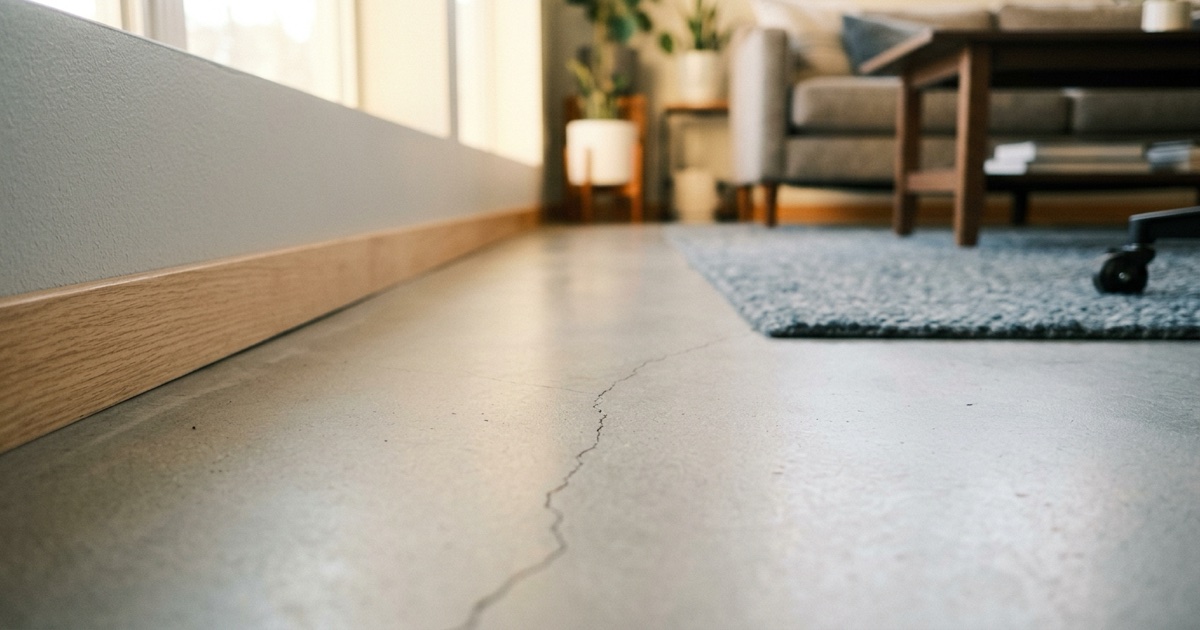
Table of contents
- What’s coming up through your basement floor?
- Does a radon test cover this?
- How close does it have to be?
- What happens when somebody tests your house?
- Does a bad result mean you have to move out?
- Does a closed cleanup site mean the problem is over?
- What if a gas station used to be on your corner?
- Does a mitigation fan fix the contamination?
Summary of this article
- Your house pulls air in through the floor, because warm air leaks out upstairs and fans and dryers push more of it out.
- Air comes from soil under the slab. If that soil holds solvent or fuel, some of it comes up too.
- A radon test will not find it. EPA says radon is not a stand-in for measuring chemicals, even though both use the same cracks.
- EPA starts looking within about 100 feet of a contaminated site. Six feet of clean soil handles gasoline, and does nothing for dry cleaning solvent.
- Screening levels are a trigger to look harder, not a line between safe and dangerous.
- Sites closed before 2017 were scored without vapor in the system at all, so a closure letter may answer a different question.
- A mitigation fan protects the building, not the ground under it, and it runs until somebody cleans the source.
What’s coming up through your basement floor?
Air. Your house draws it out of soil underneath, day and night, and whatever somebody left down there rides up with it.
Stand on your basement slab and picture what’s directly under your shoes. Concrete, then dirt, then groundwater. Both of those lower two were down there long before your house was, and both belonged to whoever used that ground first, back when nobody was writing down where a drum got emptied. A filling station. A dry cleaner with a machine in back. A shop that degreased engine parts and tipped what was left out by a fence. All of it legal then.
Here’s why it travels toward you instead of away. Warm air rises and leaks out of your upper floors, so something has to replace it, and replacement arrives low down. Cold weather makes that stronger. So does a bathroom fan, a range hood, a clothes dryer venting outdoors, a fireplace, a furnace burning air in a basement. Each one drops pressure indoors another notch.
Soil carries air in gaps between its grains. Lower pressure inside, and that air moves toward you. A hairline crack in a slab. A gap where a pipe passes through. A sump opening, a floor drain, an old sewer line.
Nobody had to spill anything on your property. Nothing has to look wrong. Your yard is fine. Your basement is dry. And a business that closed before you moved in is venting up through your floor while you fold laundry on top of it.
Does a radon test cover this?
No. Same crack in your floor, same route, completely different thing coming up it.
| Radon | Vapor intrusion | |
|---|---|---|
| Where it starts | rock and soil, spread by geology | one drum, one tank, one afternoon |
| Who is at risk | whole counties | addresses near one former business |
| What finds it | a $15 kit from a hardware store | soil gas and indoor air sampling |
| What a clear radon result proves | your radon is low | nothing about solvents |
You have probably done radon already. Kit from a hardware store, three days on a shelf downstairs, envelope in the mail, and a number back that looked fine enough to file and forget about.
That kit measured radon, which seeps out of rock, spread around by geology, thick under one county and scarce under another. Solvent came out of one drum, one leaking tank, one careless afternoon, in one spot, decades ago. EPA does not recommend one as a stand-in for the other. A radon result tells you almost nothing about how much solvent is in your air. Same hole in your floor. Two different problems.
There’s a useful half to it, though, and it’s worth knowing. Because both use the same cracks, a high radon result does tell you your slab draws soil gas. It can’t tell you what rides along with it.
And the fix turns out to be the same fix. Suction systems under a slab were invented for radon and have since been installed against chemical vapor too. So a house with a fan already humming on a basement wall has most of this answer bolted to it, which is the one cheerful line we have for you here.
How close does it have to be?
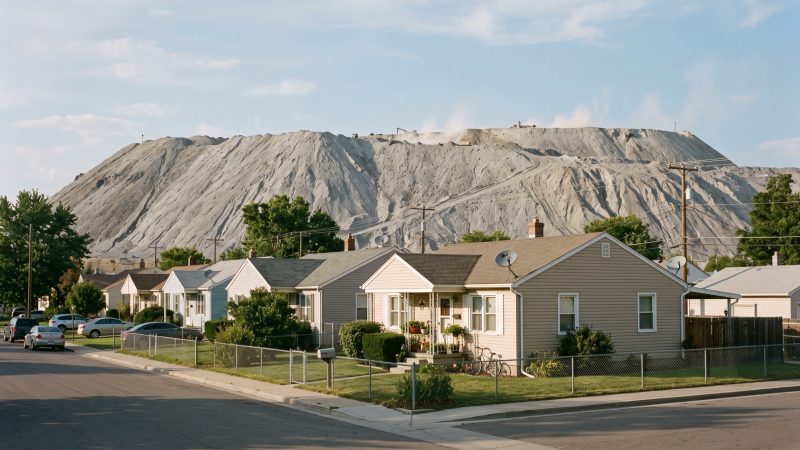
About 100 feet out from the edge of a polluted site. That’s roughly two houses wide.
That surprises people, because most of us picture something underground spreading the way smoke spreads through a room. It doesn’t. Vapor seeps through soil rather than blowing through it, and it thins fast on the way. Folkes and colleagues went back over field cases and found effects rarely turning up more than a house or two past a plume’s edge.
Three situations break that rule, and all three involve something pushing rather than seeping. A landfill making enough methane to shove gas along. A spill inside a building heavy enough to drive vapor down through a floor. A pressurized gas transmission line with a leak, which has pressure behind it by design. Any of those can carry hundreds of feet.
Little and colleagues wrote up one in 1992. A southern California landfill where methane turned up inside nearby homes at close to 1 percent by volume, and chlorinated hydrocarbons reached a house 590 feet away. We read that account in a federal guide’s footnote rather than in their paper.
Fuel gets a kinder rule. Put more than 6 feet of clean, living soil between dissolved gasoline and your building and nobody recommends digging further, because bugs in that soil eat fuel on its way up.
So distance matters. What’s buried down there counts for more. Six feet of live soil handles gasoline. It does nothing at all for dry cleaning solvent.
What happens when somebody tests your house?
A steel ball on your floor for a day, and your own cleaning products out in a shed first.
That ball is a six-liter canister, about the size of a soccer ball, and it arrives under vacuum. Somebody opens a valve and it pulls air in slowly across 24 hours. No pump, no noise, nothing to plug in. Not a sound out of it.
Your own things have to leave before it starts. Cleaners, air fresheners, aerosols, mothballs, scented candles, insect repellant, and whatever is left over from a hobby or an afternoon of car repair. Out of your building 24 to 72 hours ahead, or what you paid to measure is your garage.
One round isn’t enough, and this is where cost meets honesty. Holton and colleagues worked out what a single day can miss: a one-day sample drawn at random had a 40 percent chance of coming in under a house’s true average. Where a house genuinely ran 2 or 5 times over an action level, one day of sampling missed it 20 percent and 6 percent of the time. Those figures reach us through a federal guide’s summary of their work.
Then there’s an empty house in Utah, sitting over a plume of chlorinated solvent, with nobody inside to open a window or run a dryer. Indoor air in that house swung across two to three orders of magnitude.
Weather is doing that to your house. Pressure shifts with season, and a house pulls hardest through heating months, which is why a canister filled in January and one filled in June can tell opposite stories about identical dirt.
So ask how many rounds a quote covers before you compare two prices. Quotes covering different numbers of rounds aren’t comparable at all, and we would rather you knew that before somebody quotes you cheap.
Does a bad result mean you have to move out?
No. A screening value is a signal to look harder, and it was never built as a pass mark.
That one mix-up causes more panic at more kitchen tables than any laboratory result does, so it’s worth getting straight. These values are set deliberately low. For cancer the target is one extra case per million people across a lifetime, which is about as cautious as our environmental math ever gets.
Here’s how low. Ask the federal calculator about trichloroethylene and the groundwater figure it wants comes out at 0.518 micrograms per liter, against a legal drinking water limit of 5. Legal to drink, and still worth checking for what comes off it into your basement, which is the line in all of this that surprised us most.
Now the half that gets skipped, and it cuts the other way. Screening values are one chemical at a time. Where a few chemicals in a house share one kind of harm, they add up. A real health threat can exist with every one of them sitting under its own value. Passing each isn’t the same as passing.
And the guide carrying all of this opens with a line saying it imposes no requirements on EPA, on states, or on anybody else. Advice. Not law. The record of who built what is older than the hazard, because somebody drew your block by hand a century ago.
So a result over a screening value means keep going. It doesn’t mean pack. Anybody telling you to leave before a second round of sampling has even been booked is running well ahead of anything a number can carry.
Does a closed cleanup site mean the problem is over?
EPA did not add underground vapor to Superfund scoring until a rule took effect on 8 February 2017.
Ahead of that, a site got scored on groundwater, on air, on surface water, and on soil you might touch. What came up through a floor into a bedroom wasn’t on that sheet. Scoring had last been rewritten in December 1990. Nobody was scoring your floor.
So a property cleaned to a standard that never counted vapor could be assessed, signed off and closed, and still have a route nobody had looked at.
Years later somebody reopens it, and by then those houses have changed hands. Resale, foreclosure, a second generation moving in. Owners who arrived after the fact weren’t part of any original resolution, and plenty of them have no idea a system was ever installed under their floor. Neighbors who did go through round one can be reluctant to reopen anything, which we understand. Nobody wants to hear that their street is a case file again.
Federal law does force a look back. Any cleanup that leaves hazardous material in place gets re-examined every five years.
That flips the question for a homeowner, and it is worth putting bluntly. Not whether this site was cleaned up. Ask whether it was ever checked for vapor, and when. A closure letter written before 2017 answers a different question than the one you are asking.
What if a gas station used to be on your corner?
Start with history, not with a test. And start free.
Envirofacts checks a stack of federal databases against one address at once, it costs nothing, and it’s the first thing to open before you pay anybody to sample anything. Search yours, then widen the circle to filling stations, dry cleaners, auto shops and small industry within a couple of hundred feet, rather than only next door.
Then go older than any database, because old paper is worth more here than anything you can type into a search box. Fire insurance maps and city directories catch what federal records never had. A corner station that closed two generations ago may never have made it into a federal record at all.
Scale is our argument for bothering. 52,859 fuel releases were still waiting to be cleaned up as of March 2026, against 534,189 tanks still in the ground and working. Those are everyday addresses on ordinary corners, and some sit a block from a house like yours.
If something turns up close, call your state environmental agency. Two things to ask, in this order. Was that site ever checked for vapor. When.
Does a mitigation fan fix the contamination?
Denver is where this got proved at scale. Folkes and Kurz put suction systems under 337 homes over a plume of 1,1-dichloroethylene, and three years of monitoring across 301 of them showed very substantial drops indoors. About a quarter needed a minor adjustment or an upgrade after installation before they hit the state’s standard. That account reaches us through a federal guide’s footnote rather than from their paper.
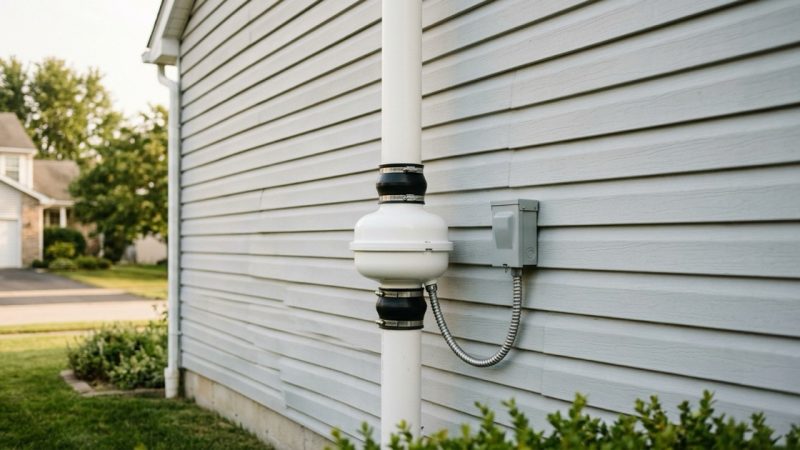
Hardware is plain. Holes cut in your slab, a pit dug out underneath, pipes up through them, everything sealed, a fan pushing soil gas outdoors.
Some places put one in before anybody has proved a problem, on the reasoning that a fan is quick and cheap next to a full site investigation, and that the alternative means strangers in your basement for months while you wonder.
Be clear about what you’re buying, though. It’s not an air filter. It works on what arrives from below and does nothing about paint thinner in your garage.
And it cleans nothing up. Where nobody deals with the source, that fan runs indefinitely and becomes part of your house the way a sump pump is. Whoever offers to put one in may pay for that while monthly running cost becomes yours, and if you turn it down, putting one in later may be on you, so get both the offer and your answer in writing.
We’ll leave you with one line rather than a rule. A fan is a fence, not a shovel. It keeps what’s under your floor out of your rooms, and everything that was down there on the day it switched on is still down there, waiting on somebody else entirely.
Sources
- U.S. Environmental Protection Agency. OSWER Technical Guide for Assessing and Mitigating the Vapor Intrusion Pathway from Subsurface Vapor Sources to Indoor Air (2015) OSWER Publication 9200.2-154
- U.S. Environmental Protection Agency. Vapor Intrusion Screening Level (VISL) Calculator (2026)
- U.S. Environmental Protection Agency. Technical Guide For Addressing Petroleum Vapor Intrusion At Leaking Underground Storage Tank Sites (2015) EPA 510-R-15-001
- U.S. Environmental Protection Agency. Addition of a Subsurface Intrusion Component to the Hazard Ranking System, final rule (2017) 82 FR 2760
- U.S. Environmental Protection Agency. UST Performance Measures (2026)
- U.S. Environmental Protection Agency. Envirofacts (2026)
Questions people ask
What is vapor intrusion?
EPA defines it as the migration of hazardous vapors from a subsurface source, such as contaminated soil, groundwater or a contaminated conduit, into an overlying building. The vapors enter through cracks, seams and gaps in floors and foundations, through utility conduits and sump pits, and along drain and sewer lines.
Will a radon test detect vapor intrusion?
No. A radon test measures radon. EPA's June 2015 technical guide states that the radon level in a building is not, as a rule, a good quantitative indicator of chemical vapor concentrations, and that measuring radon is not recommended as a proxy for measuring those chemicals directly. A high radon result does tell you the slab leaks soil gas.
How close to a contaminated site does a house have to be?
EPA uses 100 feet, about two houses wide, as the initial lateral inclusion zone for deciding which buildings to investigate. It names three exceptions where vapors can travel hundreds of feet: landfill methane, dense indoor releases pushed down through a floor, and leaks from pressurized gas transmission lines.
What is EPA's screening level for TCE in indoor air?
A run of EPA's Vapor Intrusion Screening Level calculator on 14 August 2026, residential scenario and default inputs, returned 0.209 micrograms per cubic meter for trichloroethylene. That is a health-based screening value set at a hazard quotient of 0.1, not a limit. EPA states that exceeding a screening level does not establish unacceptable risk.
How is a house tested for vapor intrusion?
Indoor air goes into a six-liter canister over 24 hours under EPA Methods TO-14A and TO-15, and soil gas is drawn from a small port cut through the slab. EPA recommends removing household solvents, aerosols and mothballs 24 to 72 hours beforehand, and collecting more than one round because indoor levels swing with season and weather.
Can a cleaned-up site still have a vapor problem?
Yes. The Hazard Ranking System that scores Superfund sites had no subsurface intrusion component until a rule effective 8 February 2017. Sites listed before that were evaluated on groundwater, air and surface water migration and on soil exposure. EPA's five-year review guidance covers vapor intrusion even where it was not addressed in the original remedy.
How is vapor intrusion fixed in a house?
Usually by sub-slab depressurization, which EPA says was first developed for radon reduction and works on similar design principles: holes in the slab, a suction pit, pipes and a fan venting outdoors. EPA notes the system protects against subsurface vapors only, not indoor sources, and that it is expected to run indefinitely if the underground source is not cleaned up.

Have questions about the environment inside your home?
Air quality, mold, EMF, light and water all shape how a house feels and how the people in it feel. Whatever your concern is, the first step is finding out what is there.
Our certified team of environmental professionals and advocates can help.