


Toxic algae now coats more than half of Lake Okeechobee
More than half the lake is covered in blue-green algae fed by farm runoff, with heat and still water helping the bloom spread. A veteran volunteer pilot called this summer's outbreak close to the worst he has seen.
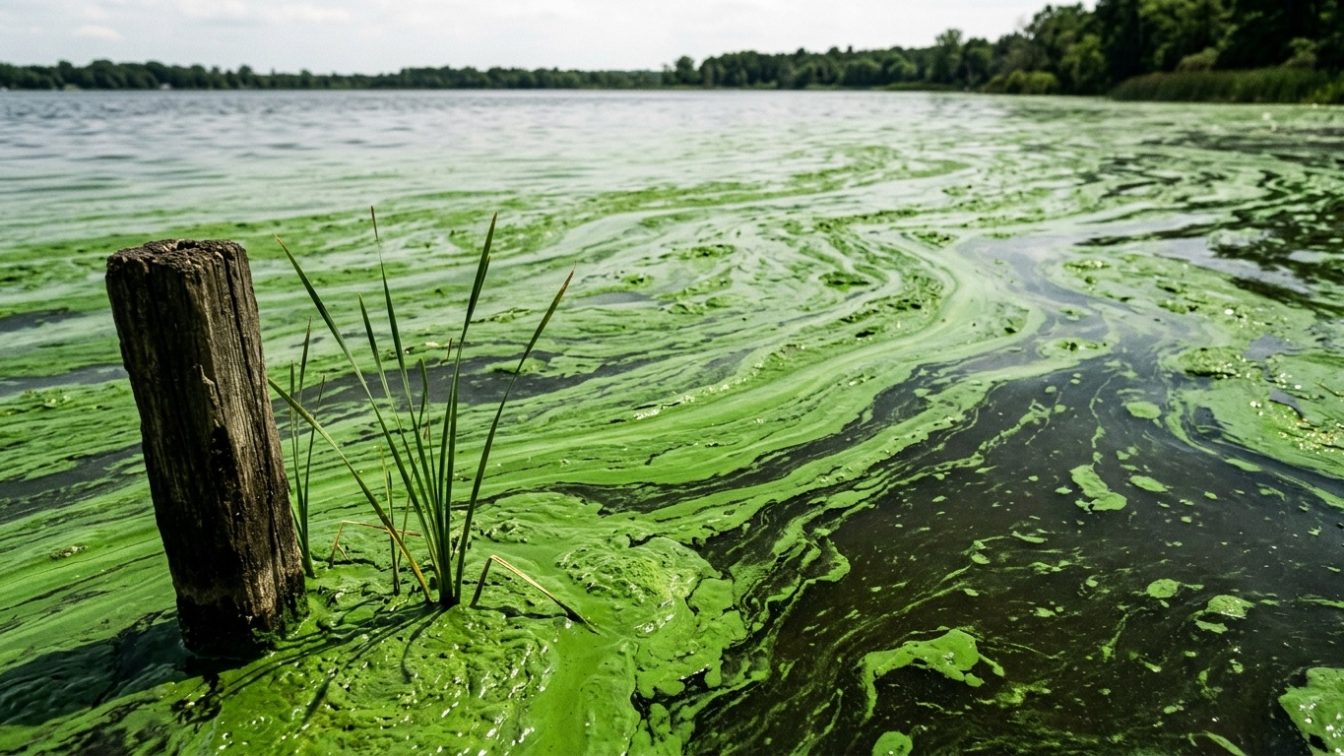
Table of contents
Summary of this article
- More than half of Lake Okeechobee is coated in toxic blue-green algae. A volunteer pilot for Calusa Waterkeeper described the summer 2026 bloom as "pretty close to the worst," according to WUSF/WGCU reporting by Tom Bayles.
- The bloom is driven by nutrient pollution. Blazing summer temperatures, still waters, and agricultural runoff loaded with nitrogen and phosphorus from excess fertilizer feed the cyanobacteria, and there is no feasible solution yet.
- Cyanotoxins can sicken people and kill animals. Blue-green algae blooms produce toxins, and larger blooms can close lakes and boat ramps and collapse fisheries.
- The economic stakes are enormous. A study commissioned by local clean-water nonprofits found a major bloom like 2019's would today cost the region $5.2 billion and 43,000 jobs.
- The 2019 mega-bloom cascaded to the coast. It began in Lake Okeechobee, traveled down the Caloosahatchee River, collided with red tide, and decimated coastal waters for more than a year. There is no indication 2026 will repeat that regional cascade.
More than half of Lake Okeechobee, Florida’s largest lake, is coated in blue-green algae. Ralph Arwood, a volunteer pilot for Calusa Waterkeeper who flies over the lake each summer, described the 2026 bloom as “pretty close to the worst.” The rest of the lake, he said, still “doesn’t look like clean water.”
That single fact carries real weight for anyone who lives near the lake, fishes it, boats on it, walks a dog near it, or draws water from the systems it feeds. Blue-green algae is not just an eyesore. It produces toxins that can sicken people and kill animals. WUSF/WGCU reporter Tom Bayles detailed the outbreak on July 20, 2026.
Understanding this bloom comes down to three questions building biology always asks: where does the problem come from, how does it reach your body, and what can you actually do about it. The answers point to a stubborn source and a set of practical protections you can put in place today.
What blue-green algae actually is
“Blue-green algae” is a common name, but the organism is not really algae at all. It is cyanobacteria, one of the oldest life forms on Earth. Given the right conditions, it multiplies explosively into a bloom that can turn water bright green, pea-soup thick, or streaked with paint-like swirls.
The danger is that many cyanobacteria produce cyanotoxins. The most common in Florida freshwater is microcystin, which targets the liver. Others affect the nervous system or the skin. These toxins do not care whether the water looks mildly murky or fully green, which is why a bloom “close to the worst” is a serious public-health signal, not just a scenic complaint.
The source: nutrients you can trace back to land
Three ingredients feed a bloom like this one: blazing summer temperatures, still water, and nutrients. The heat and the calm summer conditions are seasonal and largely out of human control. The nutrients are not.
Lake Okeechobee’s bloom is fueled by agricultural runoff loaded with nitrogen and phosphorus from too much fertilizer use. When it rains, excess fertilizer washes off farmland and lawns into ditches, canals, and ultimately the lake. Those nutrients act like food for cyanobacteria. Add heat and still water, and the bloom takes off.
This is the heart of the building-biology principle of source control: fix the problem where it starts rather than treat it downstream. As Bayles reported, the nutrient pollution is “a long time in the making, and nobody has come up with a feasible solution to get rid of it.” Every summer, Florida pays the price.
Source control at this scale means cutting the nutrient load, reducing fertilizer runoff from agriculture and development, restoring wetlands that filter water before it reaches the lake, and rethinking how water moves across the landscape. Until that happens, the lake will keep blooming when the heat arrives.
The three exposure pathways
Cyanotoxins reach your body through three routes. Knowing each one tells you exactly how to protect yourself.
- Skin contact
- Swimming, wading, or handling contaminated water can cause skin rashes, hives, and irritation of the eyes, nose, and throat. Even splashing while boating puts toxins on your skin. This is the most common way people encounter a bloom, and it is entirely avoidable by staying out of visibly affected water.
- Inhalation
- Wind, waves, boat motors, and jet skis break the water into a fine spray, or aerosol, that carries cyanotoxins into the air. Breathing that spray near an active bloom can irritate the airways and trigger symptoms in people with asthma or other respiratory conditions. This is the pathway many people overlook, because you do not have to touch the water to be exposed. Standing downwind of a bloom on a breezy day is enough.
- Ingestion
- Swallowing contaminated water, whether accidentally while swimming or through drinking water drawn from an affected source, delivers the highest doses. Microcystin ingestion can cause nausea, vomiting, diarrhea, and, at higher exposures, liver damage.
Each pathway suggests its own fix, which is what makes this framework so useful for keeping a household safe.
Why pets and animals face the highest risk
Blue-green algae blooms can kill animals, and the reasons come down to behavior. Dogs drink from the water, swim in it, and then lick the algae off their fur, combining all three exposure pathways at once. A dog that swims through a bloom and grooms itself afterward can swallow a concentrated dose of toxin.
The danger is fast and severe. Dogs have died within hours of exposure to toxic blooms elsewhere in the country. Livestock and wildlife that drink from an affected shoreline face the same risk. Warning signs in a pet include vomiting, diarrhea, weakness, stumbling, drooling, and seizures. If your dog contacts water near a bloom, rinse it with clean water immediately and call a veterinarian, because there is no antidote and speed matters.
The simplest protection is absolute: keep pets out of and away from any water showing scum, bright-green color, or a paint-like sheen.
Measurable thresholds worth knowing
Cyanotoxin risk is not just a matter of appearance. Agencies use measurable limits, and knowing them helps you interpret warnings. The risk reaches pets first, and a dog can die within hours of swallowing lake water.
For drinking water, the U.S. Environmental Protection Agency issued health advisory levels for microcystin of 0.3 micrograms per liter for children under school age and 1.6 micrograms per liter for everyone else, over a 10-day exposure period. For recreational water, the EPA recommends a swimming advisory threshold of 8 micrograms per liter of microcystin. The World Health Organization sets a lifetime drinking-water guideline of 1 microgram per liter.
The practical takeaway: these numbers are small. Toxins are dangerous at concentrations invisible to the eye, which is why you should treat any posted advisory as a hard line, not a suggestion. When the Florida Department of Environmental Protection or a local health department posts a bloom alert, the water has crossed a threshold that matters for your health.
The bigger stakes: economy and cascade
This is not only a health story. Local clean-water nonprofits commissioned an economic study that found a major bloom like the one in 2019 would, today, cost the region $5.2 billion in economic losses and 43,000 jobs. Larger blooms close lakes and boat ramps, collapse fisheries, and turn treasured waterways into ecological disaster zones.
The 2019 event shows how a lake problem becomes a coastal one. That mega-bloom began in Lake Okeechobee and traveled down the Caloosahatchee River. Once it reached the Gulf, it collided with a red tide, grew into a large harmful algae bloom, and decimated coastal waters for more than a year.
The current bloom is worse than the typical annual outbreak, but there is no indication it will repeat the 2019 regional cascade. That is measured reassurance, and it stops short of an all-clear. The lake water still moves, and the nutrient source that drives every one of these blooms remains unaddressed.
Practical fixes you can use now
You cannot fix the lake’s nutrient load on your own, but you can control your exposure and reduce your own contribution to the problem.
- Follow every posted advisory
- If a beach, boat ramp, or waterway is flagged for a bloom, stay out. Advisories mean toxin levels have crossed measurable thresholds.
- Avoid contact with discolored water
- Skip swimming, wading, and water sports in water that looks green, scummy, or paint-streaked. Do not let the water touch your skin.
- Guard against spray
- On breezy days near an active bloom, stay upwind and keep your distance from boat and jet-ski wakes. Close windows facing the water if spray is drifting inland.
- Protect pets absolutely
- Keep dogs out of and away from suspect water. If contact happens, rinse with clean water right away and contact a vet if you see vomiting, weakness, or seizures.
- Do not eat fish from an active bloom
- Toxins can accumulate in fish tissue. When in doubt, don’t harvest from affected water, and never eat shellfish from a bloom area.
- Know your drinking water source
- Public utilities treat and test for cyanotoxins. If you rely on a private surface-water intake, have it tested during bloom season against the EPA advisory levels above.
- Cut your own nutrient runoff
- Follow local seasonal fertilizer bans, avoid fertilizing before heavy rain, and leave vegetated buffers along any waterway on your property. Every pound of nitrogen and phosphorus kept out of the water is one less meal for the next bloom.
What this means for you
More than half of Florida’s largest lake is coated in toxic algae, and the source, excess nitrogen and phosphorus washing off the land, has no quick fix. That makes summer blooms a recurring feature of life around Lake Okeechobee and the waters it feeds, rather than a one-time emergency.
The good news is that exposure is largely controllable. The toxins reach you through skin, breath, and swallowing, and each of those pathways can be blocked by staying out of and away from discolored water, respecting posted advisories, and keeping pets far from the shoreline. The measurable thresholds agencies use are small for a reason: cyanotoxins are potent at low levels. Treat any advisory as a firm boundary.
The lasting fix is source control at the watershed scale, cutting the nutrient pollution that feeds these blooms year after year. Until that work is done, your best protection is knowing where the danger comes from, how it reaches your body, and the simple steps that keep it away from your family and your animals.
Sources
- WUSF/WGCU, Tom Bayles. Lake Okeechobee's annual summer blue-green algae outbreak 'close to the worst' (2026) (July 20, 2026):
Questions people ask
What is blue-green algae, and is it really algae?
Blue-green algae is the common name for cyanobacteria, one of Earth's oldest organisms. Under warm, still, nutrient-rich conditions it multiplies into blooms that can turn water bright green or scummy. Many cyanobacteria produce toxins called cyanotoxins, such as microcystin, which can harm the liver, nervous system, or skin.
How bad is the 2026 Lake Okeechobee bloom?
More than half of the lake is blanketed in blue-green algae. Ralph Arwood, a volunteer pilot for Calusa Waterkeeper who flies over the lake, described it as "pretty close to the worst," according to WUSF/WGCU. It is worse than the typical annual bloom, though there is no indication it will repeat the 2019 regional cascade.
How can the algae toxins affect my health?
Cyanotoxins reach you three ways: skin contact can cause rashes and eye, nose, and throat irritation; inhaling spray near a bloom can irritate the airways; and swallowing contaminated water can cause nausea, vomiting, diarrhea, and, at higher exposure, liver damage. Avoid contact with discolored or scummy water.
Why are dogs at such high risk?
Dogs drink the water, swim in it, and lick algae off their fur, combining all exposure routes. Toxic blooms have killed dogs within hours. Keep pets away from suspect water, rinse them with clean water if contact happens, and see a vet immediately if you notice vomiting, weakness, drooling, or seizures.
What toxin levels are considered unsafe?
The EPA's drinking-water health advisory for microcystin is 0.3 micrograms per liter for young children and 1.6 for others over 10 days, and its recreational swimming advisory is 8 micrograms per liter. The WHO sets a lifetime drinking-water guideline of 1 microgram per liter. These are small numbers, so treat any posted advisory as a firm limit.
What causes these blooms, and can they be stopped?
They are driven by heat, still water, and agricultural runoff loaded with nitrogen and phosphorus from excess fertilizer. The heat is seasonal, but the nutrients come from land and can be reduced. As of now there is no feasible solution to remove the accumulated nutrient pollution, so blooms recur each summer until the source is addressed.


Have questions about the environment inside your home?
Air quality, mold, EMF, light and water all shape how a house feels and how the people in it feel. Whatever your concern is, the first step is finding out what is there.
Our certified team of environmental professionals and advocates can help.