


That 99.97% on a HEPA filter box is its worst score
The rating is measured at 0.3 microns, the particle size a filter has the hardest time catching. Both larger and smaller particles are trapped more easily.
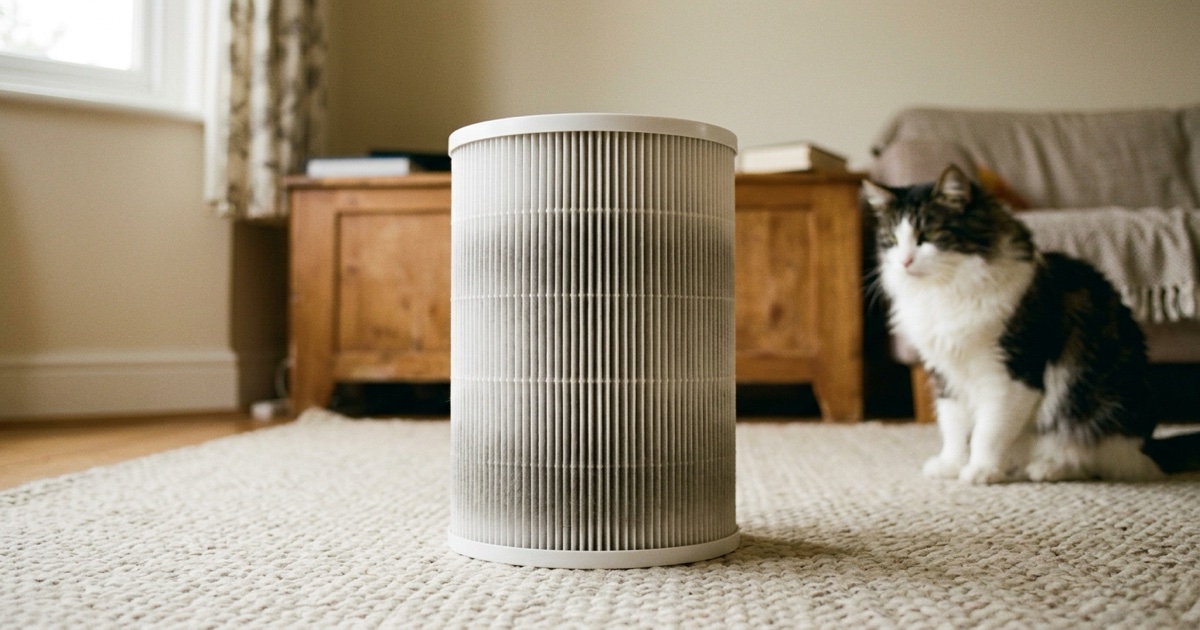
Table of contents
- Why is 0.3 micrometers so hard to catch?
- What size are the particles in real air?
- Do smaller particles slip through?
- Where did the HEPA standard come from?
- Does the word HEPA on a box mean anything?
- Why does a good filter leave a dirty room?
- Do filters do anything about smells?
- Does a dirty filter still work?
- What should you check before buying?
Summary of this article
- 99.97 percent is a worst case. It is measured at the one particle size hardest to catch, and everything bigger or smaller does better.
- The standard came out of wartime nuclear work. DOE still runs a test facility for it, and Hanford tests filters at two different airflows.
- HEPA-type and HEPA-like are marketing next to a real term. A 99 percent filter lets through more than thirty times as much as 99.97.
- A great filter with a weak fan cleans slowly. EPA says the same filter moving 10 cubic feet per minute is ten times less effective than at 100.
- Clean air delivery rate is the figure worth reading, because it folds filter quality and airflow together.
- Particle filters do nothing for smells or gases. Carbon helps and saturates, with no indicator to tell you when.
- A dirty filter catches better and moves less air, so looking dirty is not a test of anything.
Why is 0.3 micrometers so hard to catch?
Because a particle that size is too light to crash into a fiber and too heavy to wander into one. It threads straight down a gap that traps almost everything else, which is why 99.97 percent gets quoted at that size. That figure is the score at a filter’s worst size, not its average across the air in your room.
Pull one out of a machine and look at it against a window. It’s nothing like a screen. It’s a snarl of fine fibers folded into pleats, and the gaps you can see are far wider than most of what it catches.
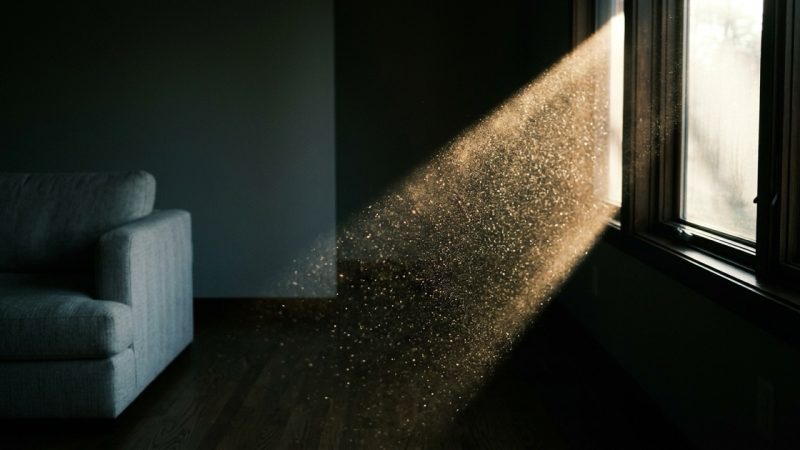
Big particles can’t turn. Air bends around a fiber, a heavy particle keeps going, and it hits. That’s most of what you see drifting in a sunbeam.
Very small particles have an opposite problem. Air molecules knock them about so hard they can’t fly straight, and anything staggering across a room staggers into a fiber sooner or later.
In between runs a stretch where neither thing works well. Academics in the 1940s did that arithmetic and put its worst point at 0.3 micrometers, decades before anybody could go and check them. Modern equipment says they were close.
So 99.97 percent is a floor. It’s one filter tested at its single weakest point, and both sides of that point do better. We had it upside down for years, and turning it the right way up changes what every box in an aisle is telling you.
| How big | What that is | How a filter handles it |
|---|---|---|
| 70 micrometers | one human hair | better than 99.97 percent |
| 10 micrometers | top of what gets called inhalable | better |
| 2.5 micrometers | fine soot and smoke | better |
| 0.3 micrometers | nothing you’d ever name | 99.97 percent, worst it does |
| 0.07 micrometers | small end of that same hard stretch | 99.97 percent, worst it does |
| 0.05 micrometers | average of most city air | better again |
Read those two hard rows twice, because that’s where this whole subject turns over. A 0.3 micrometer particle isn’t a virus, or a grain of smoke, or anything you’d worry about by name. It’s a size chosen because filters hate it.
What size are the particles in real air?
Much smaller than the difficult one, which is the whole reason a HEPA filter beats its own rating in an ordinary room.
That matters because every number on a box is a worst case by design. A rating quoted at the one size a filter handles least well tells you the floor of its performance rather than the middle of it, and a floor is the honest thing to print. Almost nothing you breathe is sitting at that floor.
Now here’s the part we’d want somebody to tell us. Count what floats in typical city air one speck at a time, and over 99 percent of it averages 0.05 micrometers. That figure comes out of a federal Nuclear Air Cleaning Handbook, and it falls underneath the hard stretch, on the easy side, where a filter beats its own label. Most of what drifts past you outdoors was never the difficult part.
Do smaller particles slip through?
They get caught more, and somebody has watched it happen one particle at a time.
Rengasamy and colleagues at a federal respirator lab fired silver particles at N95 and P100 masks, shrinking them a notch at a time. 30 nanometers, then 20, 16, 12, 8, and finally 4. Less came through at every step down.
Two of those masks let fewer than one particle out the back in half an hour, at the smallest sizes.
Read that again, because it isn’t a percentage. One particle. Thirty minutes. That’s the figure that turned us around on all of this.
That was respirator material rather than glass fiber from a home filter, and we’d rather flag a difference than paper over it. It’s the closest measurement we could open. What carries across is why a filter wins down there. A particle small enough gets shoved off course by air itself and blunders into whatever it’s passing.
A follow-up from that same group went looking for where those masks were weakest, and it wasn’t 0.3 micrometers at all. It came out between 30 and 60 nanometers. So worst size is a property of whatever a filter is made from. Which tells you how much of that famous figure is a decision somebody made about a test, and how little of it’s a fact about air.
Whichever way it moves, the thing you assumed was sailing straight through is the thing a filter is best at.
Where did the HEPA standard come from?
A gas mask. Paper inside a HEPA filter began as the same paper packed into military canisters in the Second World War, and it reached your living room by way of the Manhattan Project.
Humphrey Gilbert, a safety engineer on that project, coined the term. Gas mask standards came across with it more or less intact, which is why a thing you buy for a nursery is still described in language written for chemical and biological defense.
Those original specifications were, in that same handbook DOE still publishes, “concealed under a veil of military secrecy.” After the war, the Atomic Energy Commission picked military HEPA filters as its main way of cleaning exhaust air out of every nuclear building it ran, and letting anybody else buy one meant declassifying it first.
That world hasn’t gone anywhere, and we think it’s worth knowing before you pay a premium for it. Filters bound for nuclear buildings get shipped to a federal test lab in Maryland first, and ones that fail go back to whoever made them at the manufacturer’s expense. Pensado and colleagues at Southwest Research Institute read results from 2013 to August 2020 to ask whether every last filter still needed that trip.
A filter written into tank work at Hanford has to let no more than 0.03 percent of a test aerosol past it, checked at full rated airflow and then again at 20 percent of it, because air crawling through media behaves nothing like air being pushed.
Tested twice, at two speeds, by people with nothing to sell you. No box on a shelf at a home store meets one part of that, and we’ve never seen one claim to. Same three letters, completely different world.
Does the word HEPA on a box mean anything?
Stand in an aisle and read four boxes on your way past. True HEPA. Then HEPA-type, HEPA-like, and 99 percent HEPA.
One of those is doing what you think, and nothing printed on any of them tells you which.
EPA writes up home air cleaners in a technical summary, and on this exact question it offers you no cover at all: “there is no widely accepted definition of HEPA performance in consumer products.” In hospitals and industry, that word drags narrow performance requirements and hard testing behind it. On a box in a store it carries whatever fits. So we’ve learned to read whatever stands next to it, because that’s where you get taken.
Look at how close 99 sounds to 99.97, then flip both around and read what gets past instead. One in every hundred, against three in every ten thousand. More than thirty times as much coming out the other side of a machine you bought to stop it. A number on a box is not a measurement of your air, any more than a federal heat level describes your house.
So look for two things printed together, an efficiency and a particle size. A box handing you one without the other is a box that can’t hand you both.
Why does a good filter leave a dirty room?
Because a filter only cleans air that reaches it, and most of your room’s air is somewhere else. A beautiful filter behind a tired fan is a straw in a bathtub.
Arithmetic in that same federal summary is worth carrying around, and we do. Take your bedroom, roughly 10 feet by 12 by 8. Put a filter in it catching 99 percent of everything passing through. Move 10 cubic feet of air a minute and it’s ten times less effective than that identical filter moving 100.
One filter, one rating, ten times the result, out of a fan. Nobody ever sold us a fan, though. They sold us a filter.
You’re buying a fan. Read the aisle that way and most of it sorts itself out.
Which is why clean air delivery rate exists at all. It multiplies what a filter catches by what it moves, and portable HEPA machines run between 150 and 300 cubic feet a minute.
Two catches nobody prints large, and between them they’ve cost us more than anything else here. A figure on a box comes from the loudest setting a machine has. And a room size printed next to it assumes knocking particles down by 80 percent rather than removing them.
Do filters do anything about smells?
No. A particle is a bit of stuff. A smell is a molecule, and mesh built to trap bits does nothing to something sliding between them on its way to your nose.
EPA puts it flatly. Air cleaners built only for particles “can’t control gaseous pollutants, including those that contribute to chemical odors.”
So your cooking stays with you. Smoke smell stays. Whatever comes off new furniture stays. Fitting a better particle filter changes not one bit of it, and a fair few of us bought a machine for precisely that job.
Carbon is the usual add-on, and carbon genuinely works on some things. It takes up most hydrocarbons and a good share of organic acids. It’s poor against formaldehyde, ammonia, hydrogen sulfide and nitrogen oxide.
Thin carbon layers glued onto filter media saturate fast, and once full they can hand back what they took up. Nothing lights up to warn you. You have a lump of material sitting in an airflow while a fan runs.
So buy filtration for particles. A smell needs its source found, and then a window opened. That’s the order we’d do it in.
Does a dirty filter still work?
Better than a clean one, and that’s the second thing here that runs backwards on you.
Dust doesn’t only clog media, it builds on it. That same handbook has a name for the layer, a filter cake, and efficiency climbs in proportion to how thick a cake gets. A filter running for a month catches more than one fresh out of a bag.
Cost shows up on the other side. Resistance to airflow crept along slowly while particles were still arriving one at a time, and once a cake forms it climbs at an accelerating rate. So a loaded filter grabs a higher share of everything that reaches it, while steadily less does.
Which finishes off “it still looks clean” as a test, and “it looks filthy” with it. A loaded filter works better and moves less, and one half of that shows on a surface.
Your filter is doing its best catching in the week before you throw it out.
For hazardous work there’s an outer limit written down. 10 years from manufacture in dry systems, 5 anywhere a filter can get wet more than once, with storage time counted inside that. Get one wet and it gets replaced fast. Nothing you buy for a bedroom comes with a ceiling like that, and we’d love to know why not.
What should you check before buying?
Four things, and that famous word isn’t one of them. We shop from this list.
Clean air delivery rate first, against a room you’ll genuinely run it in. That’s the one doing real work, because it folds a fan in with a filter.
Then noise, at whatever setting produces that figure. A machine rated loud and run quiet is a machine you didn’t buy.
Then efficiency and particle size, printed together. One without the other tells you nothing.
Then filter price and how often it wants changing, because that’s the real cost of a machine, spread out somewhere you won’t notice it.
And one thing no box will ever carry, which we’d say out loud in a shop if anybody asked us. A 99.97 percent filter in a machine you switch off because it whines is worse than a 95 percent filter you leave running.
Every specification in this piece was written for buildings where a filter is safety equipment and somebody signs for it. Yours has to survive a bedroom, a light sleeper and an electricity bill. Those aren’t the same test, and one of the two was never yours to pass.
Sources
- U.S. Department of Energy. DOE Handbook, Nuclear Air Cleaning Handbook (2022) DOE-HDBK-1169-2022
- U.S. Department of Energy. DOE Handbook, Nuclear Air Cleaning Handbook, Chapter 8, Testing (2003) DOE-HDBK-1169-2003
- U.S. Department of Energy, Office of Environment, Health, Safety and Security. High Efficiency Particulate Air (HEPA) Filter Test Facility (FTF) (2026)
- Los Alamos National Laboratory. Master Specification 23 4133.16, HEPA Filters, ASME AG-1 Section FK, Special (2018) 23 4133.16 Rev. 0
- Hanford Tank Operations Contractor. Specification for Non-Standard Nuclear Grade HEPA Filters (2017) RPP-SPEC-60635 Rev. 0
- Pensado O, Adams G, Khalek I, Southwest Research Institute. Technical analysis of filter testing at the U.S. Department of Energy Filter Test Facility (2021) OSTI ID 1834370
- U.S. Environmental Protection Agency. Residential Air Cleaners: A Technical Summary, 3rd Edition (2018) EPA 402-F-09-002
- U.S. Environmental Protection Agency. Air Cleaners and Air Filters in the Home (2026)
- National Institute for Occupational Safety and Health. Approval of Respiratory Protective Devices, Subpart K, Air-Purifying Particulate Respirators (2026) 42 CFR 84.170 and 84.174
- Rengasamy S, King WP, Eimer BC, Shaffer RE. Filtration performance of NIOSH-approved N95 and P100 filtering facepiece respirators against 4 to 30 nanometer-size nanoparticles, Journal of Occupational and Environmental Hygiene 5(9):556-64 (2008) PMID 18607812
- Rengasamy S, Eimer BC, Shaffer RE. Comparison of nanoparticle filtration performance of NIOSH-approved and CE-marked particulate filtering facepiece respirators, Annals of Occupational Hygiene 53(2):117-28 (2009) PMID 19261695
- U.S. Environmental Protection Agency. Particulate Matter (PM) Basics (2026)
- U.S. Environmental Protection Agency. NAAQS Table (Criteria Air Pollutants) (2025)
- BAUBIOLOGIE MAES and IBN. Building Biology Evaluation Guidelines for Sleeping Areas, SBM-2024, Standard Point 5, Particles and Fibers (2024)
Questions people ask
What does 99.97 percent mean on a HEPA filter?
It is a minimum efficiency measured at one particle diameter, 0.3 micrometers. At that size, three particles in every ten thousand get through the media instead of being captured. The Department of Energy's Nuclear Air Cleaning Handbook, DOE-HDBK-1169-2022, defines a HEPA filter as a throwaway, dry-type filter in a rigid casing "with a minimum efficiency of 99.97 percent when tested with an aerosol of 0.3-µm diameter test aerosol particles." That is a procurement specification for federal contractors, not a limit on the air in your home.
Why is HEPA tested at 0.3 microns and not something smaller?
Because 0.3 micrometers is close to the hardest size to capture. DOE's handbook states the 99.97 percent minimum is for the most penetrating sizes, which it gives as a range of 0.07 to 0.3 micrometers. Chapter 8 of the 2003 edition records the origin: academics in the 1940s calculated that a particle of that size would be the most difficult to filter, and the handbook says modern testing proved the calculation relatively accurate. The term HEPA was coined by Humphrey Gilbert, a Manhattan Project safety engineer.
Do HEPA filters catch particles smaller than 0.3 microns?
Yes, and generally better than they catch 0.3 micrometer particles. EPA's own definition says a HEPA filter has 99.97 percent efficiency at 0.3 micrometers "with high efficiency for both larger and smaller particles." A 2008 NIOSH bench study in the Journal of Occupational and Environmental Hygiene tested five N95 and two P100 respirators against silver particles from 4 to 30 nanometers and found penetration dropped as the particles shrank. Very small particles wander off the airflow by Brownian motion and hit a fiber, so diffusion does the work that impaction cannot.
Does a HEPA air purifier remove VOCs, smells or formaldehyde?
No. EPA states that air cleaners designed only to remove particles "cannot control gaseous pollutants, including those that contribute to chemical odors." A carbon layer is the usual add-on, and EPA reports that activated carbon takes up most hydrocarbons and many organic acids but "is not especially effective" against formaldehyde, ammonia, hydrogen sulfide, oxides of sulfur or nitrogen oxide. Thin carbon layers bonded onto filter media can saturate quickly, after which the filter can release what it took up.
Does a HEPA filter help with radon or mold?
Radon, no. EPA states it "does not recommend air cleaning to reduce the health risks associated with radon and the decay products of radon gas," and points to active soil depressurization instead. Mold, partly. Air cleaners pull spores and fragments out of the air, EPA says, but "air cleaners will not prevent mold growth, nor will they rid the house of mold." The moisture source has to be fixed.
Is a home air cleaner labeled HEPA the same as a real HEPA filter?
EPA says there is no way to know from the label: "there is no widely accepted definition of HEPA performance in consumer products." In health care and industrial settings the designation carries narrowly defined performance characteristics and rigorous testing. EPA describes home filters labeled HEPA as generally comparable to MERV 16 and "unlikely to be equivalent in performance" to those systems, while still reaching very high removal efficiency for the sizes actually tested.
What number should I shop on instead of 99.97 percent?
Clean air delivery rate, sized for the room. EPA defines CADR as "the product of the fractional removal efficiency for a particular pollutant and the airflow rate through the air cleaner," and its worked example shows a 99 percent efficient filter moving only 10 cubic feet per minute in a 1,000 cubic foot room is ten times less effective than the same filter at 100 cfm. Measured CADRs for portable HEPA machines commonly run 150 to 300 cubic feet per minute, and the figure on the box is normally the loudest setting.
Have questions about the environment inside your home?
Air quality, mold, EMF, light and water all shape how a house feels and how the people in it feel. Whatever your concern is, the first step is finding out what is there.
Our certified team of environmental professionals and advocates can help.