


Nothing Indoors Breaks Pesticide Down, so Every Application a House Ever Had Is Still in It
Outdoors, sun and rain finish a pesticide inside a season. Indoors nothing touches it, so a house keeps every application it has ever had, going back to whoever owned it before you. The person spending all day in that dust is a crawling child.
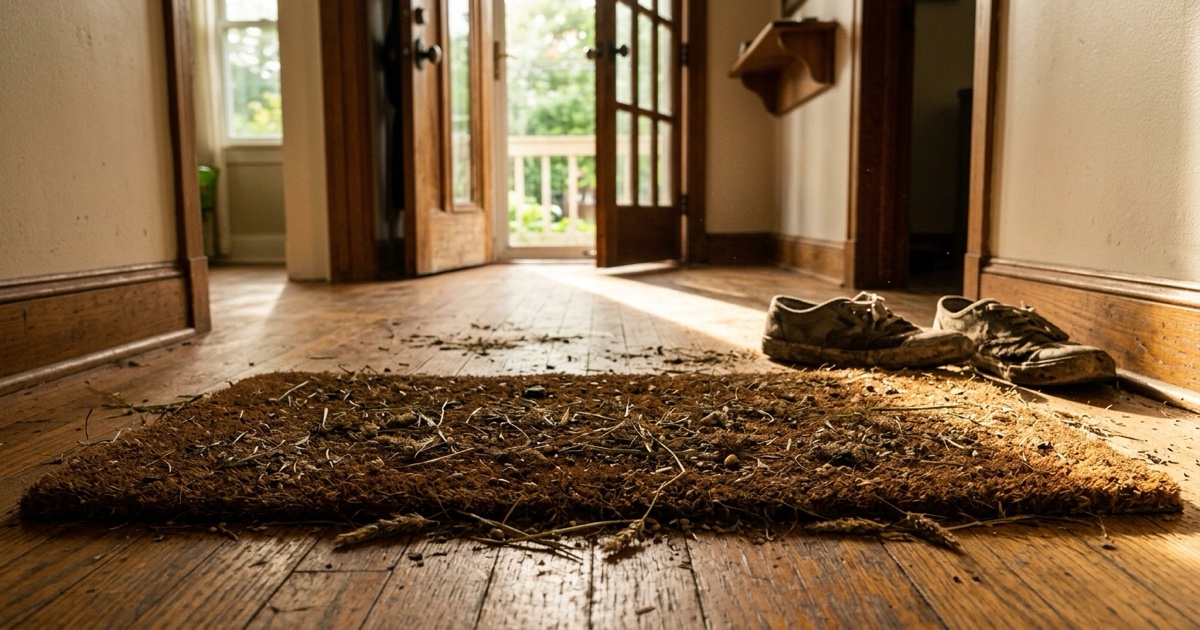
Table of contents
- Why does your house have more pesticide than you bought?
- Why does this reach children first?
- How does lawn spray get to your living room?
- What did the last owner leave in your floor?
- What is on an ordinary American floor?
- Is there a legal limit for pesticide in house dust?
- What takes it back out?
- What should you do first?
Summary of this article
- EPA says homes hold more pesticide than recent use in those homes can explain.
- Indoors there is no sunlight, rain or soil life to break residues down, so what lands stays and builds up year on year.
- It concentrates in dust rather than air, which is why crawling children and barefoot adults get the most contact.
- Chlordane was used from 1948 to 1988 and is banned now, and it still turns up in dust in houses that were treated.
- No air concentration standard for pesticides exists, so a lab can measure your dust and nobody can tell you whether it passes.
- EPA lists non-chemical pest control first, then mixing outdoors, then ventilating while applying.
- Shoes off at the door stops the largest ongoing input, and it is free.
Why does your house have more pesticide than you bought?
Because nothing indoors breaks it down, so every application a house has ever had is still in there somewhere.
Picture a wasp nest above a back door, one evening in June. One can, one job, and by Sunday nobody thinks about it again.
Outdoors that instinct would be right. Sun pulls a residue apart, rain moves it along, heat works on it, and things living in soil eat what’s left. Give it a season and it’s gone.
Your carpet does none of that. No sun gets down there. No rain, no frost, nothing alive that treats a pesticide as lunch. Researchers reviewing this put the reason in one flat line, that residues persist indoors because there is no sunlight, no rain, no temperature extremes and nothing alive to break them down.
So a house works like a preservation chamber, and what settles there stays. June’s can goes down on top of last June’s, which went down on whatever the family before you sprayed, which went down on whatever the family before them used, back as far as your flooring goes.
Which is why EPA‘s indoor air page carries a sentence that stops you the first time. The amount of pesticide found in homes, it says, appears to be greater than recent use in those households can explain.
Slow down over that one, because it’s the whole article. More is in a house than anybody currently living there ever bought.
And most of us keep adding to it. Some 75 percent of American households used at least one pesticide product indoors in the past year.
Why does this reach children first?
Picture the spot where you’d put a baby down. Carpet, probably. A rug over boards. Something soft, low, and vacuumed enough to look fine.
That’s the exact layer this stuff ends up in.
Spray settles out of air. It grabs fine particles already drifting around a room and rides them down into carpet fibers, along baseboards, under a sofa, into every place a vacuum keeps missing. Air carries a little at any moment. Dust carries years.
A crawling child works that layer all day. Palms flat on it, then fingers in a mouth. Knees in it. Face a few inches above it. Nobody else under that roof has anything close to the same job, and it took us a while to notice how completely that changes who the subject belongs to.
Dogs do it too, then climb onto furniture. So does anybody who goes barefoot, and anybody who picks a dropped pacifier off a floor and hands it back.
When researchers put a figure on what a lawn treatment does inside a house, they put it on young children. Indoor exposure for a young child ran about 10 times higher in the week after that lawn was sprayed than in the week before it.
How does lawn spray get to your living room?
It arrives on a dog, and on you. Neither of those is a guess.
Researchers picked 11 lived-in homes and 2 empty ones, sampled indoor air, wiped floors, table tops and window sills, and collected floor dust. They did all of it a week before a lawn got treated with a weedkiller called 2,4-D, went away, and came back to do the same round a week after.
What they got, in their words. “After lawn application, 2,4-D was detected in indoor air and on surfaces throughout every home.”
Two routes did most of the carrying, and their paper names both, an active dog and the homeowner who sprayed. Whoever held that sprayer walked it back inside on their own feet.
Then it stops being a doormat problem. Ordinary walking kicks settled dust back up into a room, and that resuspended dust turned out to be the major source of 2,4-D in indoor air, on tables and on window sills.
Follow that chain to its end, because we think it’s the part people miss. Something applied to grass out in a yard finishes up on a table where a toddler eats breakfast.
What did the last owner leave in your floor?
Chlordane went into soil around house foundations to stop termites. Dig a trench, pump it in, backfill, move on. It went onto crops, lawns, gardens and houses across this country from 1948 to 1988, and around a new build it was simply what you did.
EPA banned everything except termite work in 1983, then banned that too in 1988.
Here’s the part worth knowing. It never left.
Technicians wiping hard floors in 500 American homes between June 2005 and March 2006 found chlordane on 64 percent of them. Nearly two decades past a total ban, on close to two out of every three floors they touched.
Nobody in those houses bought it. Nobody in those houses applied it. Whoever mixed it and pumped it into a trench may well be dead by now, and it was still in that dust on the morning somebody came to wipe.
We’d call that the best argument going for finding out what happened on a property before you owned it. Same argument as a buried oil tank, or a dry cleaner that used to trade on your corner. Whoever made the mess is long gone. What they left is not.
None of which is cause to panic, and we’re not raising it to frighten anybody out of an old house. It is cause to treat a pre-1988 house with its first carpet as a deeper clean than anybody has ever given it.
What is on an ordinary American floor?
Permethrin, on 89 percent of them. Chlorpyrifos on 78. Chlordane on 64.
Not a farmhouse. Not a horror story. An ordinary occupied home with a kettle on.
The American Healthy Homes Survey picked 1,131 addresses to stand in for American housing, sent trained technicians into 500 of them with isopropanol wipes, and tested what came off hard floors against a list of 24 compounds.
| What they wiped for | Share of floors carrying it |
|---|---|
| permethrin | 89% |
| chlorpyrifos | 78% |
| chlordane | 64% |
| piperonyl butoxide | 52% |
| cypermethrin | 46% |
| fipronil | 40% |
Their own summary runs, “most floors in occupied homes in the U.S. have measurable levels of insecticides that occupants are then exposed to.”
A second group went at the dust itself, vacuuming it out of 28 California homes in 2006, 15 farmworker households around Salinas and 13 city households in Oakland. Permethrin turned up in 100 percent of samples in both groups. Track one of its two forms, trans-permethrin, through each.
You’d expect farm country to come off worse, and across the middle of the range it does. A typical Salinas home ran 0.95 parts per million against 0.5 in Oakland.
At the top it flips over. Take the dustiest home in twenty and Oakland ran 36.4 parts per million against 9.2 in Salinas. Whatever put that much into a city house, it wasn’t a field, and we’d want that clear before anybody files this away as a rural problem.
Is there a legal limit for pesticide in house dust?
No. Nobody has written one.
We should say people find that genuinely hard to believe, because something this ordinary feels like it ought to be somebody’s job.
That same federal indoor air page says it in nine words under its own heading for standards and guidelines. “No air concentration standards for pesticides have been set.”
No dust standard exists either, which is odd, because the same agency writes dust standards when it wants to. For lead they run to a square foot. Abatement work has to leave 5 micrograms per square foot on floors, 40 on sills and 100 in troughs, every one of them tightened by a 2024 rule. Somebody sat down and argued each of those into being.
Nothing of that shape has ever been written for a pesticide.
So a lab can measure your dust, print you a figure, and nobody alive can tell you whether it passes, because there’s nothing to pass. Our own view is that this is worth knowing before anybody spends money on a test, since a result turns up without a verdict attached.
One yardstick does exist. Building biology, a professional body rather than a regulator, publishes precautionary bands for a single pesticide in house dust. Below 0.2 parts per million is no anomaly, 0.2 to 1 slight, 1 to 10 severe, above 10 extreme. Permethrin is named on its list of examples. Those bands were written for ordinary settled dust rather than a patch treated last Tuesday, and nobody anywhere can enforce them.
Put Oakland against that. A typical home came out in the slight band. That dustiest home in twenty ran 36.4, deep inside a worst band starting at 10.
What takes it back out?
Cleaning, mostly. And not spraying in the first place.
Official advice starts somewhere you might not expect a chemical regulator to start, which is not to use one. Non-chemical pest control comes first on that list, ahead of everything else on it.
Then mix or dilute outdoors, never at a kitchen sink. Diluting a concentrate indoors puts a product in its strongest form into a closed room, and a spill goes onto a floor somebody crosses barefoot.
Then ventilate while applying anything indoors. Open a window. Run an extractor fan. Leave a room and let it clear.
Then keep whatever you didn’t use out of the house entirely.
And read a label, because directions on a can are law rather than advice: “It is illegal to use a pesticide in any manner inconsistent with the directions on its label.”
Past application, everything useful is boring. Shoes off at a door. Vacuuming edges, thresholds and under furniture instead of a room’s middle where dust shows. Wet-wiping hard floors and window sills, since dry dusting mostly relocates a problem.
No federal figure says what shoes-off buys you, and we won’t invent one. What got measured is the pathway, and that route was a dog and whoever held a sprayer.
There’s no federal cleaning guidance for pesticide dust at all. Guidance for lead dust exists, and it works on that same dust on one floor. A vacuum with a high-efficiency particulate air filter, plus regular cleaning of hard surfaces with a damp cloth or sponge and a general all-purpose cleaner.
What should you do first?
Persistence is the whole story here, so the useful question covers what has been piling up since somebody laid that floor, rather than what got sprayed this year.
Four things, in order.
Shoes off at a door, starting tonight. Free, it stops the largest input still arriving, and no other habit in this article pays like it does.
Vacuum properly and do it weekly, with a high-efficiency filter, going at edges and dark corners. You’re taking out years of settled material, not tidying a surface.
Wet-wipe hard floors and window sills weekly. Damp cloth, all-purpose cleaner, twenty minutes.
And if somebody in your house crawls, begin with a floor they crawl on. Small children get most of this exposure and the least say in whether they do.
If your house went up before 1988 and still wears its first carpet, we’d treat replacing that carpet as worth getting done on its own merits, whatever else you decide about testing.
None of it needs a skip in the driveway. It needs one person in that house knowing what a floor keeps.
One last thing, said plainly. Nobody has set a limit. Nobody is required to test. Nothing indoors breaks these things down. So the only mechanism taking pesticide out of a house is a person, on a Saturday, cleaning it out.
Sources
- U.S. Environmental Protection Agency. Pesticides' Impact on Indoor Air Quality (2026)
- U.S. Environmental Protection Agency. Hazard Standards and Clearance Levels for Lead in Paint, Dust and Soil (TSCA Sections 402 and 403) (2024) 40 CFR Part 745
- Nishioka MG, Lewis RG, Brinkman MC, Burkholder HM, Hines CE, Menkedick JR. Distribution of 2,4-D in air and on surfaces inside residences after lawn applications: comparing exposure estimates from various media for young children (2001) Environ Health Perspect 109(11):1185-91
- Stout DM 2nd, Bradham KD, Egeghy PP, Jones PA, Croghan CW, Ashley PA, Pinzer E, Friedman W, Brinkman MC, Nishioka MG, Cox DC. American Healthy Homes Survey: a national study of residential pesticides measured from floor wipes (2009) Environ Sci Technol 43(12):4294-4300
- Quiros-Alcala L, Bradman A, Nishioka M, et al. Pesticides in house dust from urban and farmworker households in California: an observational measurement study (2011) Environ Health 10:19
- Baubiologie MAES and Institut fur Baubiologie + Nachhaltigkeit IBN. Building Biology Evaluation Guidelines for Sleeping Areas, supplement to the Standard of Building Biology Testing Methods SBM-2024 (2024) Standard Point B3
- Agency for Toxic Substances and Disease Registry. ToxFAQs for Chlordane (2024) CAS 12789-03-6
Questions people ask
Is there a federal limit for pesticides in house dust?
No. EPA states on its indoor air page that no air concentration standards for pesticides have been set, and no federal dust standard exists either. EPA does write residential dust standards for lead, under 40 CFR Part 745, but nothing of that shape has been written for a pesticide.
How does lawn pesticide get into house dust?
It is tracked in. Nishioka and colleagues sampled 11 occupied homes and 2 empty ones around a lawn application of 2,4-D in 2001 and found that track-in by an active dog and by the homeowner applicator were the most significant factors for intrusion.
How long do pesticides stay in house dust?
Longer than outdoors. A 2011 study in Environmental Health states that pesticide residues persist indoors due to the lack of sunlight, rain, temperature extremes and microbial action. The American Healthy Homes Survey detected chlordane on 64% of floors it wiped, nearly two decades after EPA banned all uses of it in 1988.
What level of pesticide in house dust is considered high?
No US agency defines one. SBM-2024, a building-biology standard, rates pesticides in house dust below 0.2 parts per million as no anomaly, 0.2 to 1 as slight, 1 to 10 as severe and above 10 as extreme. Those are precautionary guideline values, not limits, and nobody can enforce them.
What pesticides are found on American floors?
The American Healthy Homes Survey wiped hard floors in 500 homes between June 2005 and March 2006. Permethrin was detected on 89%, chlorpyrifos on 78%, chlordane on 64%, piperonyl butoxide on 52%, cypermethrin on 46% and fipronil on 40%.
Does taking your shoes off at the door reduce pesticide in house dust?
No federal figure quantifies it. What is measured is the route: the 2001 study found the homeowner who applied the pesticide was one of the two biggest ways it entered the house. Removing what crosses the threshold costs nothing, which is the test worth applying.
How do you clean pesticide out of house dust?
No federal cleaning guidance exists for pesticide dust. EPA's advice for lead dust is a vacuum with a high-efficiency particulate air filter, plus regular cleaning of hard surfaces with a damp cloth or sponge and a general all-purpose cleaner. That guidance was written for lead, and it addresses the same household dust.



Have questions about the environment inside your home?
Air quality, mold, EMF, light and water all shape how a house feels and how the people in it feel. Whatever your concern is, the first step is finding out what is there.
Our certified team of environmental professionals and advocates can help.