


US wireless limits don’t protect birds, bees or other wildlife
Federal wireless standards were written to stop signals from overheating human tissue, and they don't test for harm to animals at all. That leaves birds, bees, and other wildlife outside the rules.
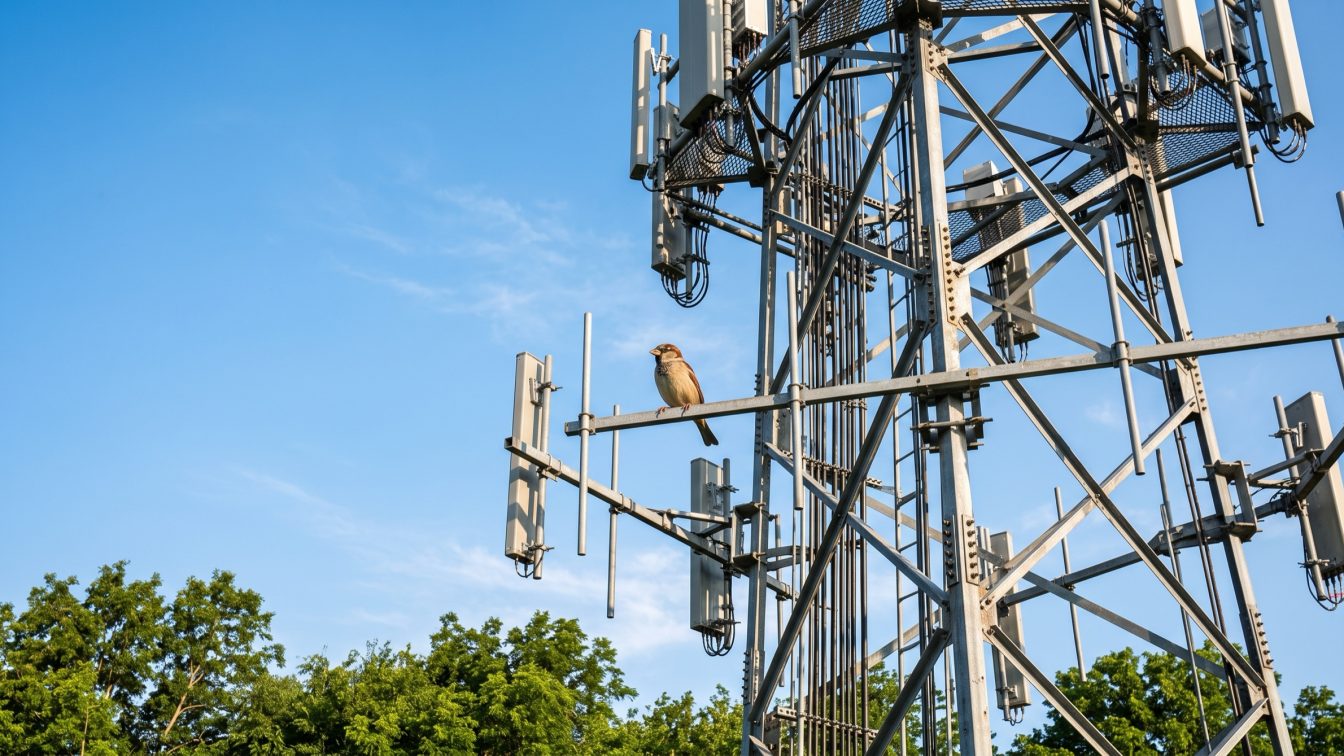
Table of contents
Summary of this article
- A 2026 scientific review covered by Environmental Health News (30 Jan 2026) found that U.S. regulations fail to protect wildlife from cell tower and wireless radiation. No federal standard accounts for the exposure animals absorb.
- The regulatory gap has a specific cause. Existing limits, enforced by the Federal Communications Commission (FCC), were built to prevent human tissue heating. They do not measure non-thermal biological effects, and they do not consider wildlife at all.
- The documented effects on bees are direct. Research covered by Environmental Health News links EMF exposure to increased mortality and impaired foraging, memory, and reproduction, the core functions a colony needs to pollinate and survive.
- Birds and other wildlife show disruption too, adding to a pattern of EMF effects on navigation, reproduction, and behavior across species.
- This is a food-system issue, not only a wildlife issue. Pollinators are responsible for roughly one in three bites of food, so pressure on them reaches the human food supply.
- The building-biology response is outdoor source control while regulation lags: limit smart-yard devices, choose wired alternatives, keep transmitters away from nests and hives, and measure yard exposure in microwatts per square meter (µW/m²) against SBM-2015 thresholds.
U.S. regulations do not protect wildlife from cell tower and wireless radiation. A 2026 review says the animals absorbing this exposure have no rules written for them.
U.S. regulations fail to protect wildlife from cell tower and wireless radiation. That is the finding of a scientific review covered by Environmental Health News on 30 January 2026, under the headline “U.S. regulations fail to protect wildlife from cell tower and wireless radiation, scientific review finds.”
The finding is not that the rules are weak. It is that, for wildlife, the rules are effectively absent. Bees, birds, and the other animals living inside the wireless environment have no exposure standard written to account for them.
The review does not prove that wireless radiation is driving any single species toward collapse. What it documents is a structural gap: a body of research showing biological effects on wildlife, set against a regulatory system that was never designed to see them. This is the policy story behind the effects on bats and aquatic life, the reason those effects go unaddressed.
Why the rules leave wildlife out
To understand the gap, start with what the rules were built to do. And they were built to do one thing: protect a human body from heat.
U.S. wireless exposure limits are enforced by the Federal Communications Commission (FCC). Those limits rest on a single assumption, that radiofrequency radiation is harmful only when it is strong enough to heat tissue, the same principle a microwave oven uses. The legal line is set just below the level at which human tissue warms measurably.
Two consequences follow, and both matter for wildlife.
First, the limits measure heat and nothing else. Biological effects that appear below the heating threshold, the kind of disruption to navigation, memory, and reproduction that research documents in animals, fall outside what the standard measures. The rule does not register them.
Second, the limits were written for humans. The reference point is human tissue. A bee, a bird, a pollinator absorbs and responds to radiofrequency energy differently than a person, often more intensely relative to body size. The standard was never calibrated for them, and it does not attempt to be. Wildlife is not a category the rulebook contains.
The result is a system where the animals most exposed, outdoors, around the clock, unable to move away from a fixed source, have the least protection.
What the research shows about bees
The clearest evidence sits with bees, and it is worth naming precisely.
EMF exposure can adversely affect bees, according to research covered by Environmental Health News, with studies finding increased mortality and impaired foraging, memory, and reproduction. Each of those four effects strikes a function a colony cannot do without.
Increased mortality means fewer bees, directly reducing the size and strength of a colony.
Impaired foraging means bees that struggle to find and return to food sources, the daily work that feeds the hive.
Impaired memory undercuts a bee’s ability to remember the location of flowers and the route home, navigation a forager depends on.
Impaired reproduction means fewer new bees, weakening the colony’s ability to sustain and rebuild itself.
Together these describe a colony under pressure at every level: dying faster, feeding worse, navigating poorly, and reproducing less. A hive with all four problems is a hive in decline.
Birds and other wildlife show disruption as well, adding to a broader pattern seen across species, the same core functions of navigation, reproduction, and behavior turning up as the points of vulnerability.
Why a wildlife gap is a food-system gap
Here is where the regulatory failure reaches the dinner table. It works through pollination.
Pollinators, led by bees, are responsible for roughly one in every three bites of food people eat. Fruits, vegetables, nuts, and the crops that feed livestock depend on pollination to produce. A pollinator population under pressure is a food supply under pressure.
Trace the sequence. Increased bee mortality and impaired reproduction shrink colonies. Impaired foraging and memory make the surviving bees less effective pollinators. Fewer, weaker colonies pollinate fewer plants. Fewer pollinated plants mean lower crop yields across the food system that pollinators support. The hardware overhead keeps multiplying, and Starlink’s US subscribers tripled to 7 million in 11 months. Thresholds disagree across agencies, and California screens soil lead at 80 ppm while the EPA uses 200. Green space cuts the other way in the record: women in the greenest neighborhoods died at a 12% lower rate.
A regulatory gap around wildlife, then, is not a niche conservation concern. It is a gap around the animals that produce a third of the human food supply. When the standard fails to account for their exposure, it fails to account for a foundation the food system rests on.
This is the point building biology has made about homes, scaled to a policy failure: an exposure does not stay at its source. The radiation reaches the pollinator, the pollinator effect reaches the crop, and the crop reaches the plate.
What pet owners and homeowners can do while the rules lag
The regulatory system will not close this gap quickly. But the building-biology approach never waits for regulation, it starts with the exposure you own, and outdoors that means the wireless devices multiplying across yards and gardens.
1. Cut the smart-yard sprawl. Wireless security cameras, motion sensors, outdoor speakers, robotic mowers, and connected irrigation controllers each add a transmitter to the outdoor environment where wildlife lives. Before installing them, weigh the convenience against the added exposure. Wired outdoor cameras and lighting remove the wireless signal entirely.
2. Keep transmitters away from nests, hives, and roosting spots. Position any necessary outdoor wireless gear away from beehives, bird nests, trees, and hedges where wildlife gathers. Distance is the simplest lever, radiofrequency exposure falls sharply with distance, so doubling the separation from a hive or nest cuts exposure to roughly a quarter.
3. Contain your Wi-Fi indoors. A router positioned to flood the entire yard with signal extends exposure across the whole outdoor habitat. Keep coverage focused on the indoor spaces that need it, and skip outdoor range extenders and mesh nodes unless they are genuinely necessary.
4. Make the yard a refuge. Support the pollinators the rules overlook. Plant native flowers, avoid pesticides that compound the pressure on bees, and site any hive or pollinator garden away from wireless gear. A yard managed as a low-exposure habitat offsets some of what the regulatory gap leaves unaddressed.
5. Protect pets in the same environment. The exposure that reaches wildlife reaches pets that sleep, play, and rest outdoors. Keep pet beds, kennels, and favorite resting spots away from outdoor routers, cameras, and transmitters, and apply the same distance logic you would use indoors.
What “measurable” looks like
Outdoor exposure is not a matter of impression. It is a number you can read.
Radiofrequency exposure is measured in microwatts per square meter (µW/m²) with an RF meter, available to rent or buy. Walk your yard and measure the areas that matter, near hives and nests, around outdoor smart devices, along hedges and trees, and in the spots where pets spend time. The readings show where exposure concentrates and where source control does the most good.
The building-biology community’s SBM-2015 guidelines set exposure targets built on the principle that lower is better, and that principle applies outdoors as fully as indoors. Where the FCC limit sits at a human heating threshold and says nothing about wildlife, SBM-2015 gives you a stricter, usable reference point. The workflow is the same one used inside the house: measure, reduce the source, measure again. The number drops. That drop is exposure removed from the habitat the rules do not protect.
The bottom line
The 2026 scientific review covered by Environmental Health News does not prove that wireless radiation is emptying the skies or the hives. It documents that U.S. regulations fail to protect wildlife from cell tower and wireless radiation, because the limits measure human tissue heating and account for wildlife not at all.
Bees show the cost most clearly: increased mortality and impaired foraging, memory, and reproduction, in the animals responsible for one in three bites of food. Birds and other wildlife show disruption too. The response does not depend on regulation catching up. Cutting outdoor wireless devices, keeping transmitters away from nests and hives, and measuring yard exposure in µW/m² costs little and protects the animals the rulebook leaves out. When the standard has no floor beneath wildlife, building your own is the reasonable default.
Sources
- Environmental Health News (Environmental Health Sciences Staff). "U.S. regulations fail to protect wildlife from cell tower and wireless radiation, scientific review finds." 30 January 2026.
- Baubiologie Maes / Institut für Baubiologie + Nachhaltigkeit (IBN). "Standard of Building Biology Testing Methods (SBM-2015)", Supplement on radiofrequency exposure guidelines.
Questions people ask
What did the 2026 review actually find?
The scientific review, covered by Environmental Health News (30 Jan 2026), found that U.S. regulations fail to protect wildlife from cell tower and wireless radiation. No federal exposure standard accounts for the radiation animals absorb, leaving wildlife without a regulatory floor. It documents a structural gap between the research and the rules, not a single confirmed extinction.
Why don't U.S. regulations cover wildlife?
U.S. wireless exposure limits, enforced by the Federal Communications Commission (FCC), were built to prevent radiofrequency radiation from heating human tissue. They measure only that heating effect, so biological effects below the heating threshold fall outside them, and they use a human body as the reference point rather than any wildlife species.
How does EMF affect bees?
Research covered by Environmental Health News links EMF exposure in bees to increased mortality and impaired foraging, memory, and reproduction. Together these effects weaken a colony at every level, fewer bees, poorer feeding, disrupted navigation, and reduced ability to rebuild the hive.
Why should a wildlife gap matter to me?
Pollinators, led by bees, are responsible for roughly one in every three bites of food people eat. Pressure on pollinator populations translates into pressure on crop yields across the food system, so a regulatory gap around wildlife is also a gap around the human food supply. The same outdoor exposure also reaches pets that rest and play in the yard.
What can I do while regulations lag?
Control the exposure you own. Limit smart-yard devices such as wireless cameras, sensors, and speakers, choosing wired versions where possible. Keep any necessary transmitters away from hives, nests, and roosting trees, contain Wi-Fi coverage indoors, and manage the yard as a low-pesticide, pollinator-friendly habitat.
How do I measure wireless exposure in my yard?
Use an RF meter, which reports levels in microwatts per square meter (µW/m²). Measure near hives, nests, hedges, outdoor smart devices, and pet resting spots to find the hot spots, then reduce or relocate the source and measure again to confirm the drop against the building-biology SBM-2015 targets.


Have questions about the environment inside your home?
Air quality, mold, EMF, light and water all shape how a house feels and how the people in it feel. Whatever your concern is, the first step is finding out what is there.
Our certified team of environmental professionals and advocates can help.